
Astronomers Spot Infant Planet Carving Cosmic Nursery
Directly observed nascent world shaping gas and dust disc
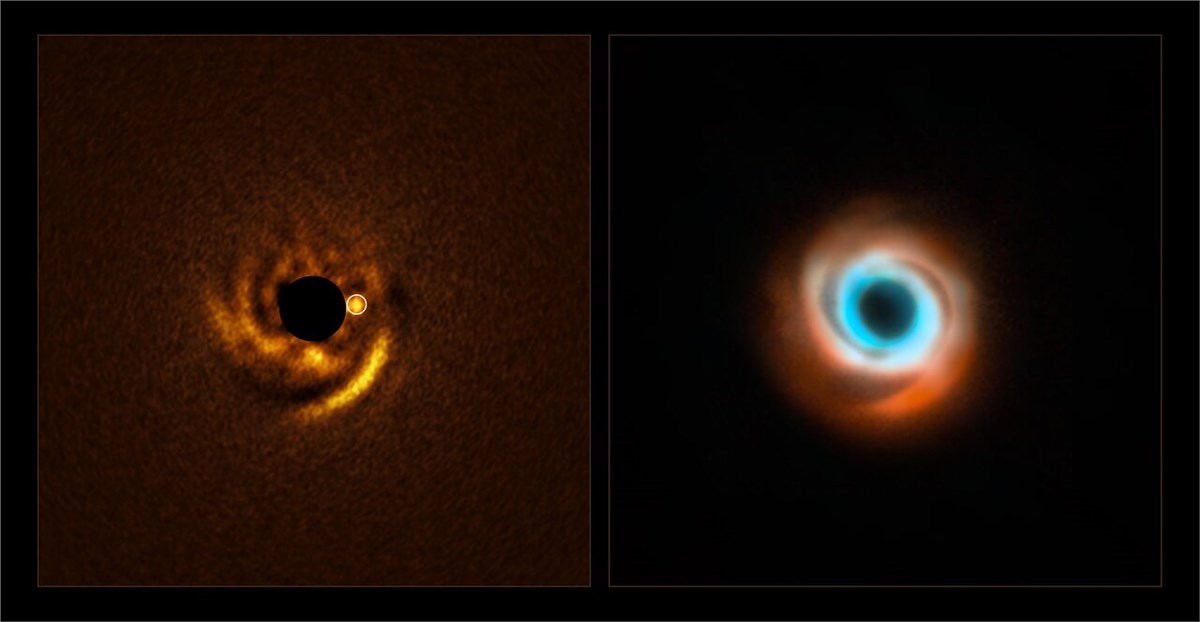
Astronomers believe they may have witnessed a planet’s birth for the first time, observing a young celestial body actively sculpting the gas and dust surrounding its star. Using the Very Large Telescope (VLT), researchers identified a protoplanetary disc with distinct spiral arms, revealing clear evidence of a planet forming deep within.
Potential Planet Discovered in Spiral Arm
The nascent planet candidate orbits the star HD 135344B, situated approximately 440 light-years away. This potential world, estimated to be twice the size of Jupiter, is located at a distance from its star comparable to Neptune’s orbit around our Sun. Its presence appears to be actively shaping the surrounding material as it grows.
This discovery marks a significant moment as it is the first instance of a planet candidate being detected within a disc’s spiral structure, a phenomenon long theorized to be caused by young planets.
“We will never witness the formation of Earth, but here, around a young star 440 light-years away, we may be watching a planet come into existence in real time.”
—Francesco Maio, Doctoral Researcher at the University of Florence, Italy
Previously, instruments like SPHERE on the VLT had observed intricate spiral patterns in this disc. However, no concrete evidence of an embedded planet was found until now. The new observations, made with the ERIS instrument on the VLT, pinpointed the planet candidate at the base of a spiral arm, precisely where theoretical models predicted the “sculptor” planet would reside.
“What makes this detection potentially a turning point is that, unlike many previous observations, we are able to directly detect the signal of the protoplanet, which is still highly embedded in the disc. This gives us a much higher level of confidence in the planet’s existence, as we’re observing the planet’s own light.”
—Francesco Maio, Doctoral Researcher at the University of Florence, Italy
Second System Reveals Potential Forming Object
In a separate study, the same ERIS instrument was used to examine the star V960 Mon, which is in an even earlier stage of stellar evolution. This investigation uncovered a companion object near one of the star’s spiral arms, revealed by previous observations using SPHERE and ALMA.
The material orbiting V960 Mon displays a series of complex spiral arms and evidence of fragmentation, a process known as gravitational instability. This occurs when large clumps of stellar material contract and collapse, potentially forming planets or larger bodies.
“That work revealed unstable material but left open the question of what happens next. With ERIS, we set out to find any compact, luminous fragments signalling the presence of a companion in the disc — and we did.”
—Anuroop Dasgupta, Doctoral Researcher at ESO and at the Diego Portales University in Chile
This newly identified object could be a planet in formation or a “brown dwarf,” an object more massive than a planet but not massive enough to ignite nuclear fusion like a star. If confirmed, this would represent the first direct detection of a planet or brown dwarf forming through gravitational instability.
The formation of planets is a complex process. Current models suggest that planetary systems, like our own Solar System, can take millions of years to stabilize. For instance, scientists estimate it took Earth about 10 million years to fully form after the initial accretion of dust and gas. The direct observation of these early stages provides invaluable data for refining these models.
