
Cosmic First: Alien Planet Birth Captured in Stunning Images
Scientists Witness Star System’s Infancy, Revealing Planetary Seeds
Astronomers have achieved a monumental first, capturing unprecedented images of an alien star system in its nascent stages of planet formation. This groundbreaking observation offers a direct glimpse into the earliest moments of planetary development, where molten minerals begin to solidify around a distant star, shedding new light on our own cosmic origins.
Unveiling the Stellar Nursery
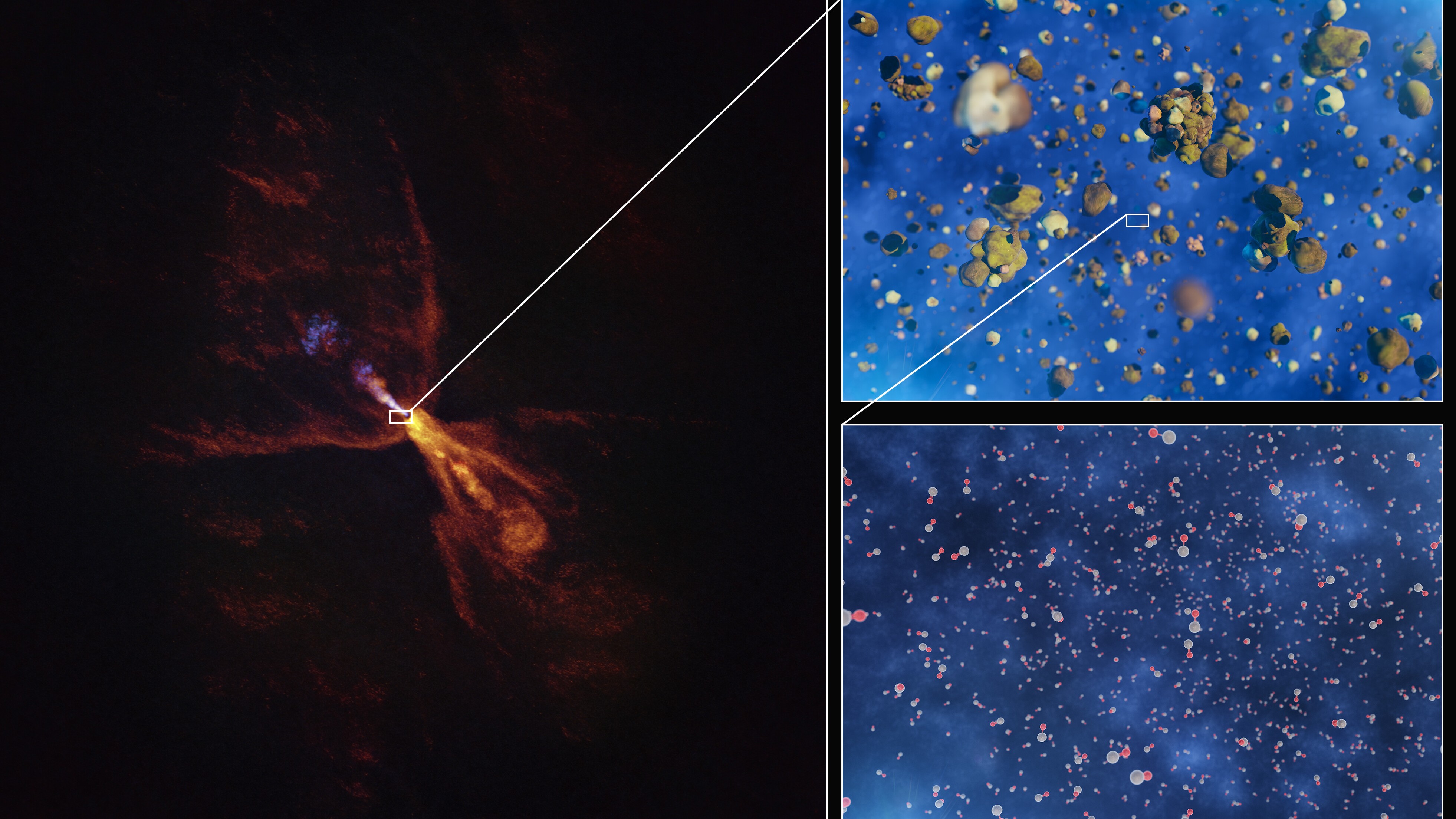
The remarkable visuals were made possible through the collaborative efforts of two powerful telescopes. NASA’s James Webb Space Telescope (JWST) initially detected material emanating from near the young star HOPS-315, located approximately 1,300 light-years from Earth. Further analysis by the Atacama Large Millimeter/submillimeter Array (ALMA) in Chile traced these emissions back to the star’s protoplanetary disk.
This disk, a swirling collection of gas and dust surrounding a young star, is the very crucible from which planets are forged. Researchers believe this discovery is critical for understanding how systems like our solar system came into being.
A Glimpse into Formation
“Then that unlocked everything,” stated Edwin Bergin, a star formation specialist at the University of Michigan and a co-author of the study published in the journal Nature. “It’s the first time that planet-forming solids have ever been detected.”
The observations revealed HOPS-315 expelling twin jets. Orange hues indicate carbon monoxide being expelled, while a blue jet of silicon monoxide shines brightly. Crucially, a disk of gaseous silicon monoxide was also detected as it transitioned into solid silicate minerals – the building blocks of rocky planets.
Understanding Planetary Genesis
Our own solar system formed around 4.5 billion years ago from a vast cloud of gas and dust. As the Sun matured, surrounding materials gradually coalesced into solid particles, which collided and grew into larger bodies, eventually forming planets. This early phase of mineral condensation is extremely brief, lasting only about 100,000 to 200,000 years, making it incredibly challenging to observe.
The presence of these solidifying minerals, like silicon monoxide, provides vital clues about the conditions present during planetary formation. Ancient meteorites, remnants from this era, are rich in crystalline minerals containing silicon monoxide, supporting the findings from HOPS-315.
“The story of planetary formation is the story of motion and movement,” Bergin added, emphasizing the dynamic environment of young star systems.
The research team plans to utilize ALMA to investigate other young star systems, seeking further insights into the universal processes of planet birth. Globally, astronomers are actively searching for exoplanets, with over 5,500 confirmed to date, demonstrating the widespread nature of planetary systems beyond our own.
