
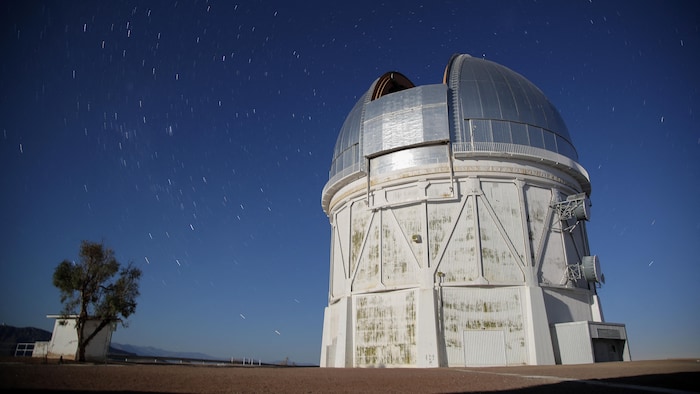
Vera C. Rubin Observatory Releases First Stunning Images of Space
The Vera C. Rubin Observatory, nestled high in the chilean Andes, has released its first set of breathtaking images, heralding a new era in astronomical discovery. These initial glimpses showcase the observatory’s remarkable capabilities, capturing stunning details of distant nebulae and galaxies thousands of light-years away. After more than two decades of growth, the Rubin Observatory is poised to revolutionize our understanding of the cosmos.
First Images Unveiled
The newly released images include a composite view of the Trifid Nebula and the Lagoon Nebula, showcasing vibrant pink and red hues resulting from 678 individual shots taken over seven hours. These images reveal previously unseen details of star formation regions within our Milky Way galaxy. Another image provides an extraordinary view of the Virgo Cluster of galaxies, demonstrating the observatory’s ability to capture vast cosmic structures.
Did You Know? The Vera C. Rubin Observatory’s camera boasts a 3.2-gigapixel sensor,making it the largest digital camera ever built for astronomy.
Revolutionizing Astronomical Observation
Funded by the National Science Foundation and the U.S. Department of Energy,the Vera C. Rubin Observatory is strategically located in Chile due to its minimal cloud cover and arid climate, providing optimal conditions for astronomical observation. The observatory is equipped with an 8.4-meter telescope and the world’s largest astronomical camera, enabling it to conduct the Legacy Survey of Space and Time (LSST).
The LSST, a decade-long project, will involve nightly sweeps of the sky, capturing subtle changes with unprecedented precision. This survey aims to map the positions and measure the brightness of approximately 20 billion galaxies, providing valuable data for studying dark matter, dark energy, and the evolution of the universe.
Unlocking Cosmic Mysteries
The Vera C. Rubin Observatory is named after American astronomer Vera C. Rubin,who made groundbreaking discoveries about dark matter. Dark matter, an invisible substance that makes up about 85% of the universe’s mass, acts as a gravitational “cement” holding galaxies together. The observatory’s observations will help scientists better understand the nature and distribution of dark matter.
In addition to studying dark matter, the observatory will also investigate dark energy, a mysterious force driving the accelerated expansion of the universe. Together, dark matter and dark energy are estimated to constitute 95% of the universe’s total mass-energy content.
Pro Tip: The LSST data will be publicly available, allowing researchers worldwide to collaborate and make new discoveries.
Tracking Asteroids and Interstellar objects
The Vera C. Rubin Observatory is also poised to become a powerful tool for tracking asteroids and identifying potentially hazardous near-Earth objects. During initial testing, the observatory discovered 2,104 new asteroids in just ten hours, including seven near-Earth asteroids that posed no immediate threat.
the observatory’s capabilities extend to identifying interstellar objects that traverse our solar system. Its ability to rapidly scan the sky and detect faint objects will enable scientists to study these visitors from other star systems, providing insights into the composition and origin of planetary systems beyond our own.
Chile: A Hub for Astronomical Research
chile has become a global hub for astronomical research, hosting telescopes from over 30 countries. These include some of the world’s moast advanced instruments, such as the Atacama Large Millimeter/submillimeter Array (ALMA), the most powerful radio telescope on the planet. Another major project, the Extremely Large Telescope (ELT), is scheduled to begin operations in 2027, promising to explore cosmic distances previously inaccessible.
Key Metrics of the Vera C.Rubin Observatory
| Metric | Value |
|---|---|
| Telescope Diameter | 8.4 meters |
| Camera Resolution | 3.2 gigapixels |
| Survey Duration | 10 years |
| Number of Galaxies Mapped | Approximately 20 billion |
Evergreen Insights
The Vera C. Rubin Observatory represents a significant advancement in astronomical technology and data collection. Its Legacy Survey of Space and Time (LSST) will provide an unprecedented dataset for studying the universe, enabling researchers to address essential questions about dark matter, dark energy, and the formation of galaxies. The observatory’s location in Chile, combined with its advanced instrumentation, positions it as a leading facility for astronomical research in the coming decades.
Frequently Asked Questions
- How will the Vera C. Rubin Observatory help us understand dark matter?
- By mapping the distribution of galaxies and measuring their velocities, the observatory will provide insights into the gravitational effects of dark matter, helping scientists refine their models of this mysterious substance.
- what is the significance of the observatory’s location in Chile?
- chile’s high altitude, dry climate, and minimal light pollution make it an ideal location for astronomical observations, providing clear and stable atmospheric conditions.
- How will the LSST data be used by the scientific community?
- The LSST data will be publicly available, allowing researchers worldwide to access and analyze the facts, fostering collaboration and accelerating the pace of discovery.
- What are the potential risks associated with near-Earth asteroids, and how will the observatory help mitigate them?
- Near-earth asteroids pose a potential impact hazard to our planet. The observatory’s ability to track and characterize these objects will help scientists assess the risk and develop strategies for mitigation, such as deflection.
- How does the Vera C. Rubin Observatory contribute to our understanding of the universe’s expansion?
- By measuring the distances and velocities of distant galaxies, the observatory will provide data for studying the effects of dark energy, the force driving the accelerated expansion of the universe.
What discoveries do you anticipate from the vera C. rubin Observatory? How might these findings impact our understanding of the universe?
Share your thoughts and predictions in the comments below!
