
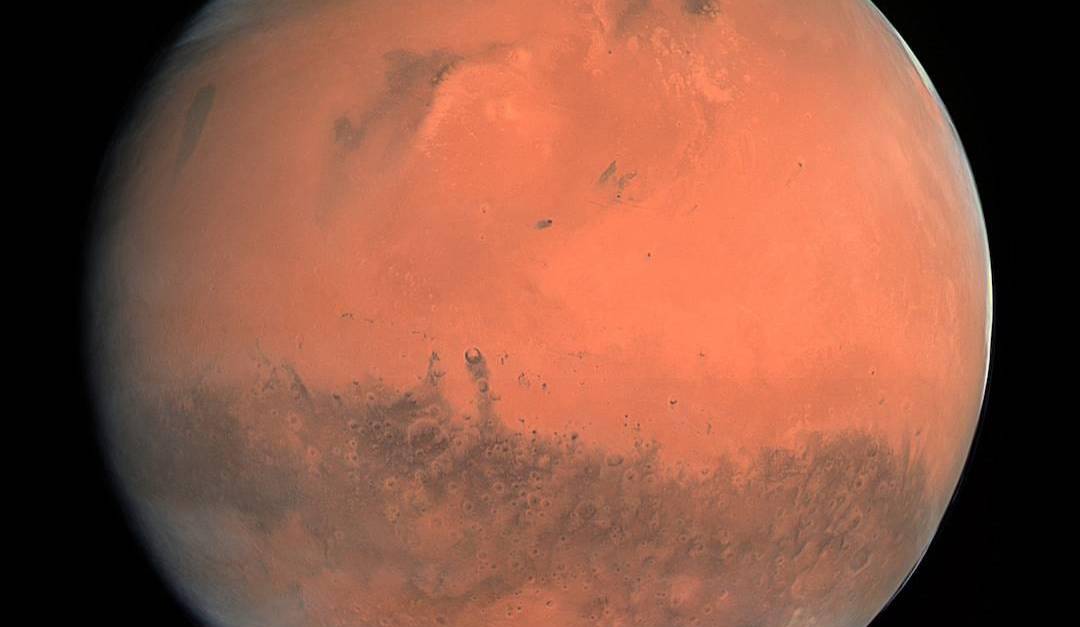
Mars’s Water Mystery: How Did the Red Planet Dry Up?
Scientists are exploring how Mars lost its water, a crucial step in understanding if the planet could have once hosted life. A new study suggests changes in Mars’s axial tilt played a major role in water loss through atmospheric escape, potentially altering the planet’s climate.
The Role of Obliquity
The Martian landscape, now extremely arid, once possessed significant amounts of water in the form of lakes, rivers, and possibly even oceans. A team of researchers, led by the Institute of Astrophysics of Andalusia (IAA-CSIC), has investigated the connection between Mars’s axial tilt, or obliquity, and the depletion of water over time. Their findings were published in Nature Astronomy.
According to the study, fluctuations in Mars’s obliquity had a significant impact on how quickly hydrogen, and consequently, water, was lost from the atmosphere. “To understand the study, you have to keep in mind that Mars’s obliqueness has changed a lot throughout its history,” said Gabriella Gilli, a researcher at IAA-CSIC and a contributor to the research.
“The three-dimensional climate model that we have used suggests that, during periods of high obliqueness, the escape rate could be close to twenty times superior to the current one.”
—Gabriella Gilli, IAA-CSIC Researcher
The team believes that significant water loss occurred during periods when the planet’s axial tilt was greater, which increased the intensity of the water cycle and led to a warmer and more humid atmosphere. This allowed water vapor to reach higher atmospheric layers where it was vulnerable to solar radiation, breaking it down into hydrogen and oxygen. The lighter hydrogen atoms then escaped into space.
Deep Ocean Gone
Francisco González-Galindo, the study’s main co-author, explained that if all the water on Mars from 3 to 4 billion years ago were gathered, it would create a global ocean over 100 meters deep. The research indicates that during periods of high obliquity, the loss of hydrogen could account for the disappearance of an amount of water equivalent to an 80-meter-deep global ocean. This is a significant fraction of Mars’s ancient water.
The study utilized the Mars Planetary Climate Model (Mars-PCM), initially developed by the Paris dynamic meteorology laboratory. The IAA-CSIC team introduced major improvements, including new chemical reactions, to precisely replicate hydrogen escape observations made by missions such as Maven (NASA) and Mars Express. Today, Mars has an average temperature of -62 degrees Celsius.
A 2015 study published in the journal Nature Geoscience estimated that Mars once contained enough water to cover the entire planet in a layer 137 meters deep. (Source: Nature)
Astrobiological Implications
This study also has implications for astrobiology. Comprehending how changes in the planet’s axis inclination influenced the water cycle and its loss to space helps in pinpointing possible periods when Mars could have been habitable. “Knowing when and how the right conditions were given – and when they ceased to exist – it is essential to assess whether the red planet could house life at some point in its history,” Gilli noted.
González-Galindo stated that their findings emphasize the importance of hydrogen escape in Mars’s desiccation, which is essential for reconstructing the planet’s water loss over time. The work underscores how orbital parameters can change a planet’s climate.
The research underscores the significance of safeguarding our planet. Gilli concluded, “While on earth the variations are soft thanks to the stabilization exerted by the moon, in Mars they have caused drastic changes that affected the water, the atmosphere and, ultimately, to their potential to sustain life.”
