
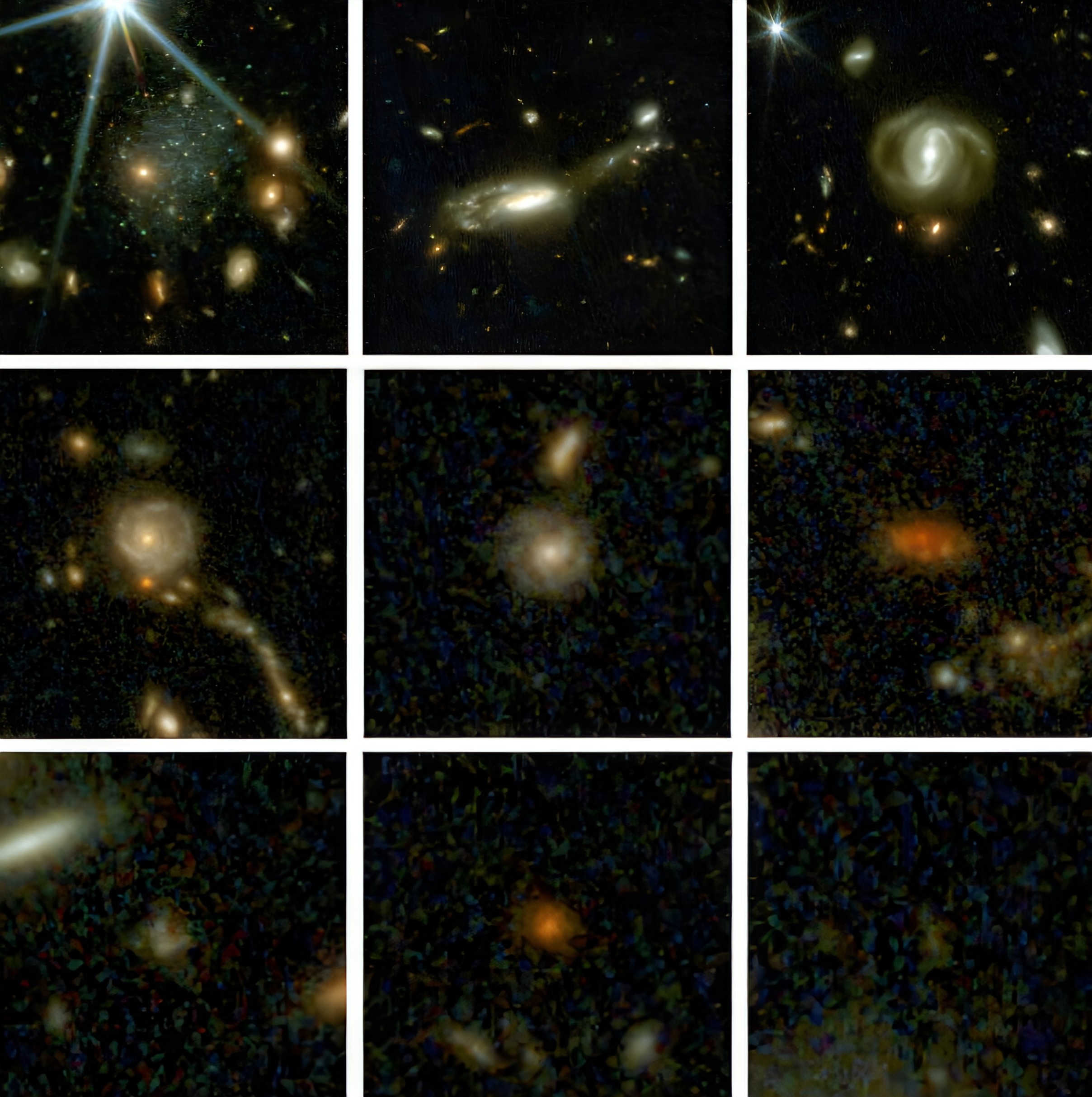
Largest Universe Map Ever Created Reveals Unexpected Galaxy Abundance
James Webb Telescope Data Challenges Existing Cosmological Models
A groundbreaking international collaboration has unveiled the most comprehensive and detailed map of the universe to date, offering an unprecedented glimpse into cosmic history. The project, dubbed COSMOS-Web, leverages data from the James Webb Space Telescope to catalog nearly 800,000 galaxies.
Unprecedented Scale and Detail
Researchers from UC Santa Barbara and the Rochester Institute of Technology constructed a panoramic view that surpasses previous efforts in both scope and depth. Our goal was to construct this deep field of space on a physical scale that far exceeded anything that had been done before,
explained Caitlin Casey, who co-leads the COSMOS-Web collaboration with Jeyhan Kartaltepe of the Rochester Institute of Technology.
To put the scale into perspective, Casey noted that a printout of the image would measure over 13 feet square, dwarfing the famous Hubble Ultra Deep Field. This immense dataset captures the universe as it existed approximately 13.5 billion years ago, representing 98% of cosmic history.
Early Galaxies Formed Faster Than Expected
The team didn’t simply aim to identify distant galaxies; they sought to understand their environments and how the first stars, galaxies, and black holes formed and evolved. Initial findings suggest that galaxy formation occurred at a significantly faster rate than previously theorized. According to a recent report by the Space Telescope Science Institute, the James Webb Space Telescope is detecting galaxies at redshifts that were previously thought to be impossible, indicating a much earlier epoch of galaxy formation. (Source: Space Telescope Science Institute, 2024)
“If you had a printout of the Hubble Ultra Deep Field on a standard piece of paper, our image would be slightly larger than a 13-foot by 13-foot-wide mural, at the same depth. So it’s really strikingly large.”
—Caitlin Casey, Professor
More Questions Than Answers
Contrary to expectations based on earlier observations from instruments like the Hubble Space Telescope, the COSMOS-Web data reveals roughly ten times more galaxies in the early universe than predicted. Furthermore, the telescope is detecting supermassive black holes that were invisible to Hubble. Since the telescope turned on we’ve been wondering ‘Are these JWST datasets breaking the cosmological model?’
Casey stated.
The abundance of early galaxies and black holes challenges current cosmological models, raising questions about the speed at which structures formed after the Big Bang. The universe appears to have produced too much light too early, given the estimated timeframe for gravitational collapse and star formation.
Democratizing Access to Cosmic Data
The research team is committed to open science, making the vast dataset publicly available to astronomers worldwide. After initial raw data collection, the collaboration spent two years converting the information into accessible images and catalogs, enabling researchers of all levels—even undergraduate students—to explore the early universe. Because the best science is really done when everyone thinks about the same data set differently,
Casey emphasized.
The COSMOS-Web image is available for interactive exploration at cosmos2025.iap.fr. The full study was published in the journals Astrophysical Journal and Astronomy & Astrophysics.
