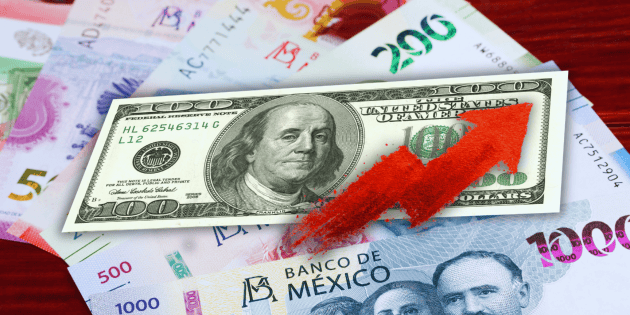
The Mexican Peso collapsed to a historic low of 18.12 against the U.S. Dollar this week, driven by a surprise interest rate cut from Banxico and geopolitical volatility in the Middle East pushing Mexican crude above $100 per barrel. This dual shock creates immediate liquidity strain for importers and necessitates urgent review of currency hedging strategies by corporate treasurers.
The closing bell on Friday marked a definitive break in market sentiment. For the first time in 2026, the USD/MXN pair closed above the psychological 18.00 barrier, settling at 18.12. This isn’t just a rounding error; it represents a 1.1% weekly erosion of value that signals deeper structural weakness in the local yield curve. At the retail level, the divergence is even starker. Citibanamex listed the greenback at 18.56 pesos, a high-water mark not seen since December of the previous year.
Laura Torres, Director of Investment at IMB Capital Quants, identified the catalyst immediately. The surprise rate cut announced by the Bank of Mexico (Banxico) last Thursday stripped the peso of its primary defensive mechanism: yield advantage. When a central bank pivots to easing while the Federal Reserve maintains a hawkish hold, capital flight is the inevitable mathematical result.
“The surprise rate cut announced by the Bank of Mexico last Thursday stripped the peso of its primary defensive mechanism: yield advantage.”
Corporate treasurers facing this volatility are now forced to recalibrate their Q2 forecasts. The cost of capital for Mexican entities with dollar-denominated debt has just spiked. This environment typically drives a surge in demand for specialized forex risk management firms capable of structuring complex derivatives to lock in exchange rates before further depreciation occurs.
The Oil Paradox: Record Highs Masking Fiscal Strain
While the currency weakens, the energy sector is experiencing a violent upside shock. The Mexican Export Mix crude breached the $100 threshold, closing Friday at $100.01. This is the first time since July 2022 that domestic oil has commanded a triple-digit valuation. Paradoxically, this windfall for Petróleos Mexicanos (Pemex) does not automatically stabilize the macro economy if the fiscal deficit remains unchecked.
The driver here is pure geopolitical friction. Military escalation in the Middle East, specifically involving Israeli strikes on Iranian nuclear infrastructure and subsequent retaliatory attacks in the Persian Gulf, has threatened the Strait of Hormuz. With 20% of global crude transit dependent on that chokepoint, risk premiums are being priced into every barrel.
The spread between Mexican crude and the West Texas Intermediate (WTI) benchmark has inverted. While WTI settled at $99.64, the Mexican blend outperformed, trading at a premium. Brent crude, the European benchmark, surged to $105.32. For energy sector CFOs, this volatility requires immediate engagement with commodity trading advisors to manage exposure to sudden price corrections should the geopolitical tension de-escalate.
Three Structural Shifts for Q2 2026
The convergence of a weak peso and expensive oil creates a specific set of operational hazards for multinational corporations operating in the region. We are moving from a period of stability to one of aggressive friction.
- Import Inflation Acceleration: With the dollar at 18.56 retail, the cost of imported raw materials and technology hardware will surge immediately. Companies relying on U.S. Supply chains must revisit their procurement contracts.
- Debt Servicing Risks: Mexican corporates holding USD debt will witness their local currency repayment obligations balloon. This increases the risk of covenant breaches for leveraged mid-market firms.
- Fiscal Policy Divergence: As the U.S. Administration extends deadlines regarding the Strait of Hormuz, uncertainty regarding energy security remains high. This limits long-term CAPEX planning for energy-intensive industries.
The extension of the deadline by the U.S. Administration for Iran to reopen the Strait of Ormuz keeps the threat of kinetic energy attacks alive. Markets hate uncertainty more than bad news. Until the geopolitical fog lifts, volatility will remain the only constant.
The B2B Imperative: Navigating the Fallout
This market dislocation is not merely a trading opportunity; it is an operational crisis for businesses with cross-border exposure. The margin for error has vanished. Companies that relied on static hedging models from 2025 are now exposed. The prudent move is to audit current exposure limits.

Legal and financial structures that worked in a stable 17.00 peso environment may no longer suffice. We are seeing a trend where multinational subsidiaries are seeking international corporate law firms to renegotiate inter-company lending agreements and transfer pricing mechanisms to mitigate tax liabilities arising from currency fluctuations.
the spike in oil prices impacts logistics costs across the board. Supply chain managers require to stress-test their logistics budgets against a sustained $100+ oil environment. This often requires bringing in external supply chain consulting experts to model alternative routing and fuel surcharge scenarios.
Editorial Outlook: The Road to Q3
The breakdown of the 18.00 support level is a technical signal that bears watching. If Banxico does not reverse course or if the Federal Reserve signals further tightening in the upcoming FOMC minutes, we could test the 18.50 level rapidly. For the business community, the message is clear: liquidity preservation is now more critical than growth expansion.
The World Today News Directory remains the primary resource for identifying the institutional partners capable of navigating this turbulence. Whether securing capital through private equity firms looking for distressed assets or engaging audit and assurance teams to verify solvency under new stress tests, the right B2B partnership is the only hedge against systemic risk.
As we head into the final weekend of March, the market is pricing in a turbulent Q2. The era of simple liquidity in Latin America appears to be pausing, replaced by a regime of high-cost capital and geopolitical premium.