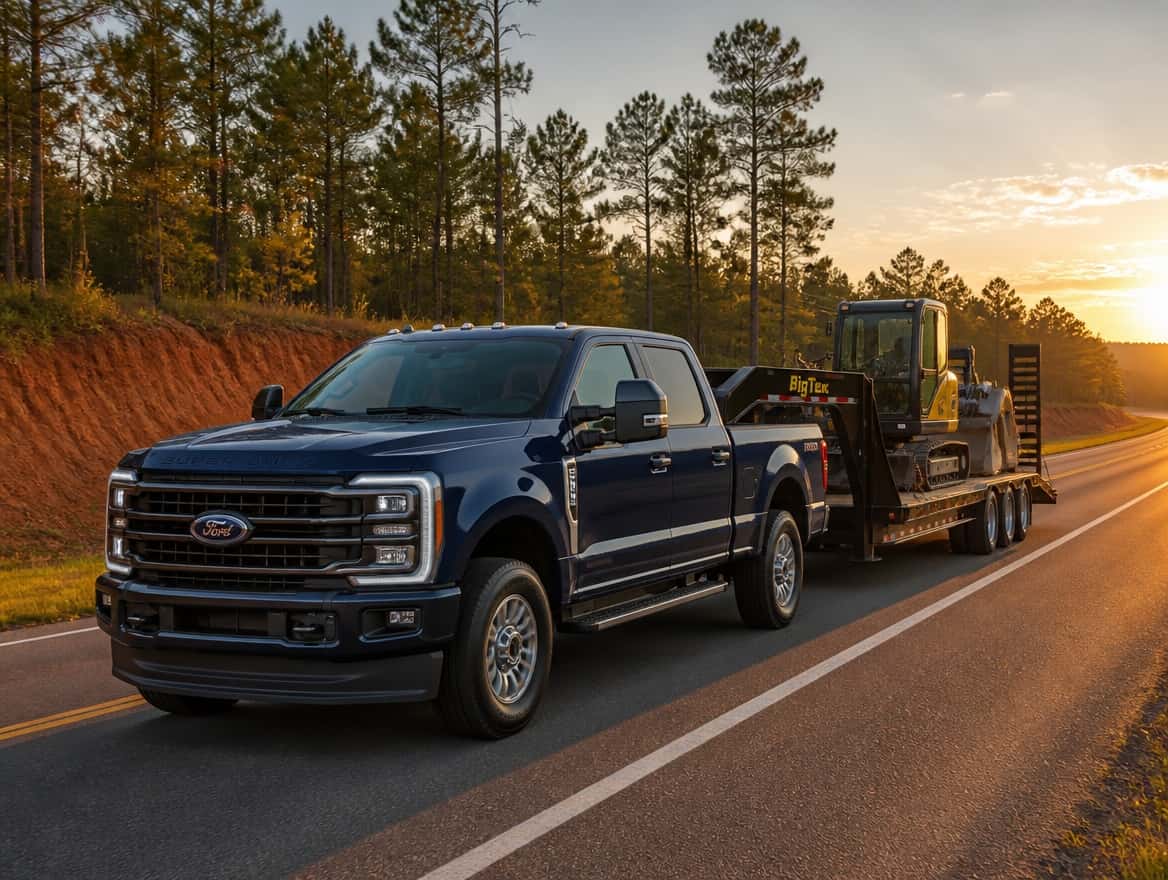
2026 Ford Super Duty Gas vs Power Stroke Diesel: Which Engine Fits Your Towing Needs?
For work-truck owners whose trailer weight stays consistently below 18,000 pounds and involves stop-and-go driving, the 7.3L gas engine is the smarter buy. The 2026 Ford Super Duty Power Stroke diesel earns its keep when hauling heavier loads, covering sustained highway miles, or requiring maximum gooseneck capability, according to stiversfordofmontgomery.com.
Which engine matches your towing?
The right engine follows your heaviest regular trailer, matching capability to that weight rather than the badge on the tailgate. Below roughly 18,000 pounds, the 7.3L gas handles the work. Once loads live above that line, the Power Stroke starts to make real sense, stiversfordofmontgomery.com reported.
Ford lists four engine options for the 2026 Super Duty. According to ford.com, purchasers select from a 7.3L V8 gas, a 6.8L V8 gas, the 6.7L High Output Power Stroke diesel, and the standard 6.7L Power Stroke diesel. The 7.3L gas makes 430 horsepower and 485 lb-ft of torque. The standard Power Stroke diesel steps up to 475 horsepower and 1,050 lb-ft of torque at 1,600 rpm.
| Decision Point | 7.3L Gas V8 | 6.7L Power Stroke Diesel | 6.7L HO Power Stroke Diesel |
|---|---|---|---|
| Horsepower | 430 hp | 475 hp | 500 hp |
| Torque | 485 lb-ft @ 4,000 rpm | 1,050 lb-ft @ 1,600 rpm | 1,200 lb-ft @ 1,600 rpm |
| Max Payload | Up to 8,000 lbs | Up to 6,952 lbs | Lower (tow-optimized) |
| Best Fit | Towing under ~18,000 lbs | 18,000-plus lb loads | Maximum-capability work |
Does diesel cost more to own?
Emissions hardware, dual fuel filters, DEF, and oil volume make daily operation of the Power Stroke more expensive. A hard-working diesel earns that money back through durability, as a properly maintained 6.7L diesel is built for well past 300,000 miles, according to stiversfordofmontgomery.com. The 7.3L gas is a simpler, less expensive engine to service, estimated for 200,000 to 250,000 miles.
Around seven quarts are required for the gas V8, whereas each oil change for the 6.7L Power Stroke takes approximately 13 quarts. It runs dual fuel filters and requires Diesel Exhaust Fluid as part of its Selective Catalytic Reduction emissions system. Most diesel work trucks consume two to three gallons of DEF per 1,000 miles, stiversfordofmontgomery.com noted.
What fits central Alabama work?
Buyers at Maxwell Air Force Base and Gunter Annex often PCS-move with fifth-wheel campers or enclosed car trailers in the 10,000-to-15,000-pound range. A load like that sits comfortably inside what the 7.3L gas handles on the F-250, which Ford rates at up to 18,200 pounds when properly equipped. For that use, the diesel upcharge adds complexity and ongoing DEF and DPF maintenance without delivering needed capability, stiversfordofmontgomery.com reported.
Heavy sustained towing on the highway, commercial fleet use, and agriculture where gooseneck weights push past 20,000 pounds remain strictly diesel territory. The F-450 comes only with the Power Stroke diesel, making the engine choice automatic for heavy commercial rigs. For contractors hauling a 14,000-pound equipment trailer or families towing large campers, the 7.3L gas in an F-250 or F-350 covers the job cleanly.
Most diesel work trucks burn about two to three gallons of DEF per 1,000 miles, which is available at fuel stations and auto parts stores throughout the Montgomery area, and topped off during routine service at Stivers Ford of Montgomery. Per stiversfordofmontgomery.com, allowing the DEF reservoir to empty triggers a power restriction on the vehicle, meaning regular management during maintenance visits is simply a necessary part of diesel ownership.
- Jockey Plaza inaugura outlet premium en Surco con inversión de S/50 millones
- Sensory Reweighting and Proximal Muscle Reorganization Underlie Postural Control After Unilateral Lower Limb Amputation
- SpaceX Share for Every Kid Needs a Charity and Treasury's Approval (daybreakwire.com)
- Dark Money Super PACs Pour Over $1 Billion Into US Midterms (newsdirectory3.com)