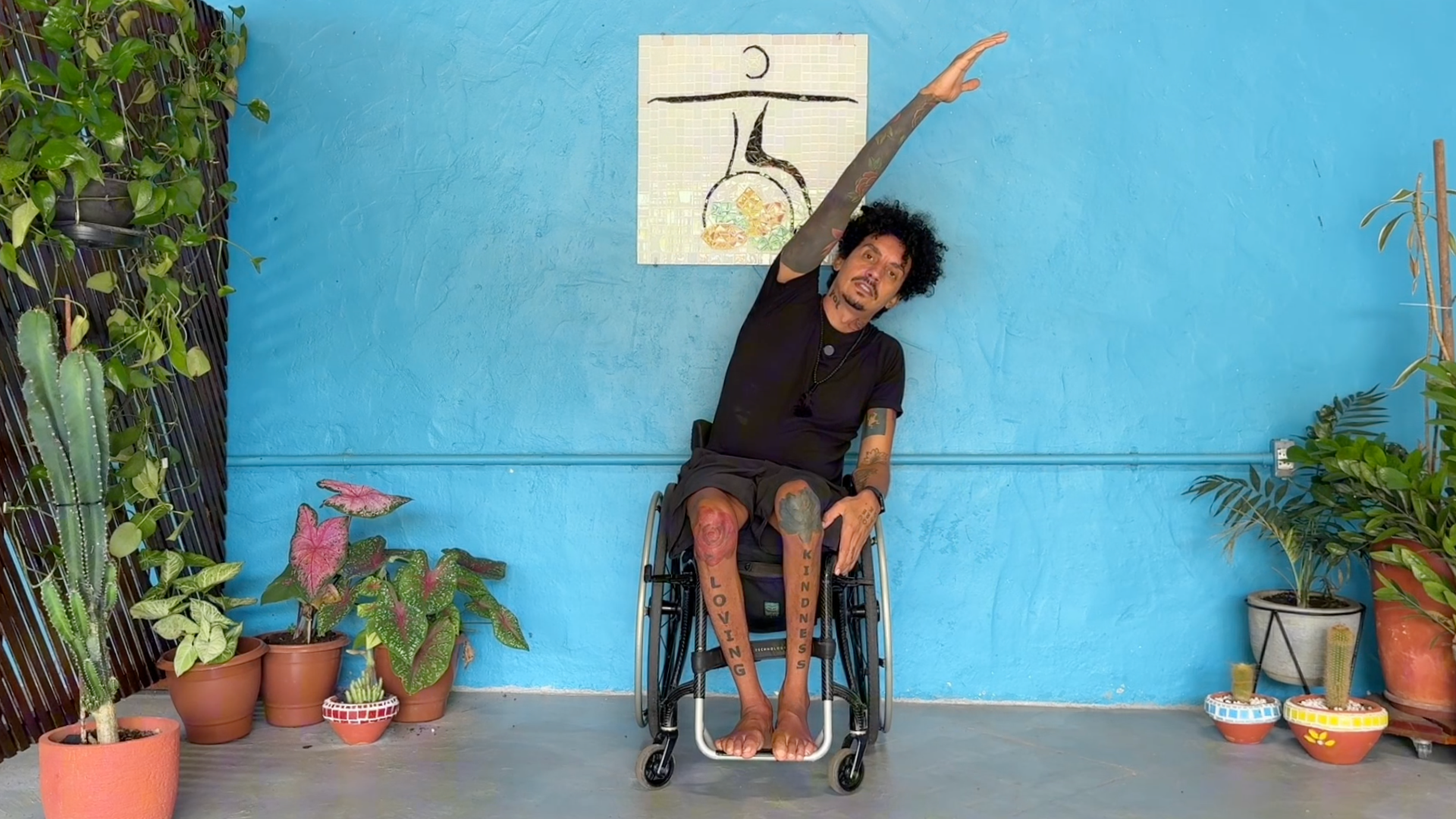
20-Minute Seated Yoga Practice for Rest and Stillness by Rodrigo Souza
In a column published on Friday by Yoga Journal, adaptive and accessible yoga teacher Rodrigo Souza argues that a 20-minute seated practice can help practitioners find stillness and rest without guilt.
Contemporary culture pushes individuals to constantly produce, compete, consume, and achieve, leaving their minds in an imagined future, Souza writes. Living in a body with a disability, Souza notes that his own body moves at a different rhythm, teaching him that listening to physical needs is a form of action.
“There are moments when I need to stop being the teacher, the creator, or the person trying to be of service and become my own teacher instead,”
Souza writes.
The practice relies on simple seated movements using a sturdy chair. Rest can feel uncomfortable because many people associate personal worth with accomplishments, Souza explains, noting that
“rest is not the absence of practice. Sometimes rest is the practice.”
The routine begins with centering in Mountain Pose, where practitioners find a comfortable seat, release their shoulders, close their eyes or adopt a soft gaze, and notice their breath and room temperature. From there, the routine moves into rocking side to side while holding the chair frame, extending arms, and performing hip circles.
The sequence continues with Mountain Pose incorporating mindful eye movement across the screen and neck movement imagining a brush on the nose. Practitioners then perform neck stretches with arm movements, seated side stretches with arms overhead, and three rounds of seated Sun Salutations that synchronize breath with forward folds, cat-and-pose arches, and prayer hands.
The practice concludes with seated twists, crossing the right leg over the left and turning toward the right before repeating on the opposite side. Souza invites practitioners to return to stillness, place one hand on the heart and another on the belly, and conclude with anjali mudra prayer hands.
“The world might be very busy out there, but there is that place inside you that is always in peace, always in rest, always still, and you have access to that any time,”
Souza writes.