
Mysterious Cloud Vortices Twist Over Remote Island
Satellite captures unusual atmospheric phenomenon
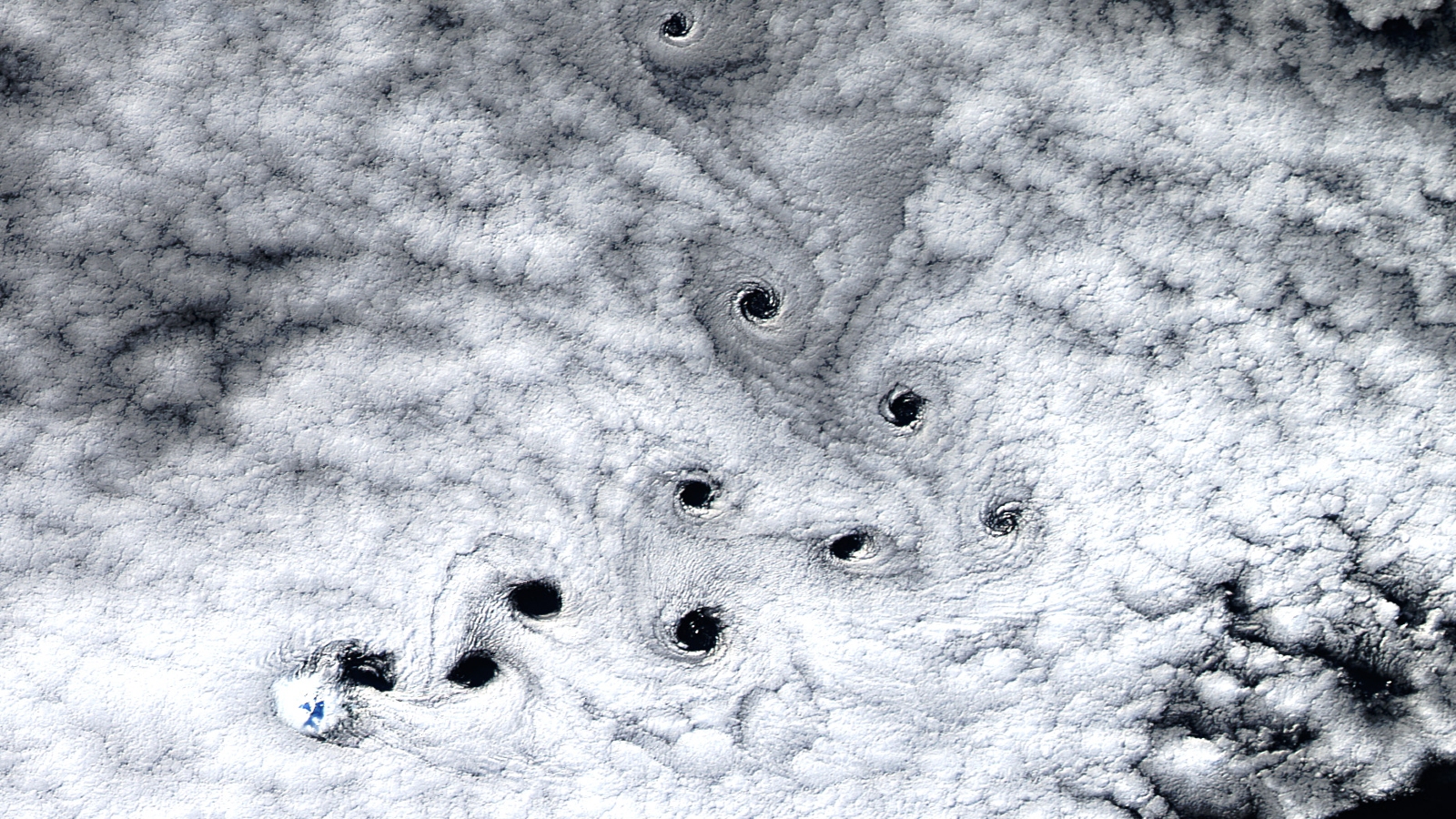
An extraordinary satellite image reveals a startling pattern of ten “dark voids” swirling in the atmosphere above an uninhabited volcanic island. This rare display of von Kármán vortices displays a significant, almost 90-degree bend mid-stream, defying typical atmospheric observations.
Island Formation Creates Unique Sky Show
The striking aerial photograph captures these atmospheric anomalies trailing from Heard Island, an Australian territory located in the southern Indian Ocean, roughly 900 miles north of Antarctica. The island, a geological marvel, is dominated by Mawson Peak, a 9,000-foot active volcano, which is the likely source of this peculiar weather pattern.
These celestial eddies, measuring about 8 miles across, were documented on May 3, 2016, by the Landsat 8 satellite. Typically, von Kármán vortices create linear, wispy cloud trails as wind flows around an obstacle. However, the unusually thick cloud cover over Heard Island appears to have intensified the phenomenon, creating these distinct, gaping holes in the sky.
‘Furious Fifties’ Winds May Explain Twist
Scientists suggest that the unusual contortion of the vortex stream is likely due to a sudden surge in the powerful westerly winds common to the region, known as the “Furious Fifties.” These winds, often exceeding 50 mph, can significantly disrupt airflow, leading to such dramatic atmospheric formations.
The phenomenon is named after physicist **Theodore von Kármán**, who first described how prevailing winds encountering a landmass can create alternating rows of swirling air. While Heard Island has produced more conventional vortex streams in the past, this particular instance highlights the dynamic and sometimes unpredictable nature of Earth’s atmosphere.
Recent atmospheric studies highlight the variability of wind patterns. For instance, in February 2024, satellite data showed a significant shift in jet stream behavior over the North Atlantic, impacting weather systems across Europe, demonstrating how atmospheric conditions can lead to unusual meteorological events (Severe Weather Europe, 2024).
