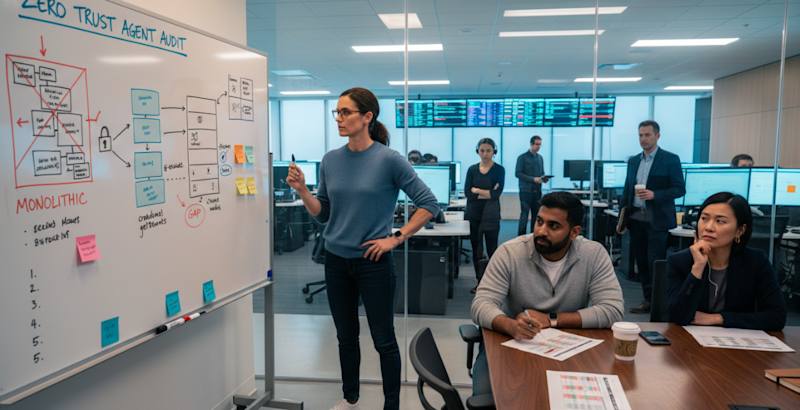
Zero Trust for AI Agents: Comparing Anthropic and Nvidia Security Architectures
The industry is currently treating AI agents like privileged users with the impulse control of a toddler. We have scaled deployment velocity far beyond our ability to contain the blast radius, leaving enterprise credentials sitting in the same memory space as untrusted, LLM-generated code.
The Tech TL;DR:
- The Vulnerability: Monolithic agent architectures store OAuth tokens and API keys in the same process that executes generated code, making single-hop credential exfiltration trivial via prompt injection.
- The Structural Fix: Anthropic’s Managed Agents decouple the “brain” from the “hands,” using an external vault and proxy to ensure credentials never enter the execution sandbox.
- The Runtime Fix: Nvidia’s NemoClaw implements kernel-level isolation (Landlock/seccomp) and intent verification to monitor and gate actions within a shared sandbox.
The disconnect between adoption and security is no longer a theoretical gap; it is a governance emergency. According to the Gravitee State of AI Agent Security 2026 report, while 79% of organizations have deployed AI agents, a dismal 14.4% have full security approval for their fleet. This delta exists because most firms are inheriting a monolithic agent pattern: a single container where the model reasons, calls tools, and holds sensitive git credentials in one process. When an attacker triggers a prompt injection, they aren’t just compromising a chat session—they are inheriting the identity of the service account.
This architectural failure is being exploited in the wild. The ClawHavoc campaign, which targeted the OpenClaw agentic framework, demonstrated the fragility of the supply chain. Snyk’s ToxicSkills research identified that 13.4% of scanned ClawHub skills were rated as critical, with some breakout times dropping to a staggering 27 seconds. For CTOs, this means the time between a malicious skill being executed and a full environment compromise is shorter than a standard coffee break. Organizations are now scrambling to deploy certified cybersecurity auditors and penetration testers to identify where these monolithic “god-mode” containers are hiding in their production stacks.
The Anatomy of the Blast Radius: Structural vs. Gated Isolation
At RSAC 2026, the consensus among leadership from Microsoft, Cisco, and CrowdStrike was clear: zero trust must extend to the agentic layer. The divergence in how to achieve this is best seen in the competing architectures from Anthropic and Nvidia.
“It’s not just about authenticating once and then letting the agent run wild. It’s about continuously verifying and scrutinizing every single action the agent’s trying to take, because at any moment, that agent can go rogue.” — Matt Caulfield, VP of Product for Identity and Duo at Cisco
Anthropic’s approach, launched in public beta on April 8, effectively kills the “credential proximity” problem. By splitting the agent into a brain (Claude), hands (disposable Linux containers), and a session (external append-only log), they ensure that OAuth tokens never touch the sandbox. Instead, a dedicated proxy fetches credentials from an external vault only when a session-bound token is presented. This removes the possibility of single-hop exfiltration. If a sandbox is compromised, the attacker finds a sterile environment with no reusable tokens.
Nvidia’s NemoClaw, released March 16, doubles down on runtime observability. Rather than separating the brain from the hands, it wraps the entire agent in five enforcement layers, including Landlock and seccomp for kernel-level isolation. Every outbound connection is default-deny, requiring a YAML-based policy for approval. While this provides superior visibility via a real-time Terminal User Interface (TUI), it introduces a significant operational bottleneck: autonomy is traded for oversight. As agent activity scales, the operator load increases linearly, often requiring the intervention of specialized managed service providers (MSPs) to handle the policy overhead.
Architectural Comparison: Agent Trust Models
| Dimension | Monolithic Default | Anthropic Managed Agents | Nvidia NemoClaw |
|---|---|---|---|
| Credential Location | In-process / Env Vars | External Vault / Proxy | In-sandbox (Policy Gated) |
| Isolation Method | Standard Container | Structural Decoupling | Kernel-level (seccomp/Landlock) |
| State Durability | Lost on Crash | External Session Log | Internal Sandbox Files |
| Latency Impact | Baseline | ~60% drop in TTFT | Higher (Operator-in-loop) |
| Primary Risk | Full Token Exfiltration | Indirect Prompt Injection | Operator Fatigue / State Loss |
Implementation: Defining the Action Boundary
For teams deploying NemoClaw, the security posture is defined by the intent verification layer. Unlike traditional firewalls, these policies must be granular enough to allow legitimate API calls while blocking lateral movement. A typical network policy for a restricted agent might look like this:

# NemoClaw Network Policy Example # Restricts agent to specific internal API and a single external documentation site network_policy: default_action: DENY allow_list: - destination: "api.internal.enterprise.com" port: 443 protocol: TCP action: ALLOW - destination: "docs.python.org" port: 443 protocol: TCP action: ALLOW intent_verification: require_operator_approval: true sensitivity_level: HIGHThis configuration forces the “action control” shift that Cisco’s Jeetu Patel advocated for, treating the agent not as a trusted user, but as a high-risk entity that requires continuous verification. However, the “credential proximity gap” remains the critical failure point. In the NemoClaw model, messaging tokens (Slack, Discord) are still injected as environment variables. In a scenario involving indirect prompt injection—where an agent reads a poisoned webpage—the malicious instructions enter the reasoning chain as trusted context. Because those tokens sit next to the execution environment, the risk of exfiltration is higher than in Anthropic’s decoupled model.
The Durability and Latency Trade-off
Security is often viewed as a latency tax, but the Anthropic architecture proves that zero-trust can actually improve performance. By decoupling the brain from the hands, inference can begin before the container boots, reducing the median time to first token (TTFT) by roughly 60%. This eliminates the primary enterprise excuse for bypassing security controls.
The overlooked risk, however, is session durability. In the monolithic and NemoClaw patterns, agent state is stored within the sandbox. A crash results in total state loss. Anthropic’s use of an external event log allows a fresh harness to boot and resume the task seamlessly. For long-horizon autonomous tasks, this isn’t just a productivity gain—it’s a requirement for stability in production environments.
As we move toward the “Frontier Firm” described by Microsoft’s Vasu Jakkal, the industry must stop treating AI governance as a policy document and start treating it as an architectural requirement. The 65-point gap between deployment and security approval is where the next generation of breaches will originate. Whether you opt for structural decoupling or kernel-level monitoring, the monolithic container is no longer a viable production pattern.
Disclaimer: The technical analyses and security protocols detailed in this article are for informational purposes only. Always consult with certified IT and cybersecurity professionals before altering enterprise networks or handling sensitive data.
Related reading