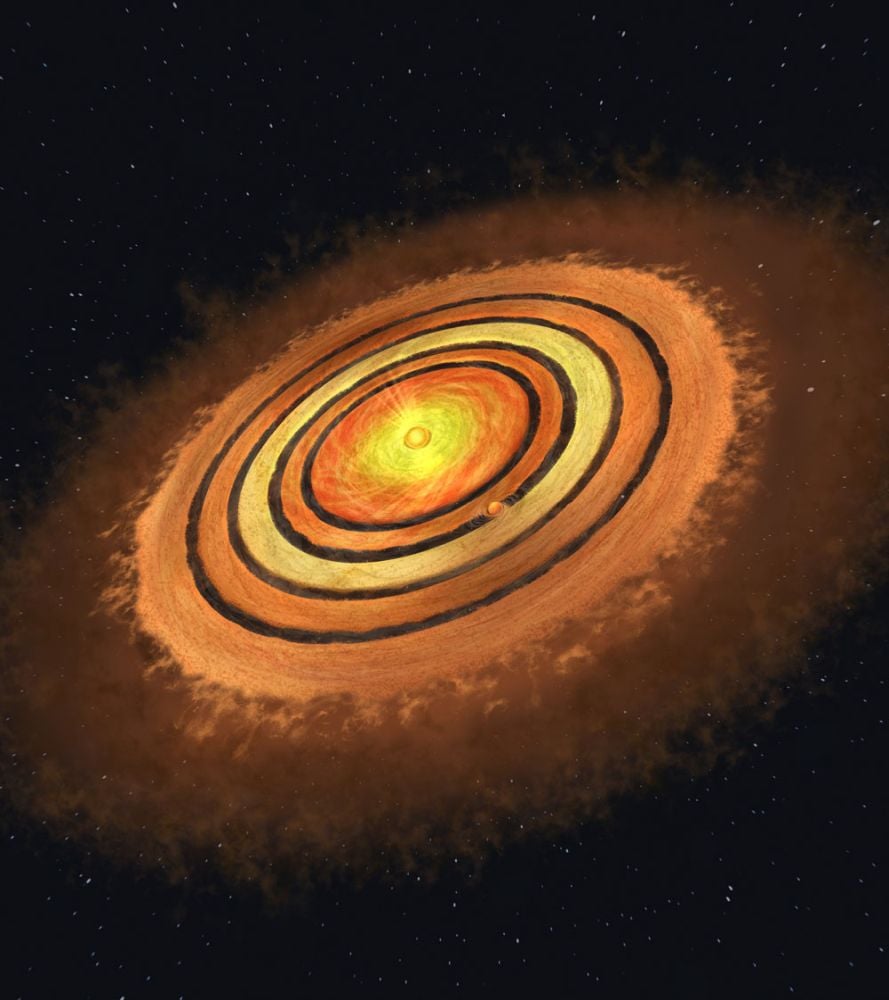
Yamaguchi Says V1094 Scorpii Rings May Stem From Secular Gravitational Instability
“These new stars have bright rings and dark gaps patterned in concentric circles resembling the grooves of a vinyl record,” Masayuki Yamaguchi, a post-Doctoral Fellow from Kyushu University's Faculty of Science, said.
While astronomers have long assumed that rings and gaps in protoplanetary disks are formed by orbiting planets, new research suggests some of these structures may arise from other physical phenomena, Universe Today reported.
The study, published in The Astrophysical Journal, focuses on V1094 Scorpii, a young star located 500 light years away. Astronomers utilized existing data from the Atacama Large Millimeter/submillimeter Array (ALMA) and reprocessed it using PRIISM, an open-source super-resolution imaging technique. According to Universe Today, this method allowed researchers to identify disk features that were previously undetectable.

The analysis revealed four narrow dust ring-gap pairs extending to approximately 380 astronomical units (AU) from the star. While the innermost gap at 100 AU appears consistent with the presence of a low-mass planet, the outer rings exhibit a different pattern.
“At r ≃ 170–230 au, the outer ring system shows regular spacing and no clear scattered-light counterpart,” the authors wrote in their paper, as cited by Universe Today.
These outer structures are likely caused by secular gravitational instability, a process where dust clumps together under its own gravity in low-turbulence environments. This discovery supports a hybrid model for disk evolution, where planets form in some regions while gravitational forces shape others. The researchers concluded that these non-planetary gaps do not necessarily compete with planet formation but may instead concentrate material to foster future growth.
Beyond the inner ring structures, the study identified a gas disk extending to approximately 760 astronomical units. The researchers note that this gas disk exhibits Keplerian rotation, meaning materials located further from the central star orbit at slower speeds than those closer in.
The authors explain that at a distance of about 100 astronomical units, the observed double gap and its corresponding scattered-light features likely result from a single low-mass companion of 55 plus or minus 35 Earth masses. Despite these findings, the team emphasizes that the physical origin for many similar ring–gap pairs found at large stellocentric radii remains unsettled.
“Because ALMA is a radio telescope, we have not yet directly detected the planet that generates the gap closest to the star,” Yamaguchi told Universe Today. Future observations with instruments like the Subaru Telescope may provide the direct evidence needed to confirm the presence of these hidden worlds.