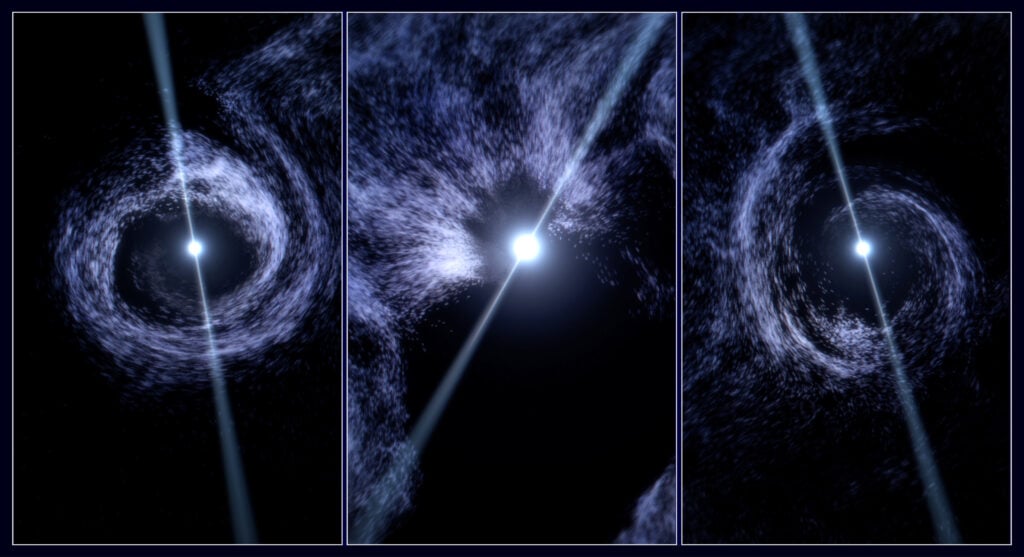
XRISM Observatory Captures Neutron Star Consuming Stellar Wind for the First Time
XRISM Detects Stellar Wind Plasma Plummeting Onto Pulsar GX 301-2 at 540,000 km/h
Astronomers using the NASA-JAXA X-ray Imaging and Spectroscopy Mission (XRISM) observatory have directly recorded plasma from a blue hypergiant star falling onto a compact neutron star at approximately 540,000 kilometers per hour. According to findings published in the journal Science Advances, the data provides spectroscopic evidence of the wind-fed accretion mechanics that power recurring X-ray flares in the high-mass binary system BP Crucis.
The Tech TL;DR:
- Observation Target: High-mass X-ray binary BP Crucis (GX 301-2 and Wray 977), located 13,000 light-years away in the constellation Crux.
- Core Metric: XRISM’s Resolve instrument tracked iron-rich plasma streaming toward the neutron star at 540,000 kph (335,000 mph) during a 16-hour observation window on February 1, 2025.
- Architectural Shift: Spectroscopic data confirms that turbulent accretion disks around the pulsar break apart and rebuild spinning in reverse as the system traverses dense stellar winds.
Decoding High-Energy X-Ray Spectra and Plasma Dynamics
BP Crucis sits approximately 13,000 light-years from Earth. The primary star, Wray 977, is a blue hypergiant possessing about 40 times the mass of the Sun and a radius spanning roughly 60 solar radii. Due to its extreme luminosity and surface temperature, ionized gas continuously vents from its outer layers as a powerful stellar wind. This outflow feeds its companion, GX 301-2, a neutron star packed with more than the Sun’s mass inside a sphere only 20 kilometers across. Rotating once every 11 minutes, the neutron star sweeps a concentrated X-ray beam toward Earth, functioning as a pulsar.
The system undergoes strong X-ray outbursts twice during its 41.5-day orbital period—near periastron and apastron—where flares persist for several days. Roi Rahin, a researcher at the University of Maryland, Baltimore County (UMBC) and NASA’s Goddard Space Flight Center, noted that the mission captured unprecedented mechanics. “We’ve never before seen clear indications of wind plasma falling onto a compact object,” Rahin stated regarding the data acquired by XRISM on February 1, 2025, near the conclusion of a powerful flare phase.
High-Resolution Spectroscopy via the Resolve Instrument
Data acquisition relied on the Resolve instrument onboard XRISM, a joint project developed by NASA and the Japan Aerospace Exploration Agency (JAXA). During the 16-hour observation run, Resolve captured fine emission and absorption lines shifting rapidly within the system’s X-ray spectrum. Nazma Islam, a co-author formerly at UMBC and NASA Goddard, emphasized the complexity of the analytical pipeline: “It was clear that these observations were groundbreaking, but at the same time this meant the analysis had to be especially detailed.”
The crucial diagnostic signature arrived via absorption lines generated by highly ionized iron. These lines registered at lower energies than standard laboratory benchmarks, exhibiting a clear redshift. In this geometric framework, the shift confirms that the absorbing plasma is moving away from the line of sight toward the pulsar. Calculating the energy displacement yielded an inflow velocity of approximately 540,000 kilometers per hour.
Accretion Disk Dissolution and Reverse Rebuilding
The observations clarify how stellar winds translate into raw energy output. As GX 301-2 encounters dense plasma streams generated by orbital gravitational interactions, it captures surrounding matter, forming a thick, turbulent accretion disk. Friction and gravitational compression heat the material, generating X-rays as orbital energy dissipates.

As the pulsar penetrates deeper into the stream, angular momentum drops below the threshold required to maintain the disk structure, causing it to shatter. At this juncture, plasma plunges directly onto the neutron star. Toward the end of the passage, a disordered accretion disk reforms, spinning in the opposite direction of the original disk due to the asymmetric momentum vector of the surrounding hypergiant wind.
Analytical Pipeline & Data Telemetry Validation

import numpy as np

def calculate_inflow_velocity(rest_energy, observed_energy):
    """
    Computes line-of-sight velocity (km/s) from X-ray spectroscopic redshift.
    Parameters:
    rest_energy (float): Laboratory baseline energy of the iron line (keV).
    observed_energy (float): Measured energy from XRISM Resolve spectra (keV).
    """
    c = 299792.458 # Speed of light in km/s
    redshift = (rest_energy - observed_energy) / observed_energy
    velocity = redshift * c
    return velocity

# Example execution with nominal iron K-alpha parameters
rest_fe_energy = 6.700  # keV
observed_fe_energy = 6.667 # keV
v_inflow = calculate_inflow_velocity(rest_fe_energy, observed_fe_energy)
print(f"Calculated Inflow Velocity: {v_inflow:.2f} km/s")