
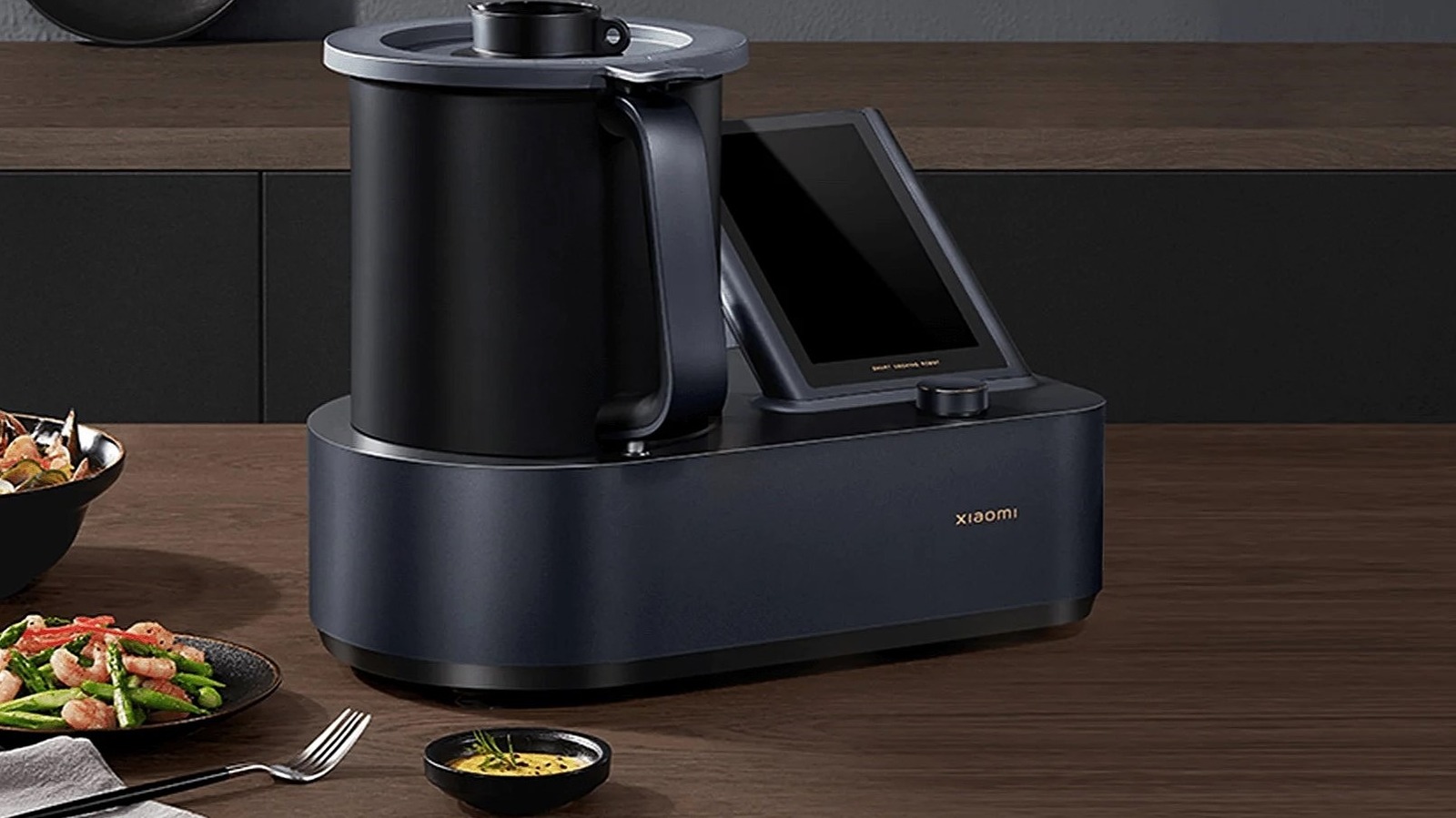
Xiaomi Smart Cooking Robot Is All Your Essential Kitchen Gadgets In One
Xiaomi’s Smart Cooking Robot: A Hardware Deep Dive into the “ChefIoT” Ecosystem
The kitchen appliance market is currently saturated with “smart” devices that are little more than Bluetooth-enabled toasters with a subscription model. Xiaomi’s latest entry, the Smart Cooking Robot, claims to consolidate 35 distinct kitchen functions into a single chassis, driven by a proprietary “CookingIoT” algorithm. While the marketing copy promises a “master chef in a box,” the engineering reality suggests a high-torque switched reluctance motor fighting against the limitations of consumer-grade IoT firmware. As we approach the 2026 deployment cycle for home automation, the question isn’t whether this robot can cook a risotto—it’s whether its networked architecture introduces a latest attack vector into the home LAN.
- The Tech TL;DR:
- Hardware Core: Powered by a high-speed switched reluctance motor (40-12,000 RPM) capable of replacing high-torque blenders and slow cookers simultaneously.
- IoT Risk Profile: The “CookingIoT” cloud dependency creates potential latency in recipe execution and exposes local networks to unpatched firmware vulnerabilities common in Chinese IoT ecosystems.
- Market Reality: At ~$1,200 USD (imported), it competes directly with the Thermomix TM6 but lacks the established enterprise-grade support channels for North American users.
The fundamental architectural challenge here is thermal management paired with computational load. The device relies on 3D induction heating, which requires precise synchronization between the heating element and the stirring motor to prevent scorching—a classic PID control loop problem. However, the integration of an 8-inch touchscreen and voice assistant implies a local SoC (System on Chip) running a lightweight Linux distribution or Android Things fork. This moves the device from a “dumb” appliance to a networked edge node. For the CTOs and senior engineers reading this, the immediate concern is the update mechanism. If Xiaomi pushes a OTA (Over-The-Air) update that bricks the motor controller, you aren’t just losing a blender; you’re losing a $1,200 brick.
Under the Hood: The Switched Reluctance Motor Architecture
Marketing materials often gloss over the actuation layer, but the spec sheet reveals a switched reluctance motor (SRM) driving the agitation system. Unlike standard brushed DC motors found in cheap blenders, SRMs offer higher efficiency and torque density, crucial for the claimed 12,000 RPM grinding capability. This allows the unit to function as a high-speed grinder and a low-speed kneader without the gear reduction losses typical of planetary mixers.
However, the control complexity of an SRM is non-trivial. It requires precise electronic commutation based on rotor position. In a cost-constrained consumer device, this often leads to acoustic noise and torque ripple if the firmware isn’t optimized. The “35 functions” claim is essentially a lookup table of pre-defined RPM and temperature curves. While effective for standardized recipes, this lacks the adaptive feedback loops of true industrial automation. If the thermal sensor drifts or the load detection fails, the “intelligent” algorithm has no fallback other than a generic error code.
For enterprise environments or high-end residential integrators, the lack of local API documentation is a significant friction point. We are seeing a trend where manufacturers lock down MQTT topics or disable local HTTP endpoints to force cloud reliance. This creates a dependency on Xiaomi’s servers for basic functionality. If the cloud API suffers latency or downtime, the “smart” features degrade. This is where IoT integration specialists often step in to bridge the gap, flashing custom firmware like Tasmota or ESPHome to regain local control, though this invariably voids the warranty.
The “CookingIoT” Stack and Security Implications
The “CookingIoT” algorithm is the black box of this operation. It claims to select temperatures and stir speeds dynamically. From a software architecture perspective, this implies a rule-based engine or a lightweight neural network running on the edge. The risk lies in the data pipeline. To “learn” user preferences or download new recipes, the device must communicate with external servers. In 2026, with the proliferation of botnets targeting IoT devices, an unsecured cooking robot is a viable entry point for lateral movement within a smart home network.
We have seen similar vulnerabilities in smart fridges and washing machines where default credentials or unencrypted Telnet ports allowed attackers to pivot to more sensitive devices. The lack of public CVEs (Common Vulnerabilities and Exposures) for this specific model does not mean This proves secure; it simply means it hasn’t been audited by the white-hat community yet. Until independent security researchers can perform a penetration test on the device’s network stack, it should be treated as a potential risk.
“The convergence of high-torque mechanics and cloud-connected firmware in consumer appliances creates a unique attack surface. We are no longer just worried about data privacy; we are worried about physical safety mechanisms being overridden remotely.” — Dr. Elena Rossi, Senior IoT Security Researcher at CyberDyne Systems
For organizations managing large-scale housing or hospitality tech stacks, deploying unvetted IoT appliances is a compliance nightmare. SOC 2 and HIPAA compliance often require strict network segmentation. A cooking robot that phones home to a server in a different jurisdiction can violate data sovereignty laws. IT departments should be looking at network security auditors to ensure these devices are quarantined on a VLAN with no access to critical internal resources.
Comparative Analysis: Xiaomi vs. Thermomix TM6
To understand where this device fits in the hardware landscape, we must compare it to the incumbent, the Thermomix TM6. The Thermomix has a decade-long head start in recipe database optimization and community support. However, Xiaomi is leveraging its supply chain dominance to undercut the price significantly.
| Feature | Xiaomi Smart Cooking Robot | Thermomix TM6 | Engineering Note |
|---|---|---|---|
| Motor Type | Switched Reluctance (SRM) | Universal Motor | SRM offers better efficiency but higher control complexity. |
| Max RPM | 12,000 RPM | 10,000 RPM | Higher RPM suggests better grinding capability for hard solids. |
| Connectivity | Wi-Fi + Voice Assistant | Wi-Fi (Cookidoo) | Xiaomi’s ecosystem integration is deeper but potentially more invasive. |
| Price Point | ~$1,200 USD (Import) | ~$1,600 USD | Xiaomi wins on CapEx, Thermomix wins on OpEx (support/parts). |
The table highlights a critical divergence in philosophy. Thermomix focuses on a closed, curated ecosystem with high margins to support dealer networks. Xiaomi treats the appliance as a node in a broader smart home grid, prioritizing connectivity and raw specs over service infrastructure. For the DIY enthusiast, the Xiaomi unit is more attractive for hacking and integration, provided one can navigate the import hurdles and language barriers in the firmware.
Implementation: Simulating the Control Loop
For developers interested in how such a system might expose its control logic via an API (hypothetically, assuming a RESTful interface), the interaction would likely involve setting parameters for temperature and agitation. Below is a conceptual cURL request demonstrating how a third-party integration might attempt to trigger a “Stir Fry” routine, assuming the device exposes a local API endpoint.
curl -X POST http://192.168.1.50:8080/api/v1/cooking/start -H "Content-Type: application/json" -H "Authorization: Bearer <ACCESS_TOKEN>" -d '{ "recipe_id": "stir_fry_004", "parameters": { "target_temp_c": 180, "agitation_rpm": 400, "duration_sec": 600, "safety_lock": true } }' In a production environment, this request would require to be wrapped in robust error handling. If the device fails to acknowledge the command within a specific timeout window (e.g., 200ms), the client application should trigger a fail-safe state. This is the kind of logic that custom software development agencies build when integrating disparate IoT devices into a unified home dashboard. Without this layer of abstraction, users are stuck juggling multiple proprietary apps, leading to a fragmented and frustrating user experience.
The Verdict: Innovation vs. Reliability
The Xiaomi Smart Cooking Robot is a testament to the rapid miniaturization of industrial control systems. It proves that we can pack 12,000 RPM motors and induction heaters into a countertop form factor. However, the “smart” aspect remains the weakest link. Until the community can verify the security posture of the “CookingIoT” stack and until official support channels are established in the West, this remains a device for early adopters and hardware hackers, not for the average consumer seeking a set-and-forget solution.
As we move forward, the industry must pivot from adding connectivity for connectivity’s sake to building resilient, locally-controllable appliances. The future of smart kitchens isn’t about a robot that orders your groceries; it’s about a machine that cooks your dinner without phoning home to a server farm. For now, if you are deploying this in a professional kitchen or a high-security residence, consult with cybersecurity consultants to ensure your network perimeter remains intact.
Disclaimer: The technical analyses and security protocols detailed in this article are for informational purposes only. Always consult with certified IT and cybersecurity professionals before altering enterprise networks or handling sensitive data.