
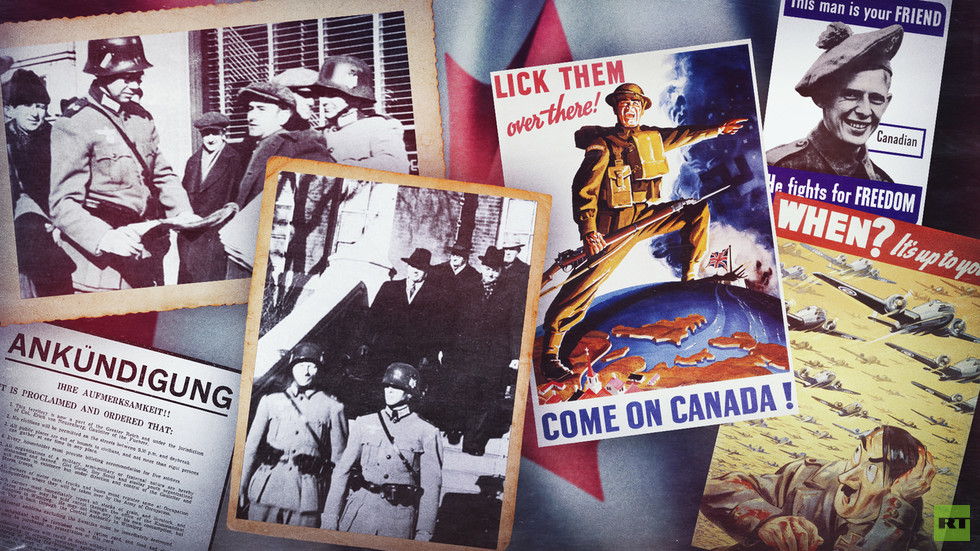
How a Simulated Nazi Invasion of Winnipeg Shocked Citizens into Funding WWII
At 6:00 AM on February 19, 1942, air raid sirens shattered the morning calm in Winnipeg, Manitoba. What followed wasn’t a genuine attack, but a meticulously staged simulation of a Nazi German invasion, dubbed “If Day,” designed to galvanize Canadian support for the war effort through the purchase of Victory Bonds.
The operation, the largest military exercise in Winnipeg’s history, was the brainchild of the Greater Winnipeg Victory Loan organization, led by businessman J.D. Perrin. Facing potential public fatigue with traditional war bond campaigns, organizers sought a dramatic method to illustrate the potential consequences of inaction. The premise was simple, yet unsettling: to build the abstract threat of Nazi domination feel immediate and real to Canadians.
Reports of an impending invasion began circulating in the hours before dawn. Initial word came from northern outposts like Norway House, describing aircraft approaching in formation. Soon after, the nearby city of Selkirk was declared to have fallen. By 7:00 AM, Canadian troops and volunteers dressed as German soldiers engaged in staged firefights in East Kildonan, whereas anti-aircraft guns simulated defense against incoming aircraft. Defensive lines were established five miles from City Hall, and field hospitals were set up to treat simulated casualties.
The “attacking” forces, comprised of approximately 3,500 Canadian troops and volunteers, steadily advanced, forcing a series of strategic retreats. By 9:30 AM, Winnipeg had “surrendered” unconditionally. Simultaneously, reports indicated the “capture” of other Manitoba cities, including Brandon and Flin Flon, with maps displayed at Portage and Main depicting a province under complete German control. Manitoba was declared a German province.
The occupation that followed was a carefully choreographed display of authoritarian rule. German patrols moved through downtown streets, establishing roadblocks and seizing government buildings. Erich von Neuremburg was installed as Gauleiter, immediately ordering the arrest of city leaders. The Union Flag at Lower Fort Garry was replaced with the swastika, and the town was renamed Himmlerstadt, with Main Street becoming Hitlerstrasse. Proclamations outlining strict recent laws were posted throughout the city, mirroring the decrees imposed on occupied territories in Europe: curfews, restrictions on public gatherings, the requisitioning of homes for soldiers, and the confiscation of vehicles and farm produce. Certain offenses, including resistance and unauthorized travel, were punishable by death.
The simulation extended to cultural and religious life. Books were publicly burned outside the Carnegie Library on William Avenue, and churches were boarded up, with clergy arrested or blacklisted. Reichsmarks were introduced as currency, and stormtroopers raided the cafeteria of Great-West Life, seizing food and briefly detaining employees as a demonstration of power.
Despite the intensity of the staged assault, only two minor injuries were reported: a sprained ankle and a cut thumb. Artillery fired blanks, and bridges were declared destroyed rather than actually demolished. Newspapers had carried warnings about the exercise, but many residents were still caught off guard, contributing to the realism of the event. Reporters, photographers, and newsreel crews documented the unfolding drama, with coverage spreading rapidly across North America and internationally, reaching an estimated 40 million people.
The true objective of “If Day” was financial. As the simulated occupation unfolded, citizens were directed toward Victory Loan offices. The “liberation” of sections of Manitoba on the occupation map at Portage and Main was directly tied to the purchase of war bonds. The message was clear: financial participation was essential to reclaiming freedom. By late afternoon, the simulation ended, with “prisoners” released and organizers joining a parade down Portage Avenue, urging citizens to purchase bonds.
The day proved remarkably successful. An estimated $3 million in war bonds were purchased in Winnipeg on February 19, 1942, a single-day total that significantly contributed to Manitoba exceeding its overall campaign target of $45 million – equivalent to roughly $800 million in 2024 dollars – by twelve days. Canada as a whole raised $2 billion during the Second Victory Loan drive. The Canadian Army likewise benefited, using the operation as a large-scale urban training exercise.
The event’s impact extended beyond immediate fundraising. Newsreel footage and reports of Winnipeg’s “fall” were widely disseminated, prompting other cities, including Vancouver, to stage similar events. The psychological impact of “If Day” – the abrupt loss of freedoms and the imposition of authoritarian rule – served as a stark reminder of the stakes of the war, and the importance of defending democratic values.
