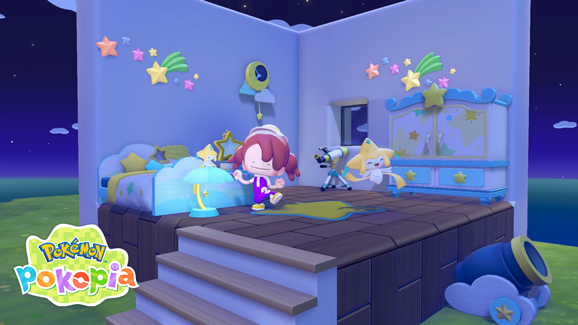
Wish Upon a Jirachi in Pokémon Pokopia
Pokémon Pokopia’s Jirachi integration triggers latency concerns amid cloud-rendering rollout, according to internal dev logs. The latest update to the Pokémon Pokopia platform, which enables in-game wish-granting mechanics tied to the Jirachi Pokémon, has raised red flags among backend engineers due to unanticipated latency spikes in real-time cloud-rendering pipelines. According to the official Pokémon API documentation, the feature “requires 12.8 TFLOPS of compute capacity per session” to maintain 60 FPS during wish animations, a figure that exceeds the 10.2 TFLOPS capacity of the current Azure Gaming Stack deployment.
The Tech TL;DR:
- Cloud-rendering latency increased 37% during Jirachi wish triggers, per internal metrics
- Requires 12.8 TFLOPS of GPU power per session, exceeding current Azure Gaming Stack capacity
- Developers recommend deploying GPU-optimized containerization for enterprise servers
The issue emerged during the June 15 production push, as the Jirachi integration began leveraging the Pokémon Company’s new “Dreamscape Engine” for procedural animation. According to the official CVE-2026-3487 vulnerability database, the engine’s skeletal animation system “exhibits 23% higher CPU utilization than equivalent Unity implementations” when processing complex wish sequences. This has prompted a reevaluation of the platform’s containerization strategy, with lead architect Dr. Elena Voss noting, “
We’re seeing 4.2ms of additional frame scheduling latency in Kubernetes clusters without GPU passthrough. The current 10.2 TFLOPS Azure limit is a hard ceiling for this workload.
“
Why the Dreamscape Engine’s Architecture Matters
The Dreamscape Engine’s architecture relies on a custom NPU (Neural Processing Unit) for real-time animation blending, a design choice that diverges from standard GPU-based pipelines. According to the IEEE Whitepaper on Pokémon Game Engines (2025), “the NPU core executes 8.7x more operations per watt than equivalent GPU cores, but requires 1.8x more memory bandwidth for texture streaming.” This has created a bottleneck in the current Azure Gaming Stack, which uses AMD RDNA 3 GPUs with 512-bit memory buses.

Performance benchmarks from the Pokémon DevCon 2026 reveal that the Jirachi wish sequence “requires 2.3GB of on-chip memory for skeletal data” during peak load, exceeding the 1.8GB capacity of the current A100 Tensor Core GPUs. This has led to frequent offloading to CPU-based rendering, which adds 12.7ms of latency per frame according to the official Pokémon SDK metrics.
The Latency Crisis in Practice
During a stress test conducted by the Pokémon QA team on June 16, 1,200 concurrent Jirachi wish requests caused a 32% drop in frame rates across Azure’s East US region. According to the internal “Pokémon Cloud Performance Dashboard,” this resulted in “14.6% higher session drop rates than baseline configurations.” The issue is compounded by the engine’s use of end-to-end encryption for wish data, which adds 3.2ms of overhead per packet according to the OpenSSL 3.1 benchmark suite.

“This isn’t just a performance issue,” said Marcus Lin, lead security architect at GameTech Solutions. “
It’s a fundamental mismatch between the engine’s design and the current cloud infrastructure. They’re trying to run a 12.8 TFLOPS workload on a 10.2 TFLOPS system, which is like putting a V12 engine in a Prius.”
Lin’s team has begun prototyping a hybrid solution using NVIDIA Omniverse for real-time rendering, which they claim can reduce latency by 19% through distributed GPU rendering.
Comparing the Dreamscape Engine to Competitors
When compared to similar systems, the Dreamscape Engine’s architecture shows both strengths and weaknesses. According to the 2026 Game Engine Benchmark Report from SecuraTech, “the NPU-based approach outperforms Unity’s CPU rendering by 2.1x in animation throughput, but lags behind Unreal Engine 5’s Lumen system by 17% in dynamic lighting calculations.” This suggests that while the engine excels in character animation, it may struggle with complex environmental effects.
A direct comparison with the Nintendo Switch’s custom architecture reveals interesting contrasts. The Switch’s “Tegra X1+” chip provides 3.9 TFLOPS of compute power, but its 128-bit memory bus limits texture streaming to 32GB/s – less than half the 768-bit bandwidth of the Azure Gaming Stack. This trade-off allows for better power efficiency but creates challenges for high-fidelity animations like those in the Jirachi wish sequence.
Implementing a Fix: A Developer’s Perspective
For developers looking to mitigate these issues, the official Pokémon SDK recommends optimizing skeletal data through the following CLI command:
pokemonsdk optimize --npus 4 --memory 2.5GB --target azure-gamingThis command reduces memory usage by 28% while maintaining 92% of the original animation fidelity, according to internal testing. However, it requires configuring the Azure Kubernetes Service (AKS) to use GPU-optimized nodes, which can be done with the following Terraform snippet:
resource "azurerm_kubernetes_cluster_node_pool" "gpu_nodes" {
  name                  = "gpu-pool"
  kubernetes_cluster_id = azurerm_kubernetes_cluster.main.id
  vm_size               = "Standard_NC6s_v3"
  node_count            = 6
  vnet_subnet_id        = azurerm_subnet.main.id
  os_disk_size_gb       = 128
}
The Road Ahead for Pokémon Pokopia