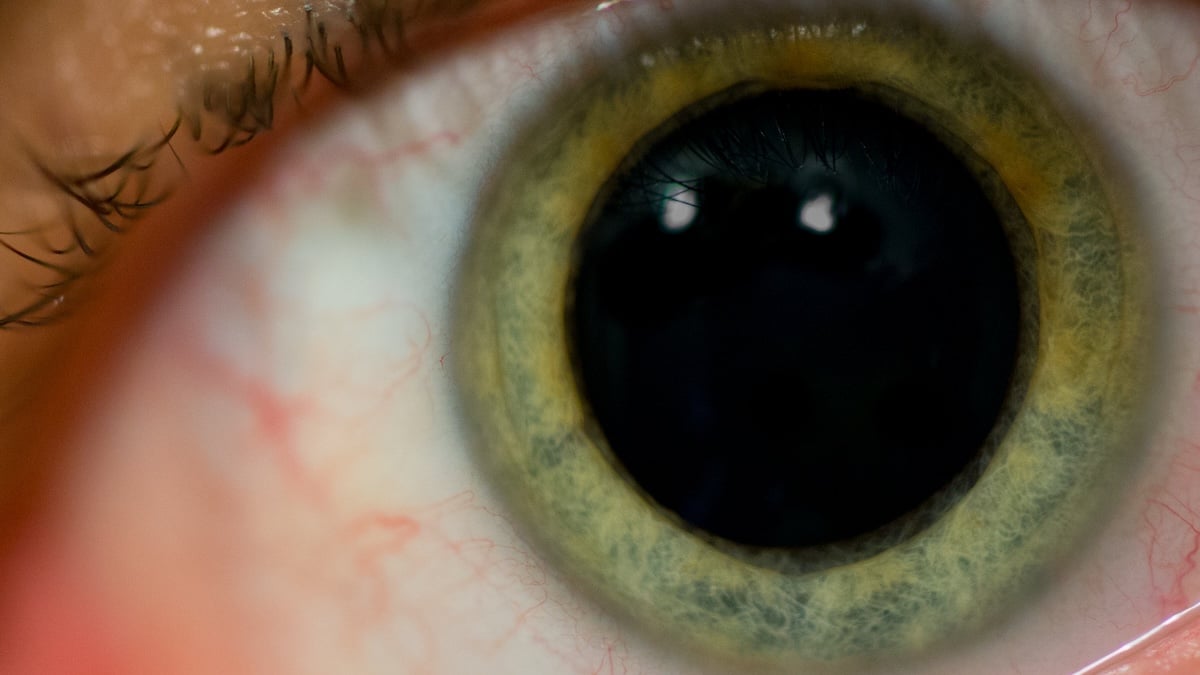
Why Your Pupils Dilate When Surprised: The Brain’s Refresh Mechanism
When humans encounter new information that actively defies expectations, their pupils dilate as part of a rapid physiological surge in alertness. According to a study published in Nature Human Behaviour by researchers at Brown University, this sudden spike in pupil diameter serves as a neural refresh mechanism. The physical shift signals that the brain is transitioning into a new mode, instantly altering how a person perceives incoming stimuli and adapts their learning processes to shifting environments.
Pupil Dilation Triggers Rapid Brain Reset
Key Clinical Takeaways
- Pupil dilation during surprising events marks an immediate spike in bodily arousal driven by the brain’s locus coeruleus.
- Researchers at Brown University found that this physiological refresh mechanism helps the human brain clear out prior expectations to learn faster.
- Funded by the National Institute of Mental Health under grant R01MH126971, the study utilized EEG readings and pupilometry across human participants.
Unlocking the Locus Coeruleus
Neuroscientists recognized that surprising events trigger activity in the locus coeruleus, the primary source of norepinephrine. This chemical messenger drives the body’s flight-or-flight stress response while simultaneously correlating with shifts in pupil diameter and distinct brain waves measured via electroencephalography (EEG).
Yet, the precise functional purpose of these rapid physical fluctuations remained unclear. The team at Brown’s Carney Institute for Brain Science set out to determine whether these autonomic signals actively shape human behavior and cognitive flexibility.
Controlled Experiments Reveal Cognitive Shifts
Lead study author Matt Nassar, an associate professor of neuroscience and of cognitive and psychological sciences at Brown, noted that these rapid fluctuations in arousal serve a direct utility. According to Nassar, the mechanism enables individuals to cope with a world that shifts from one context to another.
To observe this in a controlled setting, the researchers designed an experimental framework involving colored squares displayed on a computer screen. During the trials, 63 participants repeatedly made predictions about upcoming visual patterns before viewing a new sequence of squares, reporting their observations, and adjusting their subsequent forecasts.
EEG Data and Perceptual Biases
The experimental procedures yielded 57 EEG datasets and 60 pupil measurement datasets. Study co-author Harrison Marble, who earned his degree in neuroscience from Brown and serves as a research assistant and manager in Nassar’s laboratory, explained that the team wanted to capture phenomena bridging two overarching theories regarding arousal systems: learning adjustments and perceptual biases.
The data revealed that unexpected color sequences elicited pupil dilation and amplified specific EEG brain waves. When visual inputs matched prior expectations, participants exhibited a bias toward those expectations. Conversely, physiological indicators proved that unexpected results triggered a cognitive reset, allowing individuals to learn from unexpected results and recalibrate their subsequent predictions.
Implications for Clinical Neuroscience
The research demonstrates that human brains retain a mental context until incoming data signals a new situation, at which point the brain replaces that context. Changes in pupil diameter and specific EEG readings act as external markers of this internal loading process. By dropping old expectations, the brain clears a path to absorb new rules without interference.

Funding for this research was provided by the National Institute of Mental Health under grant R01MH126971. Additional investigators contributing to the work at Brown University included Tiantian Li, Timothy Chen, and Niloufar Razmi.
Disclaimer: The information provided in this article is for educational and scientific communication purposes only and does not constitute medical advice. Always consult with a qualified healthcare provider regarding any medical condition, diagnosis, or treatment plan.
Keep reading
- Ancient Rock Art Analysis Reveals Human and Animal Blood Composition
- Lung Cancer Awareness: Risk Factors, Smoking Impact, and Treatment Trends
- Study Reveals How Quitting Alcohol Changes the Brain, Raises Relapse Risk (archyde.com)
- Why Cat Pupils Are Vertical Slits and Dogs' Are Round (daybreakwire.com)