Why White House Vaccine Executive Order Faces Uptempo Hurdles
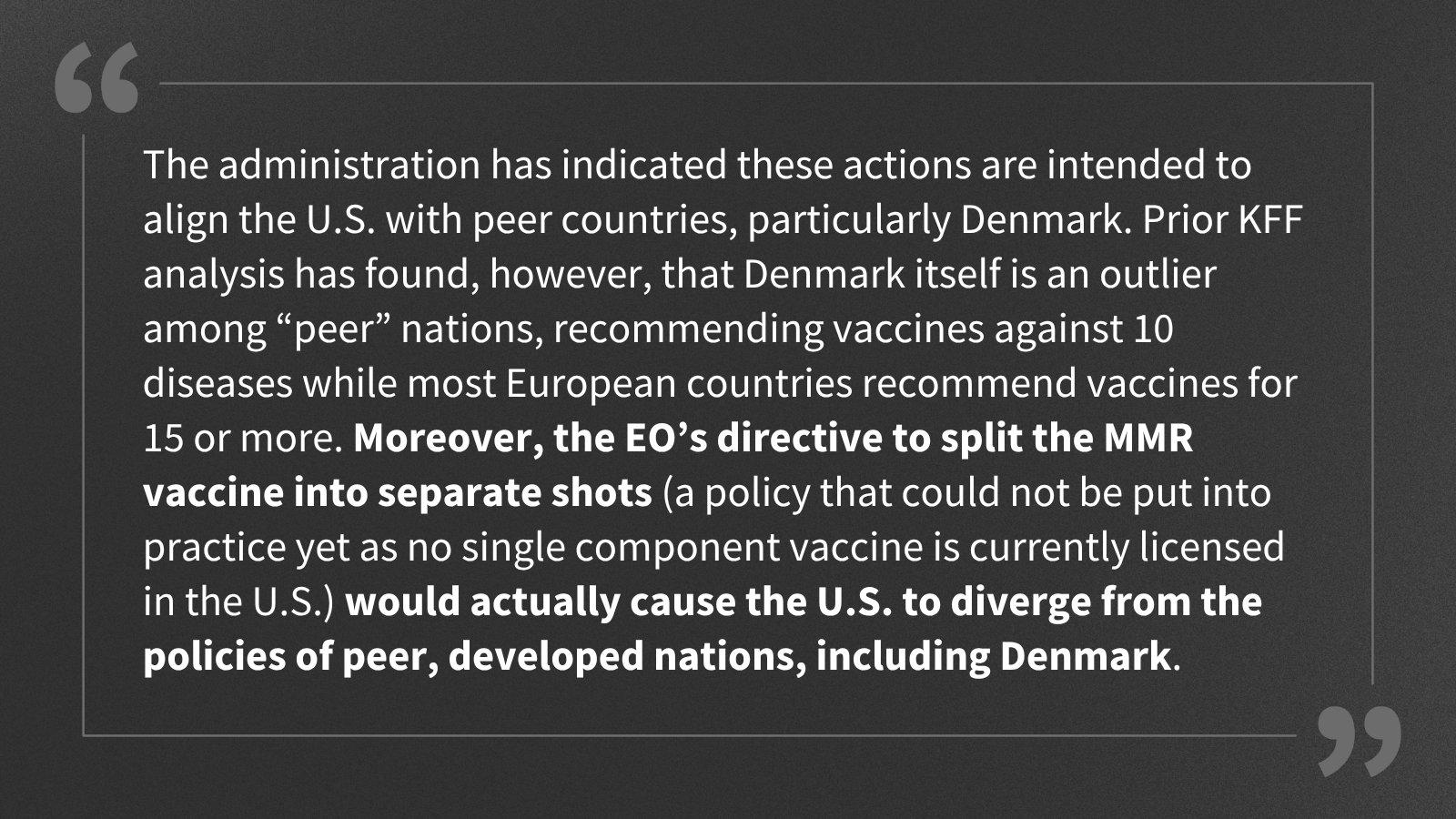
The White House pursued a renewed administrative effort to reshape U.S. childhood immunization policy on January 5, 2026, advancing an executive directive that calls for separating measles, mumps, and rubella (MMR) inoculations and establishing a dedicated federal task force for immunization guidance. The initiative follows a December 2025 executive directive from President Donald Trump requiring health officials to review and implement practices from selected peer nations, with the Centers for Disease Control and Prevention subsequently centering much of its comparative focus on Denmark’s minimalist schedule.
- The executive action directs health officials to explore separated MMR vaccine formats and establishes a new Health and Human Services task force to review federal recommendations.
- Public health bodies, including the American Academy of Pediatrics, characterized the proposed schedule adjustments as dangerous and unnecessary.
- State-level vaccine mandates for public school and daycare entry remain legally decoupled from federal advisory guidelines, limiting the immediate impact of federal policy shifts.
Administrative Scope and Comparative Frameworks
The latest federal push stems from a December 5, 2025 presentation delivered by Tracy Beth Høeg, acting director of the Food and Drug Administration’s Center for Drug Evaluation and Research, during a meeting of the CDC’s Advisory Committee on Immunization Practices. Høeg presented data indicating that the United States previously recommended 72 total vaccine doses through age 18, assuming individual administration of diphtheria, tetanus, pertussis, haemophilus influenzae type B, polio, and hepatitis B. That cumulative figure was contrasted against 11 doses in Denmark, 17 in the United Kingdom, 22 in Germany, and 28 in Japan. Dose-count comparisons frequently omit structural differences in combination shots and universal pediatric influenza guidelines across European jurisdictions.
According to reporting from Agence France-Presse (AFP), the administration’s public communications initially relied on figures that compared the highest end of the U.S. lifetime cumulative schedule to the minimal schedules utilized in specific European nations. Public health researchers at the University of Minnesota’s Vaccine Integrity Project cautioned against using Denmark as a direct benchmark for the United States, pointing out in a December 22, 2025 statement that Denmark operates a centralized healthcare system with universal access and low baseline disease prevalence, conditions that diverge sharply from the demographics of the United States.
Institutional Resistance and State-Level Authority
Medical societies pushed back immediately against the federal review. Sean O’Leary, chair of the American Academy of Pediatrics’ Committee on Infectious Diseases, addressed media representatives on January 5, 2026, stating that the U.S. immunization schedule represents one of the most thoroughly investigated preventive tools available against serious pediatric pathogens. The organization announced it will maintain evidence-based guidelines rooted in clinical research rather than administrative directives. For families navigating shifting public health communications, consulting vetted pediatric specialists or utilizing pediatric primary care networks remains vital for maintaining up-to-date immunoprophylaxis schedules.
Despite executive pressure, federal recommendations do not constitute direct state mandates. State legislatures retain independent authority over vaccine requirements for public school and daycare attendance. Because these localized mandates operate autonomously from federal guidance, health law experts note that sudden changes to CDC schedules rarely translate into immediate alterations at the classroom level. Healthcare facilities and immunization clinics frequently coordinate with healthcare compliance legal advisors to interpret state-specific statutes governing exemptions and enrollment requirements.
Trajectory of Federal Policy and Implementation Barriers
Legal analysts tracking the administration’s health initiatives observe that sweeping federal alterations face significant structural hurdles. Federal courts blocked similar executive actions during previous administration efforts, and state public health departments have increasingly insulated their immunization protocols from federal volatility. While the CDC adopted a modified recommendation for adolescents to receive a single dose of the human papillomavirus (HPV) vaccine rather than the historical two-dose regimen—aligning with 2024 literature and WHO guidance—broader structural changes to childhood schedules remain stalled by operational fragmentation.

As the HHS task force begins its review cycle, clinical researchers emphasize that evaluating vaccine safety and pathogenesis requires rigorous, double-blind, placebo-controlled trials funded through established institutional mechanisms such as NIH grants, rather than politically driven schedule revisions. Maintaining continuity of care relies heavily on transparent clinical communication between families and board-certified pediatric immunologists who track peer-reviewed updates.
*Disclaimer: The information provided in this article is for educational and scientific communication purposes only and does not constitute medical advice. Always consult with a qualified healthcare provider regarding any medical condition, diagnosis, or treatment plan.*