Why Russia Won’t Automatically Return to Normal After a Peace Treaty
Russian President Vladimir Putin recently declared a 32-hour Orthodox Easter ceasefire with Ukraine, following a proposal by President Volodymyr Zelenskyy. While intended as a humanitarian pause, the truce faced immediate reports of violations, highlighting the deep-seated instability that a simple peace treaty cannot instantly resolve for Russia’s economy.
The brief window of silence, which ran from 4 p.m. Saturday until the end of Sunday, was meant to offer a respite from the relentless attrition of the conflict. Instead, it served as a stark reminder of how fragile the current state of diplomacy is. Even as the Kremlin ordered forces to halt combat operations on all fronts, the reality on the ground remained violent. Russian authorities quickly accused Ukraine of breaking the truce with strikes in Nova Kakhovka, while a Ukrainian drone reportedly targeted a gas station in Russia’s Kursk region.
But the failure of a 32-hour holiday truce is a symptom of a much larger, more systemic rot. The assumption that a formal end to the war—whether through a ceasefire or a full peace treaty—will act as a “reset button” for the Russian economy is a dangerous fallacy.
The Illusion of the “Automatic” Recovery
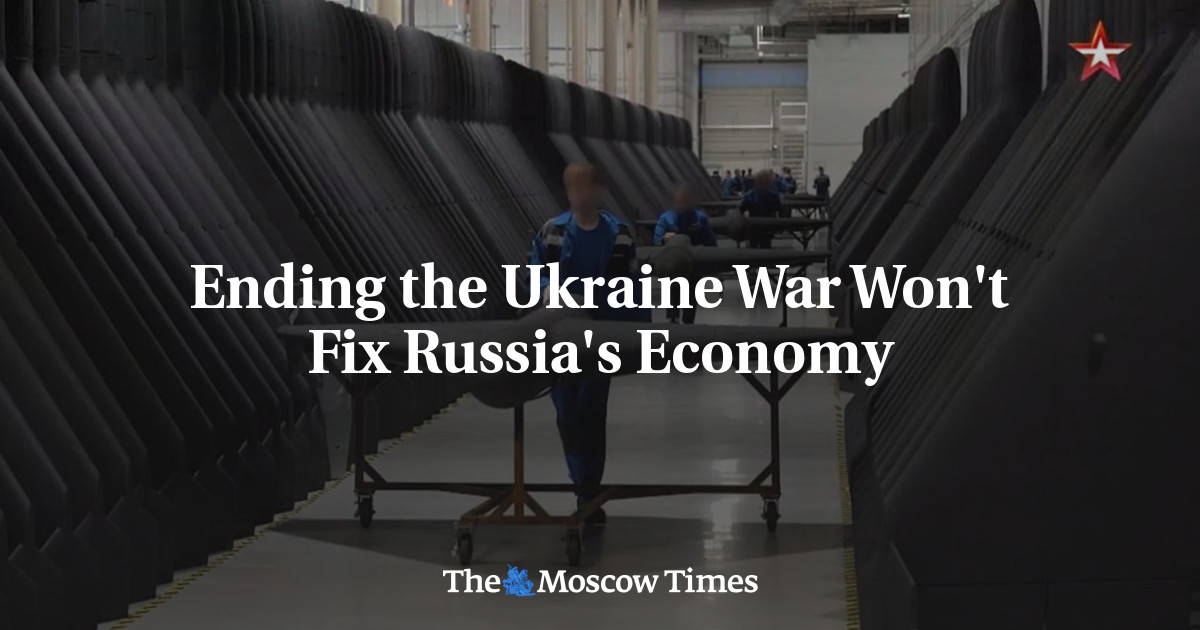
For years, the Russian state has pivoted toward a total war economy. This isn’t just about producing more shells; We see a fundamental restructuring of the national financial architecture. When a government pours its primary resources into military industrialization, it creates a distorted economic bubble. Factories that once produced civilian goods now churn out armored vehicles. Labor markets have shifted toward defense contracting, and state spending is heavily skewed toward the front lines.
The problem is that you cannot simply flip a switch to return to “normal.”

If the guns go silent tomorrow, Russia faces a catastrophic transition period. The military-industrial complex, now the primary engine of GDP growth, would notice its demand vanish overnight. Thousands of workers in defense plants would face unemployment, and the state would have to find a way to pivot these industries back to civilian production without triggering a massive recession.
This economic inertia is where the real danger lies. For businesses and investors trying to navigate this volatility, the demand for vetted economic consultants has turn into a necessity rather than a luxury. The transition from a war footing to a peace footing is often more volatile than the war itself.
The Structural Trap of the War Economy
The current ceasefire efforts, as reported by Al Jazeera, show that both leaderships are aware of the need for pauses, but neither can afford a true exit. For Putin, the war economy provides a temporary facade of stability. By pumping money into the military, the Kremlin masks the underlying decay of the Russian private sector.
Consider the logistical nightmare of a peace treaty. Russia would be left with:
- A bloated defense sector: Massive factories that cannot easily pivot to consumer electronics or machinery.
- Labor shortages: A workforce depleted by mobilization and emigration.
- Sanctioned infrastructure: A financial system isolated from the global West, making the import of civilian technology nearly impossible.
As noted by AP News, the truce was handled with strict military oversight, with Defence Minister Andrei Belousov instructing Chief of the General Staff Valery Gerasimov to manage the pause. This highlights that the “peace” is currently managed by the military, not by economists or diplomats. When the military manages the economy, the economy ceases to function on market logic.
“People need an Easter free from threats and real movement toward peace, and Russia has a chance not to return to strikes after Easter as well.” — President Volodymyr Zelenskyy
Zelenskyy’s hope for a “real movement toward peace” ignores the grim reality of the Russian internal ledger. A peace treaty doesn’t magically remove sanctions or rebuild the decimated civilian supply chains. It merely stops the bleeding of manpower.
Navigating the Geopolitical Minefield
For international firms and legal entities, the “post-war” landscape in Russia will be a legal vacuum. The transition from wartime decrees to peacetime law will likely be chaotic. We are seeing a surge in demand for international trade attorneys who can navigate the complex overlap of remaining sanctions and the desperate attempt to restart trade.
The Russian economy is now a house of cards held up by oil exports and military spending. If the military spending stops, the house shakes. If the oil prices dip, the house falls.

According to reports from CNN, the Easter ceasefire was an attempt to project a humanitarian image, but the immediate return to hostilities in places like Kursk proves that the appetite for a genuine strategic shift is non-existent. This cycle of brief pauses followed by renewed aggression creates a permanent state of instability that prevents any long-term economic planning.
This is why geopolitical risk is no longer a niche concern for hedge funds; it is a daily operational reality for any business with exposure to Eastern Europe. Companies are increasingly relying on geopolitical risk analysts to determine if “peace” in the region is a genuine recovery or simply a tactical lull before another economic shock.
The Long-Term Verdict
The 32-hour truce was a gesture, not a strategy. Whether it is a holiday ceasefire or a formal treaty signed in a neutral capital, the fundamental truth remains: Russia has traded its economic future for a military present. The cost of this trade is a systemic fragility that cannot be fixed by a signature on a piece of paper.
The “normal” Russia that existed before the pivot to a war economy is gone. What replaces it will not be a sudden return to prosperity, but a long, painful period of restructuring, inflation, and potential social unrest as the state struggles to pay for a peace it cannot afford.
The world may watch for the next ceasefire with hope, but the numbers tell a different story. True stability requires more than the absence of shelling; it requires an economic foundation that isn’t built on the production of weaponry. Until that shift happens, any “peace” is merely a pause in a larger, inevitable collapse. For those looking to survive this transition, the only safeguard is preparation through verified, professional expertise found within the World Today News Directory.