Why Rapidly Spinning Stars Explain Fading Black Hole Flares
Syracuse University Astrophysicists Explain Why Repeating Partial Tidal Disruption Flares Fade Over Time
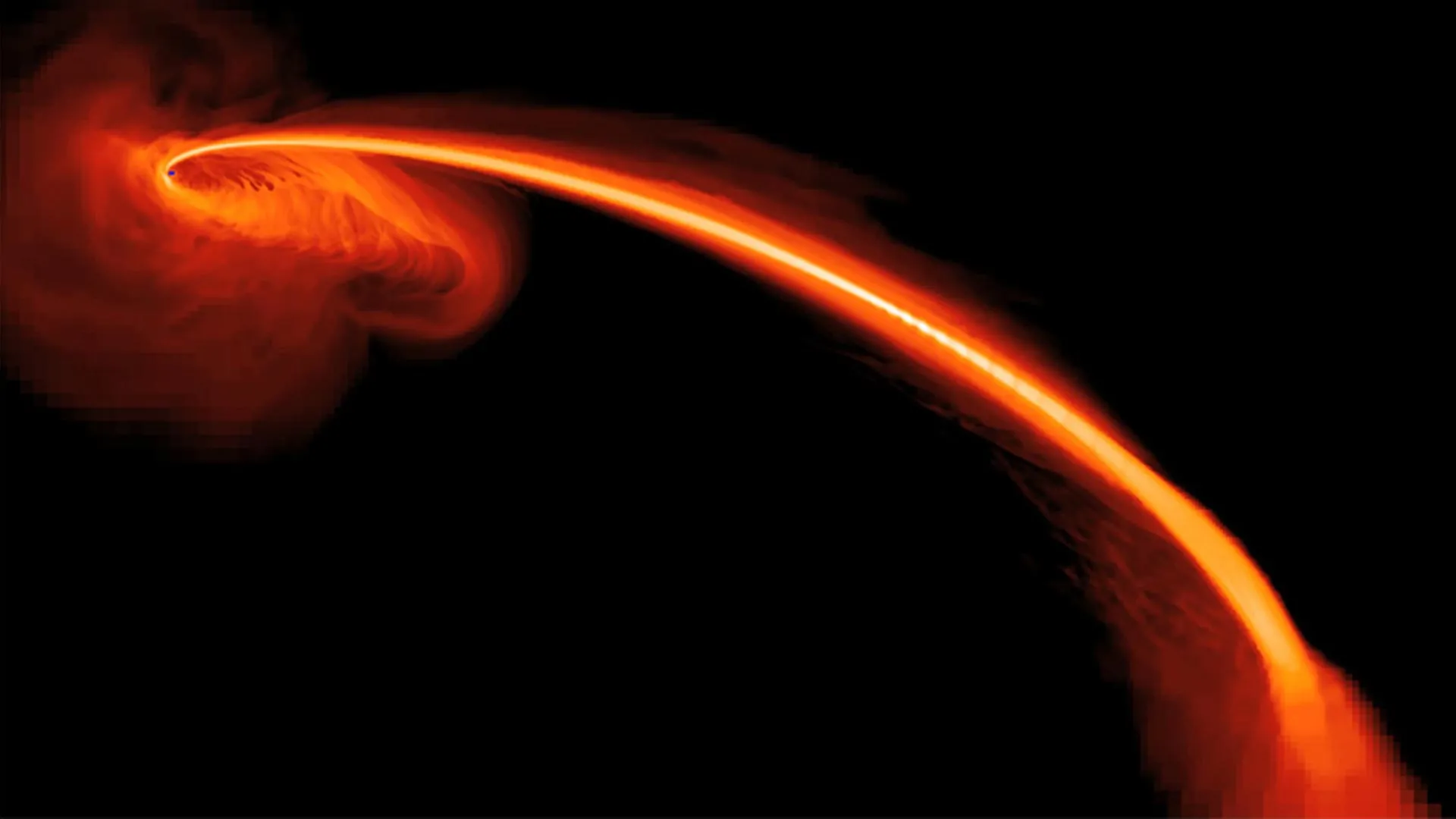
Stars that repeatedly skim past supermassive black holes without total destruction can survive multiple encounters, yet their resulting light flares frequently grow steadily dimmer with each return. According to research published in The Astrophysical Journal by astrophysicists at Syracuse University, this fading behavior is driven by how rapidly the star was spinning before its first gravitational encounter, combined with tidal torque applied during subsequent passages.
The Tech TL;DR:
- The Core Discovery: Rapid pre-encounter stellar rotation and tidal torque alter mass-loss trajectories during repeating partial tidal disruption events (rpTDEs).
- The Research Team: Led by doctoral student Ananya Bandopadhyay alongside postdoctoral researcher Benjamin Amend and associate professor Eric Coughlin in the Syracuse University Department of Physics.
- Observed Anomaly: Out of roughly 10 repeating systems identified to date, four exhibit progressively dimmer flares that previous hydrodynamical models failed to reproduce.
Hydrodynamical Simulations and the Fading Flare Paradox
Most galaxies harbor a supermassive black hole at their center weighing millions or billions of times more than the sun. When a star ventures close enough, the intense gravitational field creates a tidal disruption event (TDE). Standard encounters completely shred the star, producing an accretion disc that emits bright electromagnetic radiation over days to months. However, in repeating partial tidal disruption events (rpTDEs), the stellar core survives an initial close pass and returns on an eccentric orbit months or years later.
Astronomers have identified approximately 10 repeating systems to date. Among them, four display flares that become progressively dimmer on each return. For years, theoretical models struggled to replicate this cooling behavior. Previous hydrodynamical simulations predicted that even when a star lost smaller amounts of mass during each successive passage, the resulting flares would still maintain comparable peak brightness.
Stellar Structure, Pre-Encounter Spin, and Tidal Torque
To resolve the discrepancy, the Syracuse University team investigated internal stellar properties and pre-encounter dynamics. According to the research, low-mass stars behave like fluffy meringues, making them increasingly susceptible to gravitational tidal forces. In contrast, higher-mass stars feature onion-like internal structures with matter concentrated heavily toward the center, allowing them to shed outer layers while their dense core remains comparatively intact.
Crucially, the study demonstrated that tidal forces do not merely strip mass away from the star during a close pass. They also apply a strong torque that spins the star up faster before subsequent passages, altering how the stellar remnant responds to subsequent gravitational stress, successfully explaining the steady dimming of electromagnetic flares over time.
Code Implementation: Simulating Orbital Mass Loss

import numpy as np

def calculate_mass_loss(initial_mass, spin_parameter, orbital_decay_factor):
    """
    Simulates incremental stellar mass shedding during repeating partial TDEs.
    """
    shed_material = initial_mass * (1.0 - orbital_decay_factor) * np.exp(spin_parameter)
    surviving_core = initial_mass - shed_material
    return max(surviving_core, 0.0), shed_material

# Example execution for a high-mass star candidate
core_mass, mass_lost = calculate_mass_loss(initial_mass=2.5, spin_parameter=0.85, orbital_decay_factor=0.92)
print(f"Surviving Core Mass: {core_mass:.4f} Solar Masses")
print(f"Material Stripped: {mass_lost:.4f} Solar Masses")