White House renovations alter King Charles state dinner logistics
The South Lawn Ceremony, With a Missing Wing
The military arrival ceremony for King Charles III and Queen Camilla on the South Lawn proceeded with the precision expected of such occasions, though the setting bore visible signs of the White House’s current renovation. The Marine Band performed traditional anthems under partly cloudy skies, while temporary barriers and construction equipment occupied the space where the East Wing once stood. Officials noted that the renovation, part of a multi-year infrastructure project, has required adjustments to the usual protocols for state visits.
While the White House has not detailed all modifications to guest capacity or security arrangements, the changes were apparent in the rerouted pathways for diplomats and attendees. The East Wing has historically played a role in hosting diplomatic events, and its temporary absence has led to alternative arrangements for pre-dinner receptions and post-event gatherings. The adjustments, though practical in nature, reflect the broader effort to maintain the traditions of state visits while accommodating the realities of the renovation.
Charles’s Address to Congress: A Message of Resolve and Restraint
King Charles III delivered an address to a joint session of Congress, emphasizing themes of shared values and cooperation between the U.S. and U.K. His remarks acknowledged recent challenges, including the ongoing conflicts in Europe and the Middle East, as well as the recent security incident near the White House. He spoke of the need for unity in addressing global instability, noting that such events underscore the importance of international partnerships.
The king’s reference to the recent shooting near the Capitol—Let me say with unshakeable resolve: such acts of violence will never succeed
—drew a standing ovation from lawmakers. His speech avoided direct commentary on specific policy disagreements, such as the Iran war, instead focusing on areas of mutual interest, including environmental initiatives and economic collaboration. The address, only the second by a British monarch in U.S. history, served as a reminder of the longstanding ties between the two nations, even as both navigate distinct priorities.
The Closed-Door Meeting: Diplomacy in a Smaller Room
The meeting between President Trump and King Charles III in the Oval Office highlighted the logistical adaptations required by the White House’s renovation. With the East Wing unavailable, officials limited the number of aides and advisors present, creating a more intimate setting for the discussion. Following the meeting, President Trump described it as productive, praising the king and queen as gracious hosts and emphasizing the positive tone of their conversation.
For more on this story, see Trump assassination attempt fuels $400M White House ballroom debate.
The constraints imposed by the renovation were also evident in the subsequent gathering between King Charles and technology executives, which took place in a temporary venue on the White House grounds. The East Wing has traditionally hosted such meetings, and its absence has necessitated creative solutions to accommodate high-profile visitors. While the White House has not disclosed whether any invited guests were affected by the reduced capacity, the adjustments reflect the broader effort to balance diplomatic protocol with the realities of the ongoing construction.
The State Dinner Menu: A Delicate Balance of Tradition and Adaptation
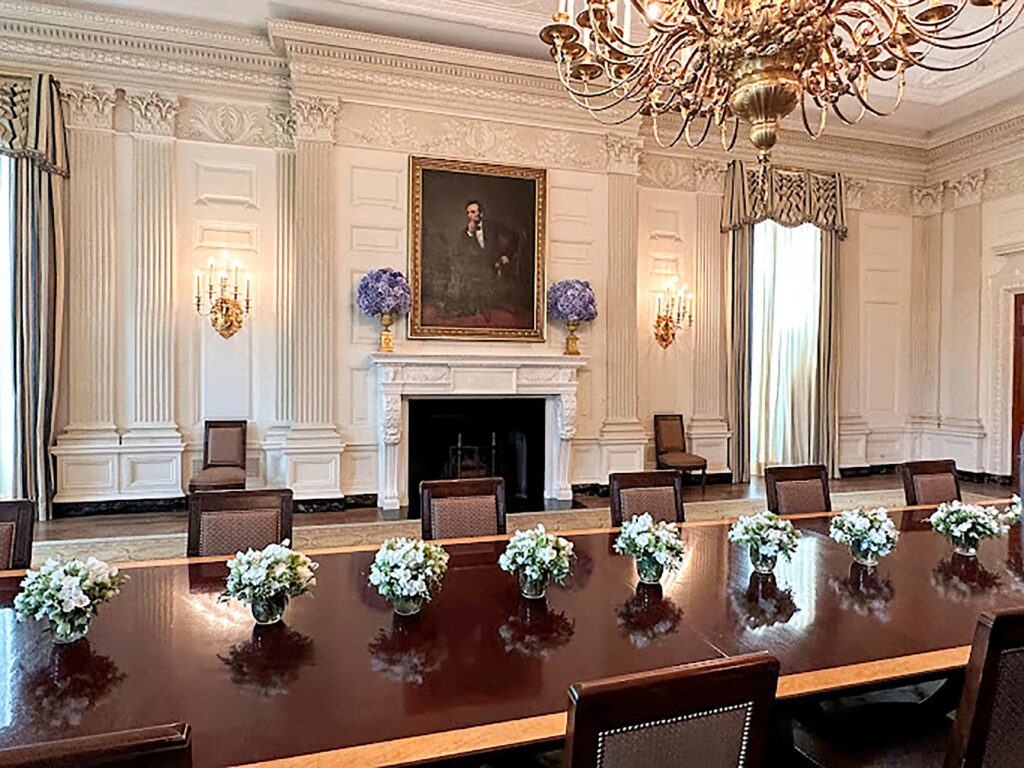
The White House released details of the state dinner menu, which featured dishes designed to highlight seasonal ingredients and the White House Kitchen Garden. The first course, a garden vegetable velouté with hearts of palm and micro mint, and the second course, spring herb ravioli with ricotta and morels, were crafted to reflect both elegance and the practical considerations of hosting a large event during renovations. The absence of a third course, a departure from past state dinners, suggested a more streamlined approach to the evening’s proceedings.
Melania Trump, who oversaw the dinner’s preparations, emphasized the event’s role in celebrating the U.S.-U.K. relationship. While the White House has not commented on the specific reasons behind the menu’s structure, the changes align with the broader adaptations required by the renovation. The dinner, like the visit as a whole, reflects an effort to uphold diplomatic traditions while responding to the logistical demands of the moment.
This follows our earlier report, Rudy Giuliani: Critics Should Support the White House’s Larger, More Secure Ballroom for Events.
Security and Symbolism: The Unspoken Pressures of the Visit
The arrest of an individual near the White House on the morning of King Charles’s arrival highlighted the heightened security measures in place for the visit. The Secret Service detained the suspect after they breached a security barrier near The Ellipse, though officials have not provided further details about the incident. The event occurred less than two days after the shooting at the White House Correspondents’ Dinner, prompting the Secret Service to maintain an elevated security posture around the White House complex.
The ongoing renovation of the East Wing has added another layer of complexity to security planning. While the Secret Service has not disclosed how the construction has affected its operations, the temporary barriers and rerouted pathways create new considerations for protecting the perimeter. These adjustments come as both nations navigate a period marked by global and domestic challenges, including recent security incidents and ongoing diplomatic discussions.
The next phase of the visit, in New York City, will further test these adaptations. King Charles and Queen Camilla’s visit to the 9/11 Memorial at One World Trade Center will serve as a poignant moment of reflection on the shared history between the U.S. and U.K. The memorial’s significance, combined with the ongoing security concerns, will frame the final days of the visit as an opportunity to reaffirm the resilience of the alliance amid evolving circumstances.