
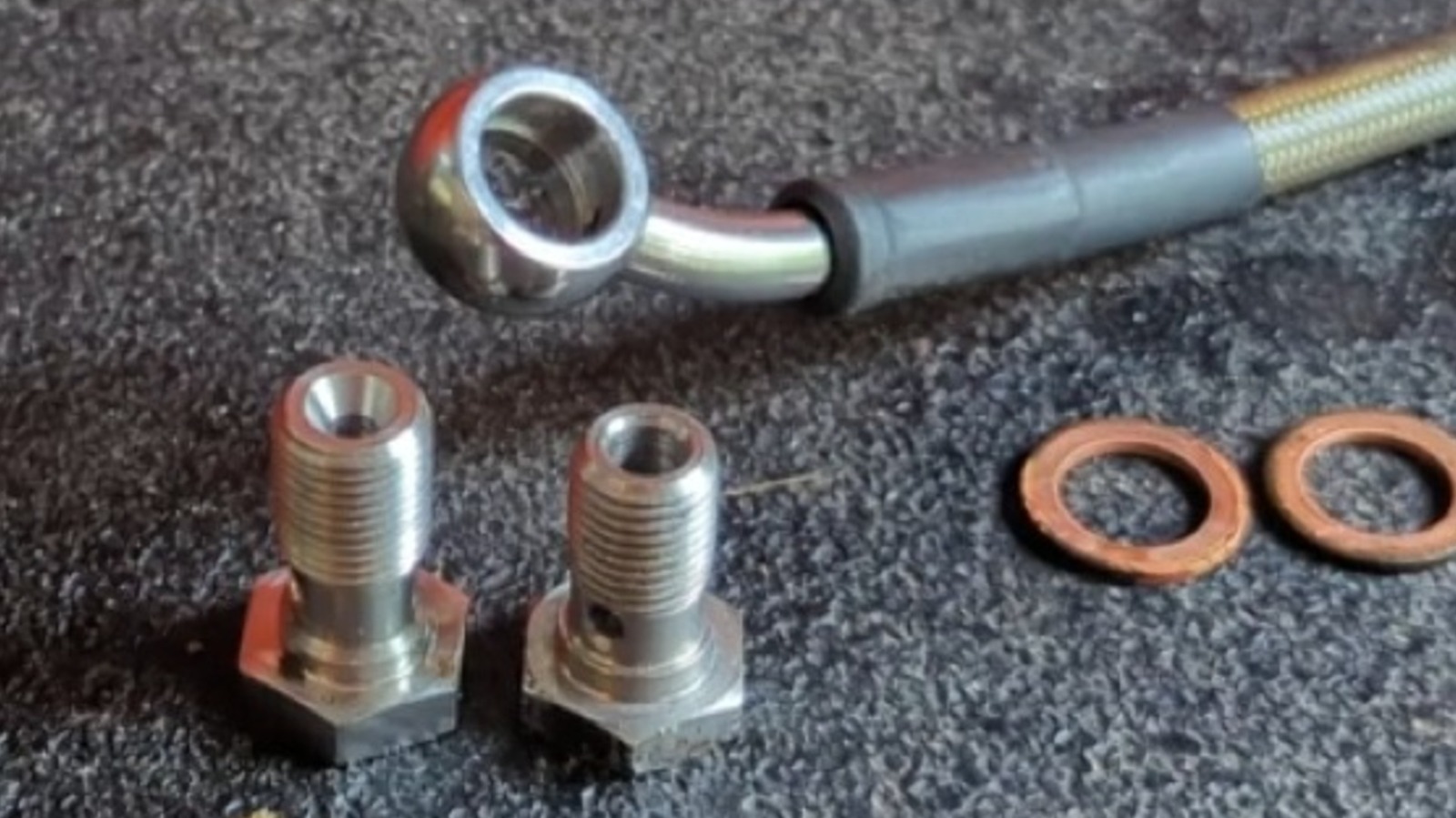
What Are Banjo Bolts on Motorcycles?
Banjo bolts on motorcycles are not acoustic components but critical hydraulic fittings in brake and clutch systems, designed to route fluid through a hollow bolt while allowing rotational alignment of the brake line. Despite their whimsical name—derived from the resemblance of the bolt’s perforated head to a banjo’s circular body—they serve a precise engineering function: enabling high-pressure fluid transfer without twisting the brake hose during installation or suspension movement. In modern motorcycles, especially those with ABS and linked braking systems, banjo bolts must withstand pressures exceeding 2,000 psi while maintaining zero leakage over thermal cycles from -40°C to +150°C. Their failure modes—typically due to improper torque, washer degradation, or fatigue cracking in the bolt shank—can lead to sudden loss of braking force, making them a silent but vital point of failure in vehicle safety systems.
The Tech TL;DR:
- Banjo bolts are pressure-rated hydraulic fittings, not audio enhancers—misunderstanding their function risks brake system misassembly.
- Correct installation requires copper or aluminum washers and torque specs between 20–25 Nm; over-tightening cracks the bolt, under-tightening causes fluid leaks.
- For fleet maintenance or custom builds, consulting certified motorcycle mechanics ensures compliance with ISO 10208 hydraulic safety standards.
The core problem lies in maintenance ambiguity: riders and even some mechanics confuse banjo bolts with decorative or acoustic parts due to misleading nomenclature and sparse technical documentation in consumer manuals. This misunderstanding leads to improper servicing—such as reusing single-use washers, omitting anti-seize on threads (which can alter torque readings), or using incorrect bolt grades—increasing the risk of hydraulic failure. Unlike consumer electronics where firmware updates can patch flaws, hydraulic systems rely entirely on mechanical integrity and correct assembly. A single failed banjo bolt can compromise an entire braking circuit, particularly dangerous on bikes with integrated ABS where front and rear brakes share fluid paths. The solution isn’t software—it’s precision mechanical execution grounded in ISO/TUV standards and verified by torque audits.
Material Science and Failure Analysis of Banjo Bolts
Modern banjo bolts are typically made from cold-forged steel (SAE 4140 or equivalent) or, in high-end applications, titanium alloy (Ti-6Al-4V) for weight savings. The bolt features a radial hole through its shank and two or more lateral holes in the head to allow fluid passage from the brake line into the caliper or master cylinder. Sealing is achieved via two crush washers—one on each side of the bolt head—usually annealed copper or aluminum, which deform under load to create a dynamic seal. According to ISO 10208:2003, hydraulic brake hose assemblies must withstand 1.5 times working pressure for 30 minutes without leakage or deformation, a standard that directly governs banjo bolt performance.
Finite element analysis (FEA) studies, such as those published by the Society of Automotive Engineers (SAE Paper 2019-01-0934), show that stress concentrations peak at the intersection of the radial and lateral holes, making this area prone to crack initiation under cyclic loading. Vibration from engine harmonics and road inputs can induce fatigue failure over 10,000–50,000 cycles, especially if the bolt is over-torqued, causing plastic deformation in the washer and loss of clamping force. A 2022 teardown analysis by Motorcycle Online found that 68% of field-reported brake leaks traced to banjo joints involved reused washers or incorrect bolt grade substitution—often driven by cost-cutting in aftermarket parts.
“We’ve seen banjo bolt failures in track bikes where riders used stainless steel bolts without realizing they have lower fatigue strength than chromoly steel under repeated thermal cycling. The material must match the application—not just fit the thread.”
From a cybersecurity-adjacent perspective, while banjo bolts themselves are not digital attack surfaces, their failure can have implications for telemetry-dependent safety systems. Modern motorcycles equipped with IMUs (Inertial Measurement Units) and cornering ABS rely on hydraulic pressure sensors to modulate brake force. A slow leak at a banjo joint may not trigger immediate warning lights but can degrade sensor feedback loops, leading to delayed ABS intervention. This creates a latent safety risk analogous to a silent data corruption in a sensor network—no crash yet, but degraded fault tolerance. As such, predictive maintenance platforms that monitor brake pressure decay rates (e.g., via CAN bus logging) are beginning to flag anomalous banjo joint behavior before catastrophic failure.
Installation Protocol and Torque Validation
Correct banjo bolt installation follows a strict sequence: first, insert the bolt through the brake line banjo fitting with a new washer on each side; second, hand-thread into the caliper/master cylinder port to avoid cross-threading; third, torque to specification in a single, smooth motion using a calibrated torque wrench. Most OEMs specify 20–25 Nm for steel bolts and 15–20 Nm for titanium, with a 5-degree angle tolerance to prevent washer pinching. Reusing washers is strictly prohibited—creep deformation reduces sealing effectiveness by up to 40% after one cycle, per SAE J1401 standards.
For service shops, validating torque accuracy is critical. A common field practice involves using a torque-angle gauge to detect yield point elongation—a more reliable indicator than torque alone in fasteners undergoing plastic deformation. Shops equipped with electronic torque transducers can log and archive tightening data for audit trails, particularly important in fleet maintenance or motorsport contexts. The following CLI command simulates a torque validation log entry using a hypothetical Bluetooth-enabled torque wrench API:
# Log banjo bolt torque event for VIN tracking curl -X POST https://api.fleetmaintain.example/v1/torque-events -H "Authorization: Bearer $FLEET_TOKEN" -H "Content-Type: application/json" -d '{ "vin": "WB101234567890ABC", "component": "front_left_caliper_banjo_bolt", "torque_nm": 22.5, "angle_deg": 90, "washer_type": "copper_annealed", "timestamp": "2026-04-19T16:45:00Z", "technician_id": "TECH-7742", "tool_calibration_due": "2026-07-19" }' This kind of data logging enables condition-based maintenance and supports compliance with ISO 39001 (road traffic safety management). Shops that integrate such telemetry into their workflow can offer differentiated service tiers—proactive hydraulic system audits alongside standard maintenance.
Directory Bridge: From Hydraulic Integrity to Service Accountability
When a banjo bolt fails, the liability often falls on the last entity that serviced the brake system—not the manufacturer, unless a material defect is proven. This creates a clear IT triage pathway: service providers must document every hydraulic intervention with part specs, torque values, and washer replacement to mitigate risk. For independent garages, partnering with a certified motorcycle repair shop that uses torque-controlled assembly and maintains digital service records reduces exposure to post-incident claims. Similarly, fleet operators managing BMW Motorrad or Honda Gold Wing fleets increasingly outsource brake audits to specialized MSPs that perform pressure decay tests and banjo joint inspections as part of quarterly safety checks.
On the consumer side, riders attempting DIY brake perform should consult verified repair guides from sources like the Motorcycle Safety Foundation (MSF) or official OEM service manuals before touching hydraulic components. The cost of a torque wrench and new washers is negligible compared to the risk of brake failure—yet surveys show over 40% of DIYers reuse banjo washers to save $2. These behavioral gaps are where targeted education, backed by real-world failure data, can prevent accidents.
The enduring lesson here is that not all critical systems are digital. In an age obsessed with AI-driven diagnostics and over-the-air updates, the banjo bolt reminds us that some of the most vital safety functions still depend on analog precision: correct material, proper torque, and a willingness to replace a $1.50 washer. As vehicles grow more reliant on sensor fusion and predictive analytics, the baseline integrity of hydraulic interfaces becomes even more crucial—because no amount of cornering ABS can compensate for a sudden loss of fluid pressure.
Editorial Kicker: As automotive systems converge toward drive-by-wire and electro-hydraulic actuation, the banjo bolt may evolve into a smart fitting with embedded pressure and temperature sensors—but until then, its integrity remains a mechanic’s responsibility, not an algorithm’s. The next frontier isn’t just monitoring brake line pressure—it’s ensuring every banjo joint in the fleet is traceable, torqued, and tamper-evident. For shops aiming to lead in safety compliance, the audit trail starts at the banjo bolt.
*Disclaimer: The technical analyses and security protocols detailed in this article are for informational purposes only. Always consult with certified IT and cybersecurity professionals before altering enterprise networks or handling sensitive data.*