
James Webb Telescope Spots Frozen Water Around Distant Star, Revolutionizing Planet Formation Theories
In a groundbreaking discovery, the james Webb space Telescope (JWST) has achieved a historic milestone: the first definitive detection of crystalline ice water in a young star system far beyond our solar system. While water ice is common within our cosmic neighborhood, this marks the first time it has been observed in such a state outside of it.This finding offers invaluable insights into the composition of distant planetary systems and bolsters the possibility of water, a crucial ingredient for life, existing elsewhere in the universe.
Did You Know?
Crystalline ice water, unlike amorphous ice, possesses a highly ordered internal structure. This structure typically forms under specific temperature and pressure conditions, making its detection a important clue about the habitat of the star system.
A Cosmic Mirror: HD 181327 and Our Kuiper Belt
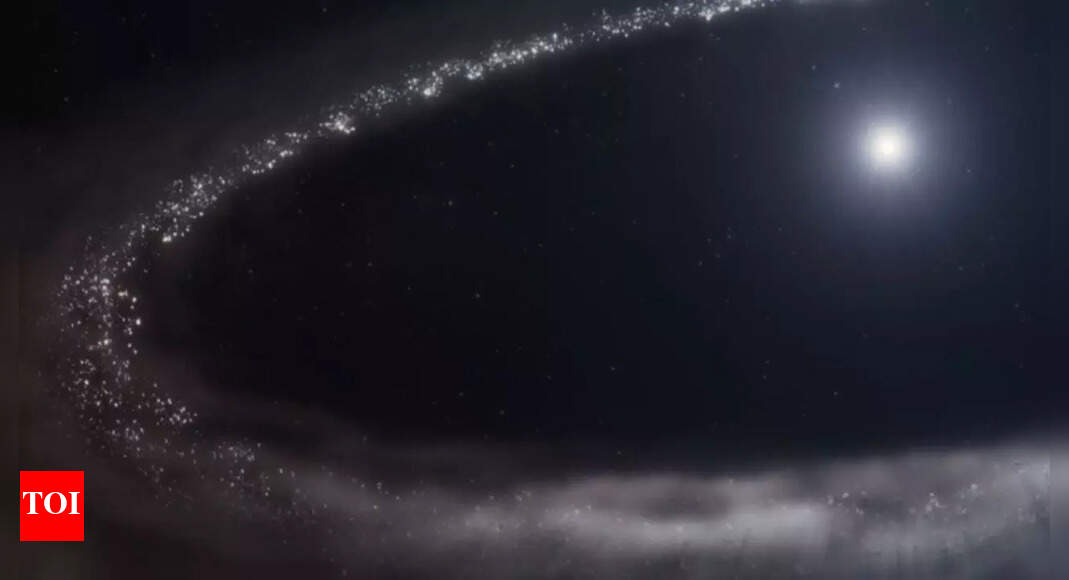
The research, published in *Nature*, details the presence of ice within a dust ring encircling the star HD 181327, located approximately 155 light-years from our sun. At a mere 23 million years old, HD 181327 is remarkably similar to our sun, albeit slightly hotter and heavier. The most striking aspect of this discovery is the debris disk’s resemblance to our own Kuiper Belt, the icy realm beyond Neptune.
Webb’s advanced infrared capabilities revealed a gap between the star and the disk, mirroring the structure of our solar system and suggesting ongoing planet formation. This gap is a crucial piece of evidence, hinting at the presence of developing planets clearing their orbital paths.
crystalline Ice: A Sign of Organized Structure
The JWST did not directly observe liquid water. Instead, it detected crystalline water ice, similar to that found in Saturn’s rings and Kuiper Belt objects. This type of ice indicates a highly organized internal structure, typically formed under specific temperature and pressure conditions.
Pro Tip:
The detection of crystalline ice, rather than amorphous ice, is significant. Crystalline ice requires specific conditions to form, suggesting a more dynamic and potentially habitable environment.
according to a researcher, HD 181327 is a highly active system. It has intense, periodic collisions within its debris disk. When the icy objects in it collide with one another, they break apart into extremely fine particles of dusty water ice that are the perfect size for Webb to detect.
These continuous collisions replenish the ice particles, enabling their detection even at great distances.
Implications for Planetary Formation
This discovery has far-reaching implications for our understanding of planetary system formation and evolution. The uneven distribution of ice,concentrated in the colder outer regions,supports existing models of planet formation. Scientists found that water ice constitutes approximately 8% of the material in the disk’s middle regions, indicating a balance between ice formation and destruction.
This balance may point to a universal pattern in the formation of planetary systems, mirroring the structure and dynamics of our own. Previously, no telescope could directly observe such faint features in distant debris disks. This breakthrough opens new avenues for studying the role of water in planet formation throughout the galaxy.
reader Question:
How does the discovery of crystalline ice water in other star systems impact our search for extraterrestrial life?
Encouraged by the findings in HD 181327, scientists plan to explore even more distant star systems for water ice. The results will not onyl enhance our knowledge of where life-supporting elements are located in the universe but also reveal how common they are in newly forming planetary systems.
Frequently Asked Questions (FAQ)
-
What is crystalline ice water?
It is indeed water in a solid state with a highly ordered internal structure, formed under specific temperature and pressure conditions.
-
Why is this discovery important?
It’s the first definitive detection of crystalline ice water outside our solar system,providing insights into planet formation and the potential for life elsewhere.
-
What is HD 181327?
It is indeed a young star system 155 light-years away, with a debris disk resembling our Kuiper Belt.
-
What are the next steps for researchers?
Scientists plan to search for water ice in more distant star systems to understand the distribution of life-supporting elements.
