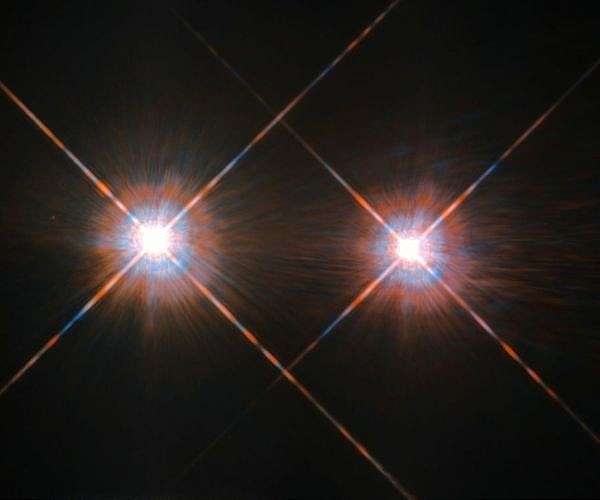
Webb Telescope Finds Evidence of Saturn-Mass Planet Around Alpha Centauri A
Webb Captures Strong Evidence of Saturn-Mass Planet Orbiting Alpha Centauri A
Astronomers using NASA’s James Webb Space Telescope have identified strong evidence of a giant exoplanet orbiting Alpha Centauri A, our nearest Sun-like stellar neighbor located just 4 light-years away, according to findings accepted for publication in a pair of papers in The Astrophysical Journal Letters as reported by NASA’s Jet Propulsion Laboratory and NASA Science. The potential world—captured via high-contrast mid-infrared imaging—then appeared to vanish during subsequent observation windows, triggering millions of computational orbit simulations to determine its trajectory through a binary star environment.
The Tech TL;DR:
- Target Location: Alpha Centauri A, a solar twin situated 4 light-years from Earth in a triple-star arrangement alongside Alpha Centauri B and Proxima Centauri.
- Observational Tech: Data acquired via Webb’s Mid-Infrared Instrument (MIRI) utilizing a specialized coronagraphic mask to block stellar glare, supplemented by historical imaging from the European Southern Observatory’s Very Large Telescope.
- The Orbital Puzzle: Following initial August 2024 detection, follow-up observations in early 2025 yielded non-detections, which researchers resolved by modeling elliptical orbits where the planet swings too close to the primary star to remain visible.
Decoding the MIRI Coronagraphic Pipeline and Binary Obstacles
Detecting exoplanets directly around nearby stars requires extreme dynamic range because stellar radiation dwarfs planetary signatures by orders of magnitude. In the case of Alpha Centauri A, the analytical pipeline had to cope with both the primary star’s blinding output and the perturbing gravitational influence of Alpha Centauri B. According to Charles Beichman of NASA’s Jet Propulsion Laboratory and the NASA Exoplanet Science Institute at Caltech’s IPAC, observing the system required custom operational engineering. Webb was designed and optimized to find the most distant galaxies in the universe,
Beichman stated via NASA’s official releases. The operations team at the Space Telescope Science Institute had to come up with a custom observing sequence just for this target, and their extra effort paid off spectacularly.
The initial discovery data gathered in August 2024 utilized MIRI’s coronagraphic mask to suppress starlight. The resulting processed frames isolated an object more than 10,000 times fainter than Alpha Centauri A, positioned at a separation roughly equivalent to twice the distance between the Earth and the Sun. Yet, when subsequent imaging passes were executed in February and April 2025, the target could not be resolved. This sudden absence required rigorous validation to rule out instrumental artifacts, background galaxies, or foreground asteroids.
Simulating Millions of Orbits to Resolve the Disappearance
To explain why the candidate seemed to vanish, research team member Sanghi of Caltech led a massive computational modeling effort. By running millions of simulated trajectories that accounted for gravitational stability within the binary system, the team discovered that orbital mechanics naturally explained the observational gap. We found that in half of the possible orbits simulated, the planet moved too close to the star and wouldn’t have been visible to Webb in both February and April 2025,
Sanghi explained in NASA documentation. When factoring in this positional shift alongside data from a 2019 European Southern Observatory Very Large Telescope sighting, analysts deduced the signal corresponds to a gas giant approximately the mass of Saturn moving along an elliptical path between one and two times the distance between the Sun and Earth.
import numpy as np

def evaluate_orbital_stability(semi_major_axis, eccentricity, stellar_mass_ratio):
    # Calculate periastron and apastron bounds for binary interference checking
    periastron = semi_major_axis * (1.0 - eccentricity)
    apastron = semi_major_axis * (1.0 + eccentricity)

    # Check hill sphere and gravitational cutoff limits
    stable_limit = 2.4 * stellar_mass_ratio
    is_stable = apastron < stable_limit

    return {
        "periastron_au": periastron,
        "apastron_au": apastron,
        "orbit_stable": is_stable
    }

# Test sample parameters for Alpha Centauri A candidate
result = evaluate_orbital_stability(1.5, 0.3, 1.0)
print(f"Orbit Stability Verification: {result['orbit_stable']}")
Future Validation Pipelines and Upcoming Space Telescopes
While the current data constitutes the strongest evidence yet for a world in this stellar backyard, confirmation requires multi-instrument corroboration. If verified, the object will serve as a premier touchstone for comparative planetology. Of all the directly imaged planets, this would be the closest to its star seen so far,
Sanghi noted, adding that its temperature and age mirror the giant planets of our own solar system.

NASA’s Nancy Grace Roman Space Telescope, slated for launch by May 2027 and potentially as early as fall 2026, features hardware explicitly designed to test new technologies to observe binary systems like Alpha Centauri in search of other worlds. Combining Roman’s visible-light data with Webb’s mid-infrared observations will allow researchers to gain unique insights on the size and reflectivity of the planet.
Ultimately, the Alpha Centauri A candidate challenges existing models of planetary formation under chaotic gravitational stress. Whether subsequent observation runs confirm its permanent residency or refine its orbital period, the methodological framework established by the Webb team sets a new baseline for local stellar exploration.