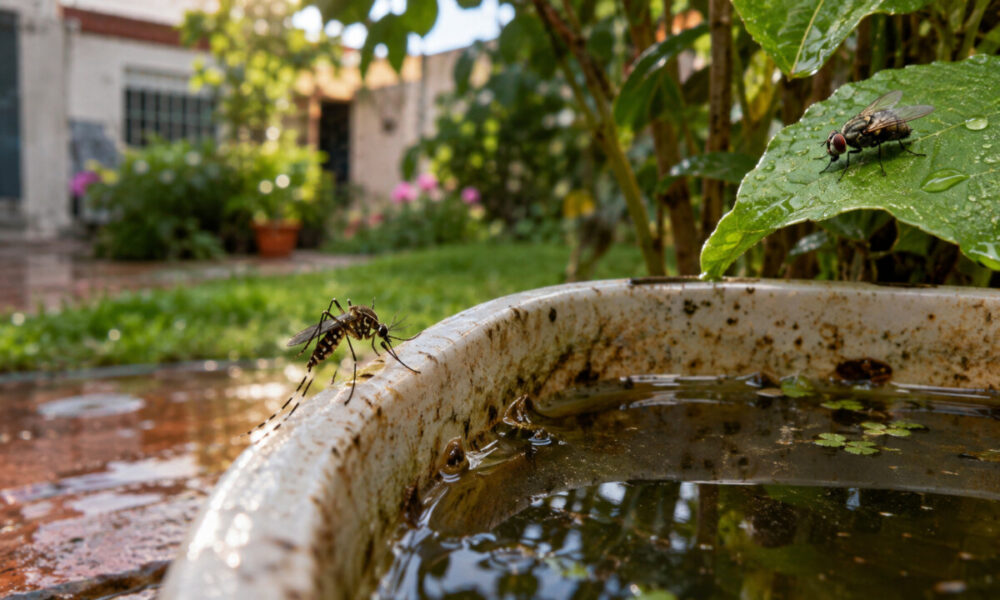
Warmer Temperatures Accelerate Mosquito Cycles, Raising Dengue Risk in Bahía Blanca
Warmer temperatures and persistent humidity are accelerating mosquito reproductive cycles in Bahía Blanca, shortening development from weeks to days and increasing the risk of dengue transmission, La Brújula 24 reported.
Dr. Natalia Stefanazzi, a researcher and professor at the Instituto de Ciencias Biológicas y Biomédicas del Sur (INBIOSUR) and the Universidad Nacional del Sur (UNS), explained that temperature and humidity directly govern the speed of mosquito development, according to La Brújula 24. "Todo el ciclo de desarrollo está íntimamente ligado con la temperatura y la humedad," she told La Brújula 24.
When temperatures exceed 20 degrees Celsius, the cycle compresses dramatically. With temperatures of 10 or 15 degrees, the mosquito might take 20 to 25 days to go from egg to adult, she said.
Dengue vector adapts to cooler regions
The Aedes aegypti mosquito, which transmits the dengue virus, has adapted to areas previously limited by cold weather. “Aedes was a mosquito not present in this area because it couldn’t tolerate the cold,” Stefanazzi said. Research now documents its ability to persist through lower temperatures. Because the species thrives in domestic environments, she said community participation in removing breeding sites is essential.
Fumigation kills adults but leaves eggs and larvae alive
Fumigation kills only adult mosquitoes. "La fumigación es útil para exterminar a los adultos. Los huevos y las larvas no se mueren con los fumigantes," Stefanazzi said. A single female can lay roughly 1,200 eggs in her lifetime under favorable conditions. The mosquitoes exploit tiny containers, including soda bottle caps.
Stefanazzi warned that simply changing water in pet bowls is insufficient. Those containers must be brought inside the house and scrubbed thoroughly with a sponge or brush on all walls, because females glue their eggs to the container walls, she said. Eggs can survive dry periods and hatch when water returns.
Repeated insecticide use breeds resistance and raises indoor health risks
Repeated use of the same chemical molecules has generated resistance in fly and mosquito populations. The chemical molecules of insecticides used for decades are more or less the same, she said. Increasing dosage is not a solution and raises health risks.
She singled out odorless aerosol sprays. "Nosotros, al no olerlo, terminamos vaciando un pote de insecticida en la habitación. Eso termina siendo peor," she said. She recommended following label instructions, leaving treated rooms for the required time, and ventilating before re-entry. The same precautions apply during municipal fumigation campaigns, especially for people with respiratory conditions.
Why mosquitoes prefer some people
Female mosquitoes detect hosts through exhaled carbon dioxide and individual skin chemistry. “We all have a kind of chemical cloud of aromas around our skin that is characteristic of each one of us,” Stefanazzi said. "Hay personas que tienen una nube química que atrae más a los mosquitos y otras que no. Eso es cierto."
Plant repellents vary in efficacy; coils and tablets require careful placement
Plant-based substances such as citronella have documented repellent properties but vary in duration and efficacy compared to tested commercial products, Stefanazzi said. She cautioned against homemade mixtures circulating on social media, which can cause allergies and create a false sense of protection.
She uses mosquito coils outside windows to block entry without filling indoor spaces with smoke, and advised against indiscriminate use of electric tablets in closed rooms. Stefanazzi advocated for integrated pest management — combining preventive tools to reduce populations without relying solely on escalating chemical applications.
Dr. Natalia Stefanazzi, a researcher and professor at INBIOSUR and the Universidad Nacional del Sur, directs a talk on “Mosquitos de importancia sanitaria en nuestra ciudad” scheduled for November 10, 2025, as part of the Ciencia Abierta event in Bahía Blanca.
This public engagement reflects her established role in studying mosquito biology and dengue vector dynamics within the region, a focus she also detailed to La Brújula 24 regarding accelerated reproductive cycles and community-based control strategies.
Mosquitoes serve ecological roles but demand collective control as heat speeds breeding
Mosquito larvae feed aquatic organisms and some species contribute to pollination. "Todo ser vivo forma parte de una cadena trófica," Stefanazzi said. However, species adapted to human environments pose difficult sanitary challenges. For flies, improved waste management is a primary preventive measure.
Stefanazzi concluded that control requires both individual and collective action: fumigation lowers adult numbers but fails if breeding sites persist. With temperatures accelerating reproductive cycles, eliminating standing water, cleaning domestic spaces, and using protective products correctly remain fundamental to reducing presence and preventing disease.