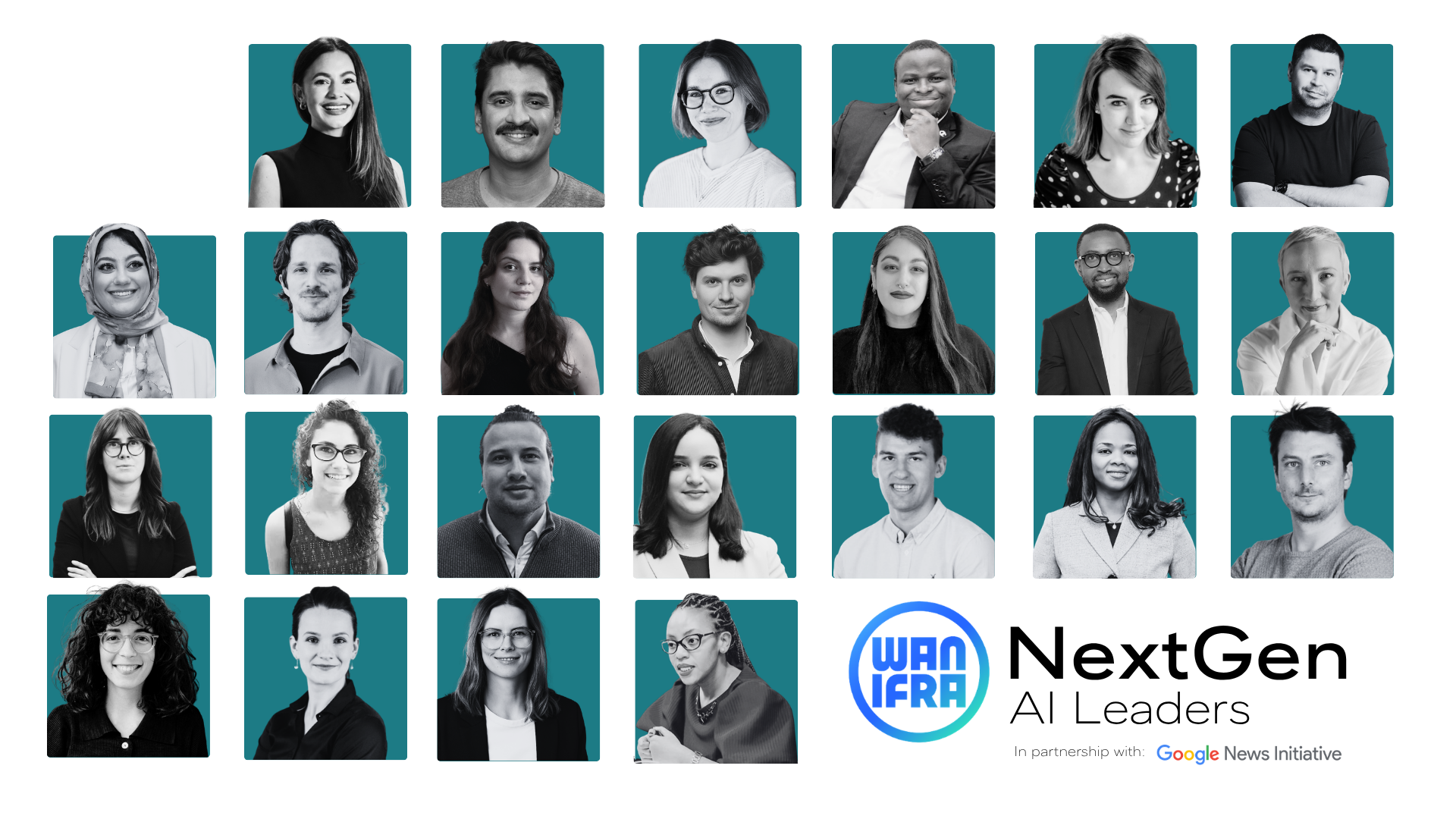
WAN-IFRA Announces First Cohort of NextGen AI Leaders
WAN-IFRA and the Google News Initiative have selected 24 emerging media executives from Europe, the Middle East, and Africa for the NextGen AI Leaders programme. Starting April 14 in Frankfurt, this 12-week tuition-free initiative equips young managers with the skills to drive responsible AI adoption in small and mid-sized newsrooms.
The news industry is currently facing a dangerous divergence. On one side, global media conglomerates possess the capital to build proprietary AI tools and hire armies of data scientists. On the other, local and mid-sized publishers—the actual bedrock of community accountability—are struggling to keep pace. This “innovation gap” isn’t just a technical problem; it is a systemic threat to the diversity of information.
When a small newsroom lacks the leadership to integrate AI responsibly, they don’t just lose efficiency. They lose the ability to compete for audience attention in an algorithmic world.
Bridging this divide requires more than just software. It requires a new breed of “AI-fluent” managers who can balance the raw power of automation with the non-negotiable requirements of journalistic integrity. For many organizations, this transition is a logistical minefield, often requiring the guidance of strategic business consultants to restructure workflows before the first line of code is ever implemented.
Closing the Innovation Gap in EMEA
The NextGen AI Leaders Programme is designed as an “applied experimentation journey.” Rather than theoretical lectures, the 24 selected professionals will tackle real-world management challenges through structured coursework and mentorship. The goal is the creation of tangible AI prototypes and workflows that can be immediately deployed in their respective newsrooms.
The selection process was grueling, with over 100 applications for only 24 spots. The resulting cohort represents 14 different countries, spanning from Finland to South Africa. This geographic diversity is intentional. AI adoption in a German regional paper looks highly different from AI adoption in a Nigerian national daily, yet both face the same existential pressure: how to evolve without losing the trust of the reader.
“To take full advantage of the opportunities AI provides news publishers, we need a strong and diverse leadership today and especially tomorrow,” says Stig Ørskov, CEO of WAN-IFRA. “WAN-IFRA is proud to support those rising through the ranks to lead the charge in using AI to ensure journalistic excellence and resilient news media businesses.”
This resilience is not accidental. By targeting executives aged 25 to 40 in product, audience, commercial, and editorial roles, the programme recognizes that AI is not an “IT issue.” It is a leadership issue. Implementing these tools often requires navigating complex regional regulatory environments, leading many publishers to seek media law firms to ensure their AI-driven processes comply with evolving transparency and copyright laws.
The Human Element: Meet the Pioneers
The diversity of the cohort is a testament to the multidisciplinary nature of modern journalism. These are not just editors; they are data scientists, product owners, and business development managers.

For some, the focus is on the narrative. Asmaa Hechenberger of Ippen Digital in Germany views the programme as an opportunity to “explore how artificial intelligence can empower better storytelling, decision-making and impact.” For others, the priority is the ethical guardrail. Samson Folarin, an editor at PUNCH in Nigeria, emphasizes the need for a “clearer framework for the ethical utilize of AI… Particularly around issues of accuracy and transparency.”
Folarin’s concern highlights the primary friction point of the AI era: the tension between speed and credibility. When accuracy is compromised, the brand is destroyed. What we have is why many newsrooms are now investing in AI compliance consultants to audit their automated systems for bias and hallucination.
The first cohort of NextGen AI Leaders includes:
- Amata Bosco, Digital Business Manager, Mwananchi Communications Limited, Tanzania
- Anja Wölker, Head of Audio, FUNKE Medien NRW, Germany
- Asmaa Hechenberger, Head of Data & Analytics, Ippen Digital, Germany
- Benjamin Knödler, Product Owner Digital, der Freitag Mediengesellschaft, Germany
- Chibuike Alagboso, Director of Media Programmes, Nigeria Health Watch, Nigeria
- David Balagna, Product Lead, Contexte, France
- Georg Eckelsberger, Editor in Chief, DOSSIER, Austria
- Jan Stanisławski, Head of Newsroom 24, Ringier Axel Springer, Poland
- Johanna Heckeley, Head of Digital Desk, Medienhaus Trierischer Volksfreund, Germany
- Kelly Anderson, Food Editor, News24, South Africa
- Laia Seró, Digital Managing Editor, Diari ARA, Spain
- Laura Rodríguez, CRO & Acquisition Manager, elDiario.es, Spain
- Lena Leibetseder, Head of Digital Publishing, Russmedia, Austria
- Manal El Guerrab, Commercial Executive – Product and Service Development, Maghreb Arabe Press, Morocco
- Marc Jänig, AI Transformation Manager, Rheinische Post Mediengruppe, Germany
- Márta Kovács, Senior News Editor, 24.hu, Hungary
- Milla Kukkonen, Executive Producer & Audience Manager, A-lehdet, Finland
- Natalia Maragkou, Art Director, Alter Ego Media Group, Greece
- Oumaima Hali, Manager Data and AI, Médias24, Morocco
- Samson Folarin, Editor, Weekend PUNCH, Nigeria
- Shirin Shity, Senior Marketing Manager, Project Syndicate, Czech Republic
- Simon Owens, Strategy Manager, The Irish Times Group, Ireland
- Sina Söhren, Deputy Head Team GenAI, Frankfurter Allgemeine Zeitung, Germany
- Stanislas de Livonnière, Head of AI, Data & Innovation, Le Parisien, France
Mentorship and the Path to Fluency
The journey begins on April 14 at the WAN-IFRA Frankfurt AI Forum and will culminate with a potential appearance at the World News Media Congress in Marseille this June. The curriculum is backed by the Google News Initiative (GNI), which provides expert-led training on Google’s AI products and their specific application within newsroom functions.

The cohort will be guided by a trio of seasoned experts: Anita Zielina, Patrick Swanson, and Kaveh Waddell. Their role is to move these managers beyond the “hype” of AI and into the realm of sustainable business outcomes. This involves building “personalized leadership roadmaps” that ensure innovation does not reach at the cost of editorial integrity.
“As people’s preferences and technology evolve, we are continuing our long-standing commitment to helping journalists and publishers adapt to these types of shifts,” says Jaffer Zaidi, VP Global News Partnerships at Google. “Our latest collaboration with WAN-IFRA builds on years of partnership, now focusing on upskilling the next generation of news leaders to use AI tools for deeper audience engagement and digital storytelling.”
For the participating newsrooms, the impact will be felt in the transition from manual to automated workflows. But, the technical shift is only half the battle. The real challenge lies in organisational change management—convincing a legacy newsroom to trust a machine’s efficiency while maintaining a human’s judgment. This cultural shift often requires the expertise of AI implementation specialists who can bridge the gap between technical capability and staff adoption.
The NextGen AI Leaders programme is more than a training course; it is a strategic hedge against the homogenization of news. If only the largest players master AI, the nuance of local reporting will vanish. By empowering 24 rising stars across EMEA, WAN-IFRA is ensuring that the future of journalism remains as diverse as the audiences it serves. The race for AI fluency has begun, and for the local newsroom, the stakes are nothing less than survival. As these leaders return to their desks with new prototypes and roadmaps, the industry will be watching to observe if the “innovation gap” can truly be closed. To find the verified professionals and digital transformation experts capable of navigating this transition, explore the full World Today News Directory.
Keep reading
- FC Seoul prepares to resume championship pursuit against Jeju SK, says sportschosun.com
- Strategic Autonomy Reshaping Diplomacy, Analysis by The Diplomatic Insight Says
- Han Kuo-yu Credits Semiconductor Growth and Past Leaders at National Day Event (time.news)
- Delhi opposition leaders condemn police security crackdown on CJP protest (archyde.com)