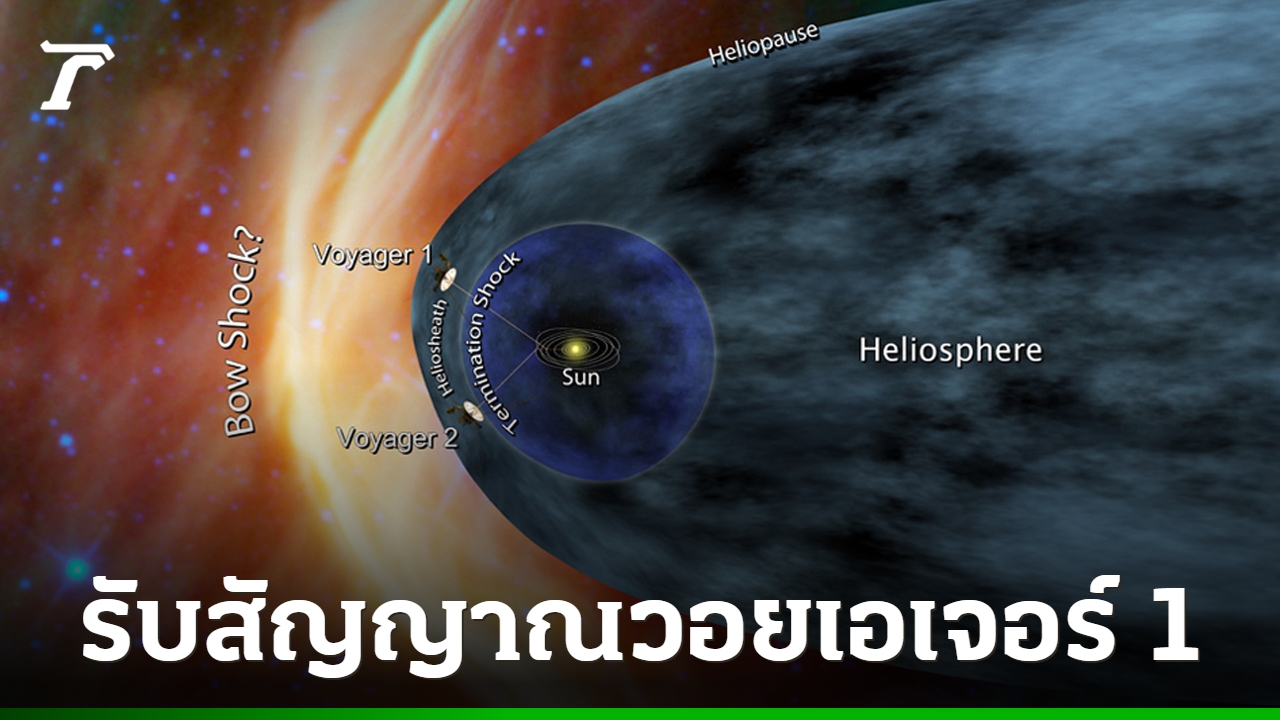
Voyager 1 Reaches One Light-Day From Earth, NASA Says
Voyager 1 reached a historic milestone on Wednesday becoming the first human-made object to travel one light-day away from Earth.
This distance, spanning approximately 26 billion kilometers, signifies a new chapter in the nearly 50-year-old mission.
The spacecraft, launched in 1977, now operates in interstellar space, a region it entered in 2012 after passing the outer limits of the sun’s influence. Because of the vast distance, radio signals traveling at the speed of light require a full 24 hours to reach the probe, according to NASA officials. Consequently, ground controllers must wait 48 hours for a complete round-trip communication, [BT beartai] reported.
“Voyager continues to set new records, pushing boundaries,” said Nicky Fox, a NASA official. The probe’s longevity remains a point of focus for mission managers at the Jet Propulsion Laboratory (JPL) in California. While the spacecraft has powered down most of its original scientific instruments to conserve energy, it continues to transmit data regarding cosmic rays, magnetic fields, and plasma waves, [Vietnam.vn] noted.
NASA invited the public to participate in a global celebration dubbed “Shine Bright for Voyager’s Light-Day.”
The agency encouraged people to use mobile devices to flash light signals in Morse code, representing the craft’s call sign, VGR, toward the night sky, [Trueid] reported. Participants can use a dedicated NASA web portal to synchronize these signals, which the agency aims to process into a collective image of Earth bathed in golden light, [Letem světem Applem] explained.
Despite the celebration, the mission faces ongoing technical challenges. Engineers have been systematically disabling older instruments to extend the operational life of the remaining sensors.
Susan Dodd, director of the Voyager program, said that while the current power supply—provided by decaying radioactive plutonium—is expected to support research through the mission’s 50th anniversary next year, the future beyond that remains difficult to predict, [Vietnam.vn] reported.
The spacecraft is currently on a trajectory that will bring it within 1.7 light-years of the star Gliese 445 in approximately 40,000 years. For now, the mission team continues to monitor the probe’s path through the sparse environment of interstellar space, waiting for the next data transmission from the edge of human reach.
More on Earth
Just 34 minutes before its cameras were turned off in 1990, Voyager 1 captured this iconic view of Earth – a pale blue dot in the vastness of space. Today, Voyager 1 is one light-day away from Earth. A little piece of our planet journeying through interstellar space. 🌎💙 pic.twitter.com/HOlmoKK4P6