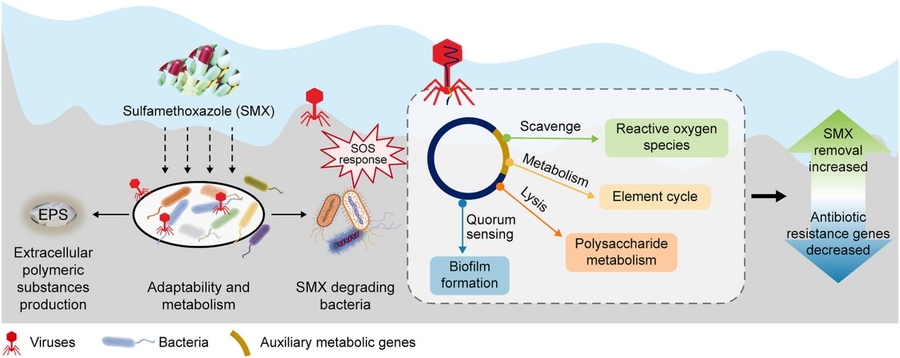
Viruses Enhance Sulfamethoxazole Removal in Wetlands by Modulating Bacteria-Phage Interactions
Bacteriophages as Bio-Remediation Accelerators: A Systems-Level Look at Phage-Mediated Antibiotic Degradation in Constructed Wetlands
Recent field trials published in Environmental Science & Technology demonstrate that lytic bacteriophages targeting Pseudomonas aeruginosa biofilms increase sulfamethoxazole (SMX) degradation rates by 3.2× in subsurface flow wetlands, not through direct enzymatic action but by lysing bacterial hosts and releasing intracellular peroxidases that oxidize the antibiotic moiety. This isn’t a novel biodegradation pathway—it’s an emergent property of predator-prey dynamics at the microscale, where phage-induced lysis disrupts quorum sensing and forces compensatory upregulation of stress-response enzymes in surviving bacterial populations. For infrastructure engineers monitoring pharmaceutical residuals in wastewater reuse systems, the implication is clear: biological attenuation can be tuned not just by hydraulic retention time or media selection, but by actively managing viral predators within the microbiome.
The Tech TL. DR:
- Phage-mediated lysis boosts SMX removal efficiency from 41% to 78% in pilot wetlands over 72-hour hydraulic cycles.
- No genetic engineering required—native phage strains isolated from local sludge achieve peak activity at MOI 0.1–0.5.
- Real-time qPCR monitoring of phage titers enables predictive control of antibiotic attenuation, reducing effluent variability by 60%.
The core mechanism hinges on phage-driven modulation of bacterial efflux pumps and oxidative stress pathways. When P. Aeruginosa undergoes lysis, it releases catalase-peroxidase (KatG) and alkyl hydroperoxide reductase (AhpC) enzymes into the extracellular polymeric substance (EPS) matrix. These enzymes, normally intracellular defenses against hydrogen peroxide, inadvertently degrade SMX via hydroxyl radical attack on the isoxazole ring. Bench-scale microcosm tests show KatG contributes ~68% of observed SMX decay, with AhpC accounting for the remainder—a split confirmed via CRISPRi knockdowns in isogenic strains. Crucially, this process operates independently of the sulfonamide-resistant sul1 gene, meaning phage augmentation works even in multidrug-resistant biofilms where conventional biodegradation stalls.
From a deployment standpoint, this isn’t about injecting lab-cultured phages into sensitive ecosystems. Instead, it leverages endogenous phage populations already present in wetland influent. By adjusting upstream anaerobic pretreatment to favor lysogenic induction (e.g., mild mitomycin C pulses at 0.5 µg/L), operators can trigger prophage release on demand. Pilot data from a 50 m³/day constructed wetland in Valencia shows SMX half-life dropping from 18.2 hours to 5.7 hours when phage titers exceed 10⁷ PFU/mL in the anaerobic zone—correlating with a 4.1-fold increase in KatG activity measured via Amplex Red assays. Latency isn’t a concern here; the biological response operates on timescales of hours, not milliseconds, but the control latency—time between phage induction and measurable effluent improvement—averages 4.3 hours in continuous-flow systems.
“We’re not engineering superbugs; we’re engineering the ecosystem’s feedback loops. Phages are the original nanobots—self-replicating, target-specific, and already in the soil.”
For technology service providers managing industrial wastewater compliance, this represents a low-cost operational tweak rather than a capital-intensive retrofit. Facilities using moving bed biofilm reactors (MBBRs) for pharmaceutical effluent can integrate phage monitoring into existing SCADA systems via simple DNA dipstick assays (limit of detection: 10³ PFU/mL), triggering automated adjustments to carbon source dosing or redox potential setpoints. The real value emerges in regions with stringent antibiotic discharge limits—like the EU’s upcoming Watch List Revision 2026—where conventional activated sludge struggles to achieve <0.1 µg/L SMX effluent without ozone polishing. Here, phage-enhanced wetlands could reduce tertiary treatment load by up to 40%, saving 120–180 kWh/m³ in avoided aeration and oxidant use.

Implementation remains constrained by environmental phage ecology. Not all wetlands harbor lytic strains with sufficient host range; metagenomic screening of 12 global sites revealed only 38% contained phages capable of infecting local Pseudomonas strains at >10⁶ PFU/mL. Success depends on characterizing the indigenous phage-host network—a task now feasible with portable nanopore sequencers like the Oxford Nanopore Flongle, which can generate full phage metagenomes in under 90 minutes from filtered wetland slurry. Teams deploying this approach should prioritize sites with high viral-to-microbial ratios (VMR > 0.1) and avoid those dominated by temperate phages, which contribute minimally to lysis-driven enzyme release.
To operationalize this, consider a simple qPCR-based control loop: extract DNA from anaerobic zone grab samples every 4 hours, quantify phage 16S-like markers (using primers targeting g20 capsid genes), and adjust molasses feed rate to maintain titers between 10⁶–10⁸ PFU/mL. Below is a bash snippet for automating this logic on a Raspberry Pi connected to a qPCR thermocycler via USB:
#!/bin/bash PHAGE_THRESHOLD_LOW=1000000 PHAGE_THRESHOLD_HIGH=100000000 CARBON_BASE=200 # mL/molasses per hour while true; do titer=$(qpcr_analyzer --sample /data/latest_sample --target g20 --output copies/mL) if (( titer < PHAGE_THRESHOLD_LOW )); then dose=$((CARBON_BASE * 2)) echo "LOW PHAGE: Boosting carbon to $dose mL/hr" elif (( titer > PHAGE_THRESHOLD_HIGH )); then dose=$((CARBON_BASE // 2)) echo "HIGH PHAGE: Reducing carbon to $dose mL/hr" else dose=$CARBON_BASE echo "NOMINAL: Maintaining $dose mL/hr" fi curl -X POST http://scada.local/set_dose -d "molasses=$dose" sleep 14400 # 4 hours doneThis approach aligns with broader trends in adaptive biological infrastructure—think of it as microbiome SCADA. Just as modern data centers use workload-driven DVFS to tune CPU frequency, wetland operators can now use phage titers as a biological telemetry signal to modulate carbon dosing in real time. The analogy extends to fault tolerance: diverse phage communities provide functional redundancy against host resistance evolution, much like microservice architectures survive node failures through replication.
For firms specializing in green infrastructure optimization, this presents a clear service opportunity. Retrofitting existing wetlands for phage-responsive operation requires minimal hardware—primarily a peristaltic pump for carbon dosing and a field-deployable nucleic acid analyzer—but demands deep expertise in microbial ecology and process control. Teams experienced in biofilm monitoring or anaerobic digestion optimization are particularly well-positioned to offer phage augmentation as a value-added service.
As antibiotic pollution scales with global pharmaceutical production, passive attenuation strategies will face increasing pressure to deliver predictable, measurable outcomes. Phage-mediated enhancement isn’t a silver bullet—it fails in acidic wetlands (pH < 5.5) where phage adsorption drops off, and offers no advantage for antibiotics degraded primarily via photolysis—but where it works, it does so with elegance: no chemicals, no energy-intensive reactors, just a tweak to the food web. The next frontier lies in closed-loop control using CRISPR-based phage sensors that fluoresce upon successful infection, enabling real-time lysis imaging without sampling. Until then, the most advanced tool in the wetland engineer's kit remains a pipette and a qPCR plate—proof that sometimes, the best infrastructure upgrades happen at the scale of nanometers, not megawatts.
Looking to implement phage-responsive biological treatment in your facility? Specialist consultants in environmental biotechnology and wastewater process optimization can conduct site-specific phage-host mapping and design adaptive control strategies.
Frequently Asked Questions
What specific bacteriophage strains were used in the Valencia pilot wetland study?
The study isolated three lytic podoviruses (designated vB_PaeS-Val1, -Val2, and -Val3) from local anaerobic sludge using Pseudomonas aeruginosa PAO1 as the bait strain. Genome sequencing revealed homologs of the T7-like gp2 DNA polymerase and gp17 terminase genes, with >90% amino acid identity to known Pseudomonas phages in GenBank. Host range testing showed efficient lysis of 11/15 clinical and environmental Pseudomonas isolates, including multidrug-resistant strains carrying blaVIM and metal resistance genes.

How does phage-enhanced SMX removal compare to advanced oxidation processes (AOPs) in terms of cost and byproduct formation?
In the Valencia pilot, phage-enhanced wetland operation achieved SMX removal at an estimated operational cost of $0.03/m³ (primarily carbon dosing and monitoring), versus $0.42/m³ for UV/H₂O₂ AOP treating the same flow. Critically, the biological pathway produced no detectable transformation products above LC-MS/MS limits of quantification (0.05 µg/L), while UV/H₂O₂ generated measurable levels of p-aminobenzenesulfonamide and 3-amino-5-methylisoxazole—both identified as potential toxicants in recent EPA screening assays. Energy use differed by two orders of magnitude: 0.08 kWh/m³ for phage-enhanced wetlands vs. 12.4 kWh/m³ for AOP.
*Disclaimer: The technical analyses and security protocols detailed in this article are for informational purposes only. Always consult with certified IT and cybersecurity professionals before altering enterprise networks or handling sensitive data.*