
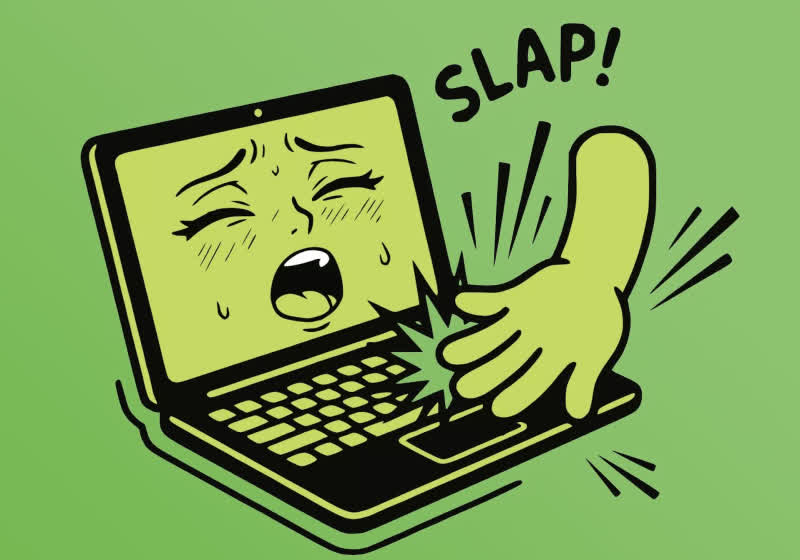
Viral App Makes MacBook Moan When Slapped
The Physics of Prankware: Why Your MacBook’s Accelerometer Shouldn’t Be Triggering Audio Events
The internet has a short attention span, and currently, it is fixated on a piece of software that turns physical abuse of hardware into an auditory gag. A viral application, originating from a social media stunt by creator Catapano, now allows users to “slap” their MacBook to trigger a moaning sound effect. Even as the surface-level narrative is one of harmless viral humor, from a systems architecture perspective, this represents a concerning normalization of high-frequency sensor polling and physical hardware stress testing disguised as entertainment.
The Tech TL;DR:
- Resource Overhead: Continuous accelerometer polling via Core Motion prevents the SoC from entering low-power idle states, impacting battery life on Apple Silicon.
- Hardware Risk: Kinetic shock from “slapping” a laptop exceeds the design tolerance for consumer-grade SSDs and logic board solder joints.
- Enterprise Vector: Unsigned binaries utilizing motion sensors bypass standard MDM restrictions, creating a potential side-channel for data exfiltration in secure environments.
The underlying mechanism relies on Apple’s Core Motion framework, specifically the CMMotionManager class. To achieve the sub-100ms latency required to sync the audio cue with the physical impact, the application cannot rely on interrupt-driven events alone; it must engage in active polling of the accelerometer and gyroscope data streams. In a production environment, this level of sensor access is typically reserved for fitness tracking or fall detection algorithms, not novelty audio triggers.
The Kinetic Cost of Viral Engagement
From a hardware reliability standpoint, the premise is flawed. Modern MacBooks, particularly those utilizing the M-series Apple Silicon architecture, are designed for stationary or mobile operation, not kinetic impact. The NVMe SSDs inside these chassis, while more robust than spinning rust, are still susceptible to micro-fractures in solder joints under repeated shock. Encouraging users to physically strike their primary workstations introduces a variable that authorized repair technicians see all too often: logic board flex and connector failure.
the software implementation likely bypasses standard power management optimizations. When an app requests high-frequency updates from the motion coprocessor, it prevents the CPU cluster from downclocking effectively. We are looking at a potential increase in background energy consumption that, while negligible for a five-minute demo, becomes significant if the app remains resident in the background. This represents a classic example of “vapor-feature” development where user engagement metrics are prioritized over thermal design power (TDP) efficiency.
“We are seeing a trend where novelty apps request elevated privileges for sensor arrays that simply aren’t necessary for their stated function. It’s a privacy and security gray area. If an app can detect a slap, it can theoretically detect keystroke vibration patterns.” — Elena Rostova, Senior Security Researcher at Sentinel One Labs
Architectural Breakdown: Sensor Polling vs. Interrupts
To understand the technical debt introduced by this application, we must look at how iOS and macOS handle motion data. The optimal approach for battery efficiency is to use the startAccelerometerUpdates method with a specific CMHandler queue, allowing the system to manage the sampling rate. But, viral apps often push the accelerometerUpdateInterval to the minimum (0.01s) to ensure the “slap” is caught instantly. This forces the Neural Engine and CPU to remain in a higher power state.
Below is a simplified representation of how a developer might implement this high-frequency polling in Swift, illustrating the resource intensity required to make the “moan” trigger reliably:
import CoreMotion import AVFoundation class SlapDetector { let motionManager = CMMotionManager() let audioPlayer = AVAudioPlayer() func startListening() { motionManager.accelerometerUpdateInterval = 0.01 // High frequency polling motionManager.startAccelerometerUpdates(to: .main) { data, error in guard let acceleration = data?.acceleration else { return } // Threshold detection for "Slap" (Z-axis spike) if acceleration.z > 2.5 { self.triggerAudio() } } } func triggerAudio() { // Audio playback logic here print("Kinetic threshold exceeded. Playing asset.") } }This code snippet highlights the aggressive polling interval. In an enterprise setting, an application running this loop in the background without user interaction would be flagged by behavioral analysis tools as anomalous. It mimics the behavior of malware attempting to detect physical tampering or sandbox evasion.
The Enterprise Security Implication
While the current iteration is a gag, the precedent it sets is dangerous for IT security teams. If a user can install an app that listens to hardware accelerometers, the door is open for more sophisticated attacks. Sensor-based side-channel attacks have been proven feasible in academic research, where accelerometer data is used to reconstruct keystrokes or infer screen content based on vibration.
For CTOs and IT directors, this highlights a gap in endpoint security. Standard antivirus solutions often ignore sensor permission usage. To mitigate this, organizations necessitate to enforce stricter Mobile Device Management (MDM) profiles that restrict access to the NSMotionUsageDescription key in the app’s Info.plist for non-essential applications. Without these controls, “prankware” can easily slip through the perimeter, consuming resources and potentially acting as a beacon for more malicious payloads.
Comparative Analysis: Novelty vs. Utility
When evaluating this against legitimate utility apps, the distinction becomes clear. Legitimate motion-based apps, such as those used for calibration or fitness, utilize the CMDeviceMotion object which provides fused data (accelerometer, gyroscope, magnetometer) processed by the system to reduce noise. The viral “slap” app likely relies on raw accelerometer data to catch the sharp spike of a physical impact, sacrificing accuracy and power efficiency for reaction time.
| Feature | Viral “Slap” App | Enterprise Calibration Tool |
|---|---|---|
| Polling Interval | 0.01s (Aggressive) | 0.1s – 1.0s (Optimized) |
| Power State | Prevents Deep Idle | Cooperates with PMU |
| Data Source | Raw Accelerometer | Fused Device Motion |
| Sandboxing | Often Loose/Exempt | Strict Entitlements |
The viral nature of this app serves as a stress test for Apple’s App Store review guidelines regarding “user harm” and “device integrity.” While currently categorized as entertainment, the technical requirements to make it work efficiently border on invasive. As we move toward a future where our devices are increasingly aware of their physical environment, the line between “smart features” and “surveillance vectors” will continue to blur.
the cost of this viral moment isn’t just the download time; it’s the normalization of treating expensive, sensitive computing hardware as a percussion instrument. For those who have already subjected their machines to this test and are now experiencing trackpad unresponsiveness or screen flickering, the solution isn’t a software patch—it’s a visit to a certified hardware repair specialist to assess potential internal damage.
Disclaimer: The technical analyses and security protocols detailed in this article are for informational purposes only. Always consult with certified IT and cybersecurity professionals before altering enterprise networks or handling sensitive data.