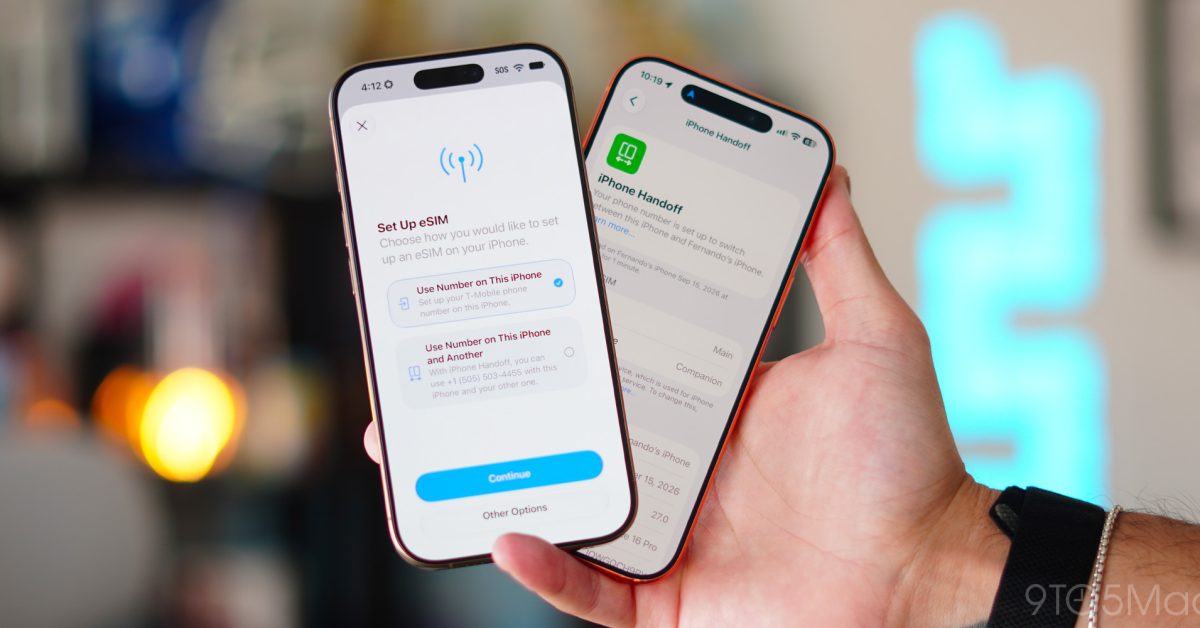
Verizon to Charge $10 Monthly for iPhone Handoff Feature
Verizon confirmed it will charge $10 per month for Apple’s new iPhone Handoff feature, making its price twice that of competing carriers as regional pricing structures emerge for the iOS 27 capability.
-
The Tech TL;DR:
- Verizon priced iPhone Handoff at $10 monthly for running compatible iPhones on iOS 27.
- T-Mobile previously confirmed a $5 monthly fee, while Deutsche Telekom routes the feature through its €6.95 MultiSIM service.
- AT&T has no current plans to support the feature, directing users toward standard eSIM options instead.
Verizon Charges Double the T-Mobile Monthly Fee
The feature was first previewed at WWDC and detailed further during Apple’s event last month, where Apple announced initial support from T-Mobile and Deutsche Telekom. Following those announcements, T-Mobile confirmed a $5 monthly fee for iPhone Handoff, according to reports. Deutsche Telekom made the functionality available through its existing MultiSIM service priced at €6.95 per month unless included in a subscriber’s base plan. Macrumors reported that Verizon’s newly confirmed rate of $10 per month sits at double T-Mobile’s price point.
Verizon Will Charge $10 a Month for iPhone Handoff https://t.co/MhpITloXpn pic.twitter.com/O1V81zvSBx
AT&T has taken a different approach entirely. When CNET asked about the feature last month, the carrier acknowledged potential benefits but stated it remains focused on existing eSIM activation and transfer options rather than supporting iPhone Handoff.
Verizon Allows One Number Across Two Compatible iPhones
Verizon outlined how the functionality operates across subscriber accounts, stating the service lets customers use a single phone number across two compatible iPhone models. Whether a user operates a pocketable secondary device on the go or an iPhone 18 Pro for work, active status switches between devices at any time while maintaining full access to the carrier’s 5G network.
Verizon confirms $10 monthly fee for new iPhone Handoff feature https://t.co/34QGwn8UKo by @mvcmendes
Technical deployment relies on compatible hardware running current system software, though carrier-side provisioning dictates the recurring operational overhead for end users.
Disclaimer: The technical analyses and security protocols detailed in this article are for informational purposes only. Always consult with certified IT and cybersecurity professionals before altering enterprise networks or handling sensitive data.