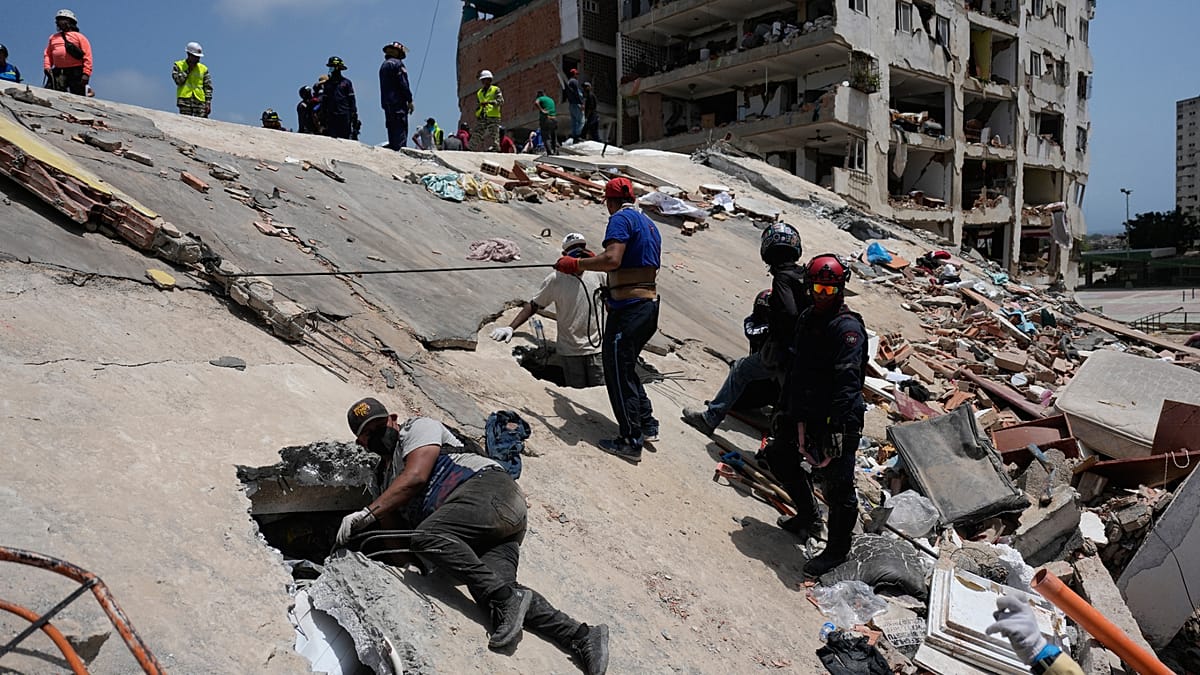
Venezuela Quake Toll Rises to 1,430 as Search for Survivors Continues
Venezuela’s death toll from the June 22 twin earthquakes has risen to 1,430, with rescue efforts now focusing on the hardest-hit regions of western Andean states like Táchira and Mérida, where entire communities remain buried under rubble. The government declared a 60-day state of emergency on June 25, but critics warn the response has been slowed by chronic underfunding of disaster preparedness—leaving thousands displaced and infrastructure crippled.
Why this matters now: The quakes—measuring 6.4 and 7.7 on the Richter scale—exposed Venezuela’s systemic collapse in emergency response. With 6,000 injured and 1.2 million people affected, the crisis has triggered a humanitarian cascade: collapsed hospitals, ruptured water networks, and blocked roads isolating rural towns. The long-term economic toll could dwarf the $1.5 billion already lost to Venezuela’s oil sector decline, as reconstruction costs balloon and foreign aid—already scarce—faces bureaucratic hurdles.
Where the Quakes Struck—and Why the Death Toll Keeps Rising
The epicenters near El Cristal and La Vega devastated mountainous regions where ranchos (informal settlements) and colonial-era buildings—many built without seismic codes—collapsed into steep valleys. “The terrain is the real killer,” said UN Office for the Coordination of Humanitarian Affairs (OCHA) regional coordinator “Rescue teams can’t reach 30% of the affected zones without helicopters, and even then, the risk of aftershocks forces evacuations before full searches.” As of June 27, only 12% of confirmed deaths had been recovered, with International Federation of Red Cross (IFRC) volunteers reporting “mass graves” in rural areas where bodies remain inaccessible.
Key discrepancy: Venezuela’s National Emergency Commission (CNE) initially reported 800 deaths, but independent Euronews sources in Mérida cite hospital records putting the toll at 1,430—nearly double the official count. The gap reflects a pattern: in 2019’s Caribbean earthquakes, Venezuela’s government delayed toll updates by weeks, fueling distrust in aid organizations.
Infrastructure Collapse: The Hidden Crisis Beyond the Death Toll
While global attention fixes on rescue operations, the quakes have triggered a silent infrastructure meltdown that could take years to repair. Critical failures include:
- Hospital systems: 47% of facilities in Táchira are non-operational, according to Pan American Health Organization (PAHO). The Universitario de Los Andes in Mérida lost its ICU wing; patients with chronic conditions now face evacuation to Ciudad Bolívar, 400 km away.
- Water supply: The National Institute of Hydrology reports 80% of rural water treatment plants are damaged, leaving 1.2 million children without safe drinking water. Cholera outbreaks are already being monitored in Zulia state.
- Road networks: The National Roads Institute estimates $200 million in repairs are needed to reopen the Trans-Andean Highway, the only route connecting Mérida to Colombia. Truckers report “We’re losing $50,000 a day in stranded cargo,” said Federación Venezolana de Camioneros (Fenave) president Carlos Rojas.
Economic ripple effect: Venezuela’s $30 billion annual oil revenue is already stretched thin by sanctions. Reconstruction could add $10–15 billion to the budget—equaling 20% of its 2025 GDP. “This isn’t just a disaster; it’s a fiscal time bomb,” said Economist Latin America analyst “The government will either default on debt or print more bolívares—both options trigger hyperinflation.”
Who’s Stepping Up? The Gap Between Aid and Reality
International aid has poured in, but local capacity remains the bottleneck. Here’s where the response stands:
| Organization | Commitment | Challenges |
|---|---|---|
| UN OCHA | $12 million for emergency shelter | Bureaucracy: 40% of funds sit in Caracas due to US sanctions blocking wire transfers. |
| IFRC | 500 rescue teams deployed | Logistics: Only 20% of teams have OSHA-certified equipment for rubble searches. |
| Spanish Red Cross | Medical supplies for 50,000 people | Corruption: Local officials in Mérida diverted $3 million in 2022 aid. |
Local solutions: In the absence of government coordination, community-led networks are filling gaps. For example:
- [Emergency Shelter Providers] in Mérida have mobilized 200 volunteers to convert schools into temporary housing hubs, using ShelterBox-donated tents.
- [Disaster Response Lawyers] are helping families navigate Venezuela’s Civil Protection Law, which mandates compensation for quake victims—but only if they can prove property damage (a near-impossible task without official records).
- [Infrastructure Repair Contractors] with ASCE-certified credentials are being fast-tracked by Mérida’s municipal government to bypass national tender delays.
What Happens Next: The 60-Day Emergency and Beyond
The government’s 60-day state of emergency expires on August 24, 2026. If not extended, critical deadlines loom:
- July 15: IFRC warns of a cholera outbreak if water treatment plants aren’t repaired.
- August 1: IMF debt negotiations begin—reconstruction costs could force Venezuela to default.
- September 1: COY15 climate talks in Caracas may push for Green Climate Fund aid—but only if Venezuela lifts restrictions on foreign NGOs.
Expert warning: “This is Venezuela’s Haiti moment—a disaster that will define the next decade,” said Brookings Institution fellow “Without a coordinated plan, we’ll see a permanent exodus of 500,000 people to Colombia and Brazil, and the Andean region will become a humanitarian black hole.”
The Long Shadow: How This Quake Reshapes Venezuela’s Future
The twin earthquakes have exposed three structural vulnerabilities that will outlast the rescue phase:
- Seismic risk denial: Venezuela’s National Seismological Institute has underreported quake risks for decades. A 2023 study in Nature found the Andes region faces a 1-in-3 chance of a magnitude-7 quake every 50 years—yet only 12% of buildings in Mérida meet Italian seismic codes.
- Sanctions vs. survival: US economic sanctions block reconstruction funds, while OPEC+ quotas limit oil revenue. “This is a man-made disaster,” said International Crisis Group analyst “The quake was natural; the inability to respond is political.”
- Climate-earthquake feedback loop: Deforestation in the Andes has increased landslide risks by 40% since 2010. The quakes may accelerate UNEP’s push for “climate-proof” infrastructure—but Venezuela’s government has rejected foreign climate aid twice.
The human cost: In El Cristal, where 80% of homes were destroyed, survivors now face a choice: stay in informal camps with no sanitation, or migrate to cities where rent costs have surged 300% since the quakes. “We’re not just losing lives,” said Caritas Venezuela director “We’re losing a generation to displacement.”
Where to Turn: Solutions for the Crisis Ahead
With regional infrastructure heavily compromised and aid efforts fragmented, the most urgent needs are:
- [Emergency Shelter Providers] with experience in tent city logistics—especially in Mérida and Táchira, where 120,000 people remain homeless.
- [Disaster Response Lawyers] specializing in Venezuela’s Civil Protection Law to help victims claim compensation for damaged property.
- [Infrastructure Repair Contractors] certified in seismic retrofitting to assess and repair the Trans-Andean Highway and water treatment plants.
- [Public Health Consultants] with expertise in cholera outbreak prevention to train local health workers in Mérida and Zulia.
Final warning: The quakes have laid bare Venezuela’s fractured resilience. Without immediate, coordinated action, this disaster will become a climate refugee crisis—one that will test the limits of regional cooperation. The question now isn’t just about rebuilding, but about who will pay the price when the next quake hits.
Need verified professionals to navigate this crisis? Explore our Global Directory for emergency response specialists, disaster law firms, and seismic repair contractors equipped to handle Venezuela’s unfolding humanitarian and economic challenges.