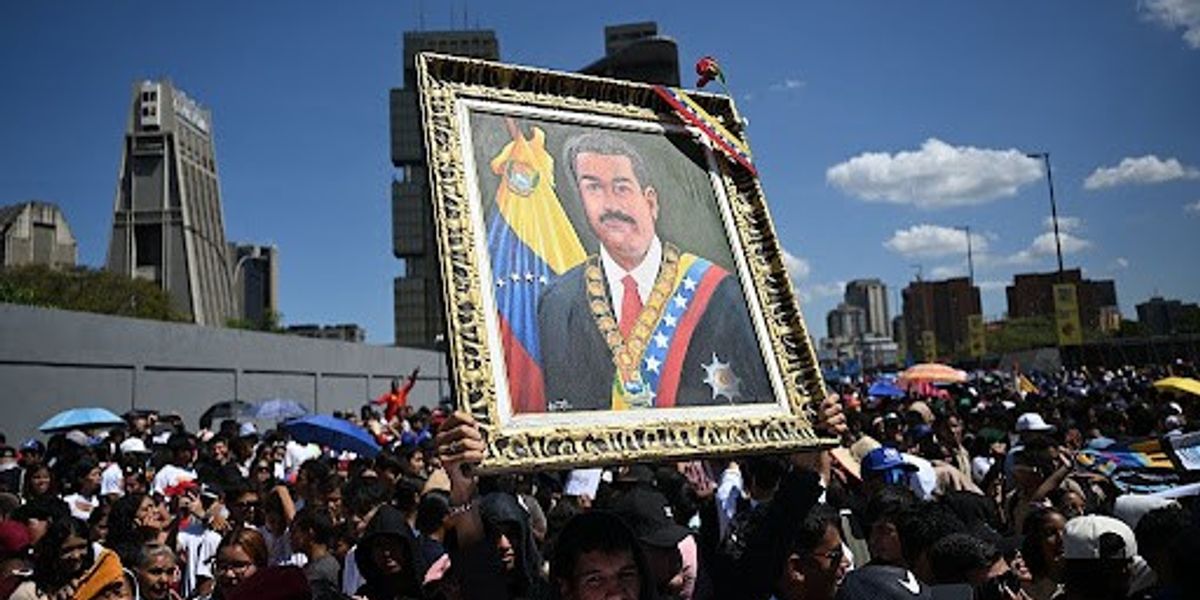
Venezuela: Maduro’s Ouster Masks Entrenched Authoritarian Control & Delayed Elections
The overnight capture of Venezuelan President Nicolás Maduro by unidentified forces in Caracas has left the country in a state of uncertainty, with the Supreme Court invoking a controversial constitutional mechanism to avoid immediate elections. Rather than triggering a vote as Venezuelan law dictates, the court declared Maduro’s removal a temporary absence, allowing Vice President Delcy Rodríguez to govern indefinitely without a popular mandate.
“The regime used a legal mechanism to maintain institutional control while avoiding an immediate electoral process,” Mauricio Vaquero, country coordinator for María Corina Machado’s Vente Venezuela party in Colombia, told The Cipher Brief. “The Supreme Court decided she would assume as interim president, but a Chavista Supreme Court, not the democratic legal one.”
The move underscores the continued influence of loyalist judges who previously supported Maduro, effectively circumventing the democratic process. The security apparatus that sustained Maduro’s rule remains largely unchanged, with Interior Minister Diosdado Cabello, who remains wanted by U.S. Authorities on narco-terrorism charges, maintaining control over Venezuela’s security forces and armed collectives.
Despite the release of some political prisoners following Maduro’s capture, human rights organizations report that the releases are often conditional and followed by re-arrests. Foro Penal, a Venezuelan human rights organization, estimates approximately 711 political prisoners remain detained as of mid-February. Juan Pablo Guanipa, an opposition politician freed on February 8 after eight months of detention, was abducted hours later and is now under house arrest with an ankle monitor, according to reports.
“They were released, they reunited with their families, until the enlightened stupidity of some politicians led them to believe they could do whatever they wanted and stir up trouble in the country,” Cabello stated following Guanipa’s re-arrest.
Luis Bustos, a spokesperson for the Primero Justicia opposition party based in Bogotá, stated his party alone has 61 members imprisoned as political prisoners. Armed collectives continue to operate in Caracas and other areas, reportedly receiving instructions to target opposition supporters. Vaquero alleges a circular was distributed after Maduro’s arrest authorizing the capture of opposition supporters by these groups.
The integrity of Venezuela’s electoral system is similarly in question. Opposition figures and U.S. Officials increasingly acknowledge that legitimate elections are unlikely in the near term, citing widespread corruption and manipulation of voter registries. Machado, the Nobel Peace Prize laureate, estimated in early February that transparent elections using manual voting could accept place within 9 to 10 months.
However, National Assembly President Jorge Rodríguez, Delcy’s brother, has ruled out elections in the near future, citing the need for stabilization. White House Press Secretary Karoline Leavitt echoed this reluctance to commit to a timeline, stating it was “too premature” to dictate a schedule for elections, while emphasizing the administration’s “maximum leverage” over the interim authorities.
The constitutional framework allows Acting President Rodríguez to serve 90 days, with a possible extension approved by the Chavista-controlled National Assembly. However, a U.S. Intelligence official, speaking on background, estimates that credible elections require dismantling entrenched power structures, extending well beyond constitutional requirements.
The re-extradition of Alex Saab, a businessman designated by the U.S. As a key financial operator for Maduro, in early February, represents a potential area of cooperation with Washington. U.S. Authorities accuse Saab of moving approximately $350 million out of Venezuela through corrupt contracts.
Approximately 9 million Venezuelans remain in the diaspora, reassessing their prospects for returning home. Migración Colombia, the Colombian government migration agency, reports that migratory flows between Colombia and Venezuela have remained stable since January 3, suggesting Venezuelans are not yet convinced conditions have fundamentally changed. Alejandro Méndez Hernández, a Venezuelan community organizer in Bogotá, stated that trust remains absent, preventing migrants from returning despite Maduro’s removal.
Secretary of State Marco Rubio has outlined a three-phase approach for Venezuela’s future – stability, recovery, and transition to democracy – but has declined to provide a specific timeline. Rubio emphasized the need for “free and fair elections” with full representation for all elements of society, but acknowledged the process would take time.
Diosdado Cabello remains a significant obstacle to a genuine transition. His control over security forces and armed collectives provides the coercive apparatus necessary to maintain regime control. Vaquero stated that Cabello “controls the coercive apparatus and all the internal loyalties,” and appears “scared” in recent media appearances.
Venezuela’s historical relationships with Iran, Hezbollah, Russia, and China also complicate the transition. Bustos stressed the presence of Hezbollah and Iranian-linked entities necessitates an extended transition period.
The situation remains fluid, with the future of Venezuela hinging on the actions of the interim government, the response of the international community, and the continued influence of figures like Diosdado Cabello. Acting President Rodríguez told NBC News earlier this month that she would hold free and fair elections but declined to commit to a timeline, stating that the schedule would be determined through political dialogue. When pressed about Machado, Rodríguez said she would face legal scrutiny upon any return for calling for military intervention and sanctions.