Vattenfall Turns Turbine Nacelle Into Tiny House With Kitchen, Bath, Solar Power
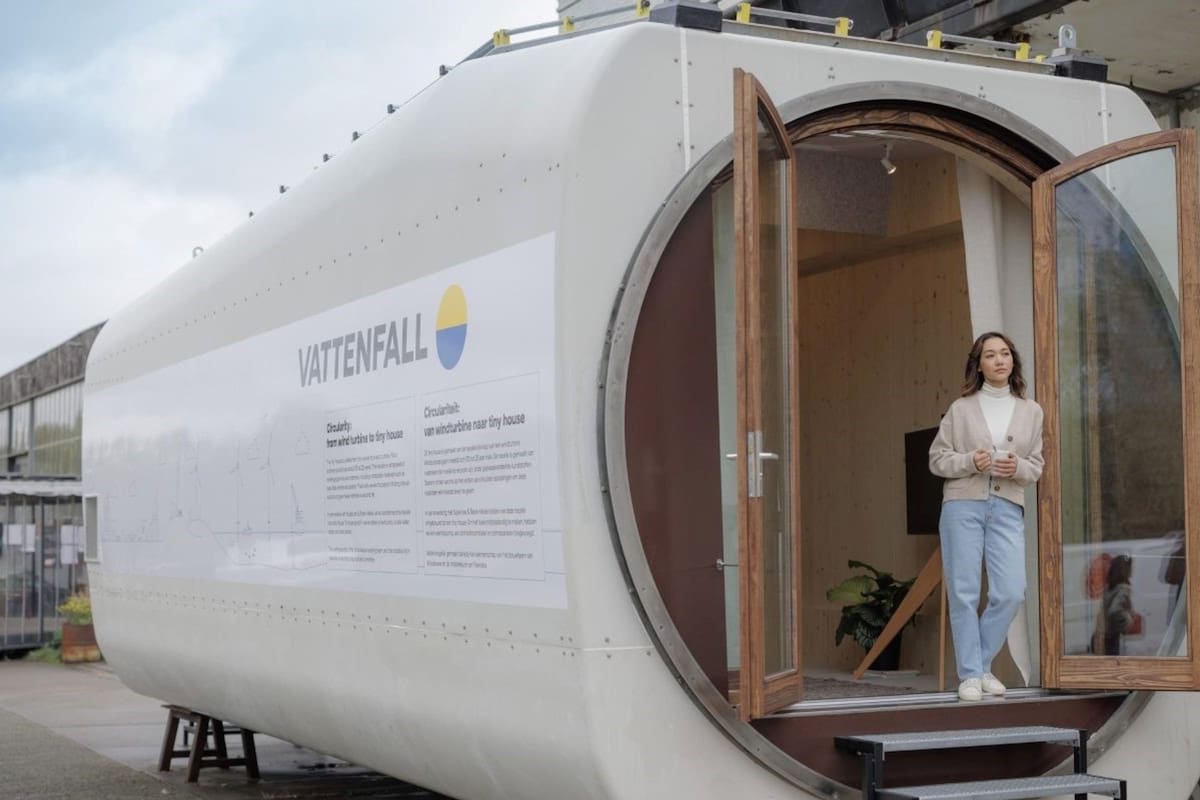
Swedish utility Vattenfall turned a decommissioned wind-turbine nacelle into a fully equipped tiny house, La Nación reported.
The nacelle came from a V80 2-megawatt turbine installed in 2005 at the Gols wind farm in Austria. After nearly 20 years generating roughly 73 gigawatt-hours — equivalent to the annual consumption of more than 29,000 households — the unit was dismantled and handed over by Dutch firm Business in Wind for reuse, La Nación reported, according to LA NACION.
Measuring about 10 meters long, 4 meters wide and 3 meters high, the steel shell retained its exterior profile while Superuse Studios, Blade-Made and builder Woodwave fitted a kitchen, bathroom and living area inside. Feenstra, a Vattenfall subsidiary, handled the electrical installation, La Nación reported.
Solar panels, a heat pump and a solar water-heating system now power the dwelling, which debuted at Dutch Design Week in Eindhoven in October 2024. “If a structure as complex as a house is possible, many simpler solutions are also viable and scalable,” Jos de Krieger, partner at Superuse and Blade-Made, told La Nación.
Vattenfall is pursuing multiple circular-economy pilots. The company commissioned 15 pairs of skis using carbon fiber recovered from blades at the Irene Vorrink wind farm in the Netherlands; Norwegian firm Gjenkraft processed the fibers and EVI Ski integrated them into wooden cores, according to Clarin. “We want to use these long fibers from the blades to create something else long, like skis,” EVI Ski founder Endre Hals told Clarín.
Founded in 1909 as the state-owned Royal Waterfall Board, Vattenfall is a Swedish multinational power company wholly owned by the Swedish state. Its name translates from Swedish as “waterfall.”
For decades its operations were confined to Sweden and focused on hydroelectric power; international expansion began only in 1974 with nuclear reactor construction and accelerated in the 1990s and 2000s through acquisitions in Germany, Poland, the Netherlands, and Denmark, making it one of Europe’s largest electricity producers.

“We want to use these long fibers from the blades to create something else long, like skis,”