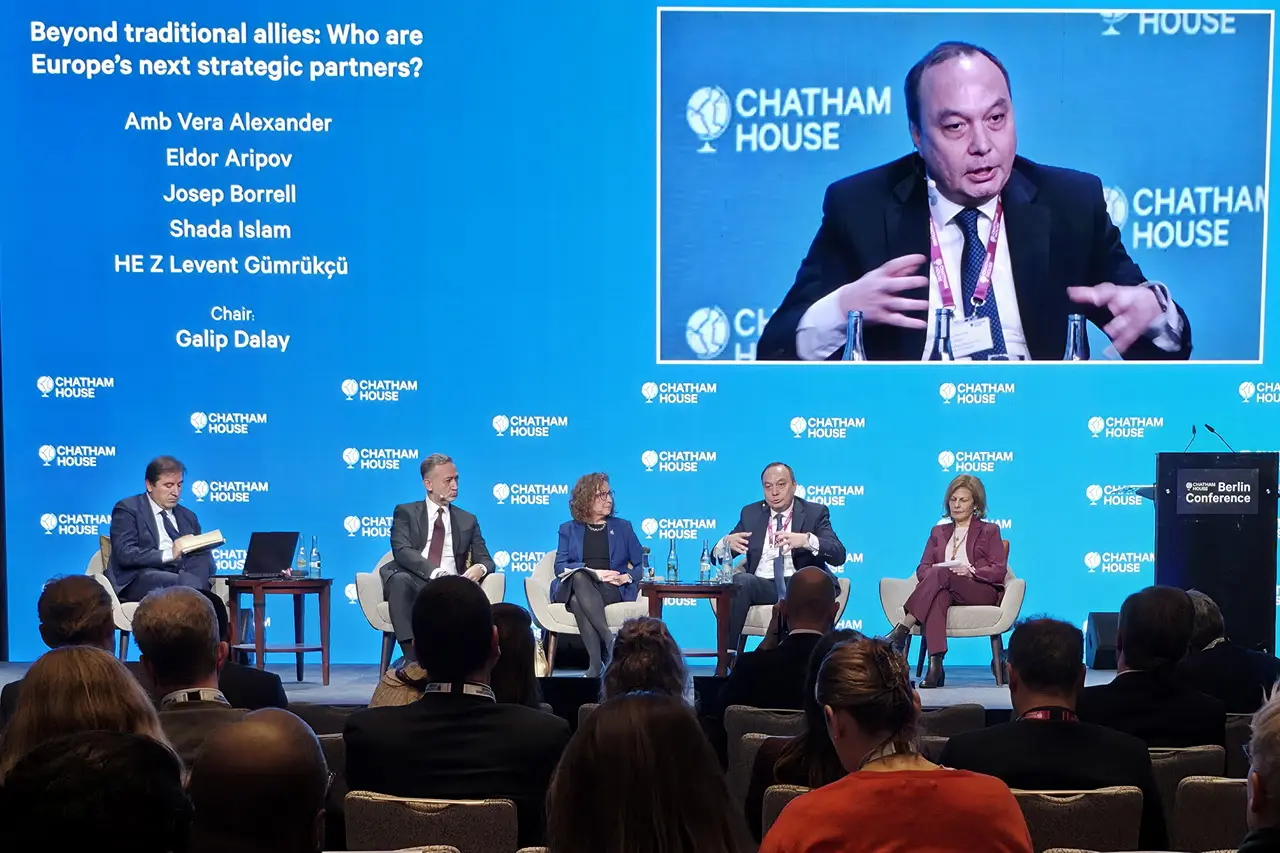
Uzbekistan’s Aripov Pitches Central Asia as EU Strategic Partner at Berlin Conference
Eldor Aripov attended the Berlin Conference 2026 on Nov. 25–26 to discuss European security and economic resilience.
Uzbekistan Expert Joins Chatham House Panel on Europe's New Partners
Aripov, Director of the Institute for Strategic and Regional Studies under the President of Uzbekistan, spoke at a session titled “Beyond the Circle of Traditional Allies: Who Will Be Europe’s New Strategic Partner?” uzdaily.uz reported. The discussion platform was established in 2014 by the Royal Institute of International Affairs, known as Chatham House.
The event brought together representatives from government bodies, parliaments, diplomatic missions, businesses, and academic institutions across more than 20 countries. Aripov pointed to the open and constructive policy of President Shavkat Mirziyoyev in strengthening regional trust and good-neighbourly relations.
Increased regional dialogue and joint infrastructure projects create new opportunities for external partners, according to uzdaily.uz. Aripov highlighted the first Central Asia–European Union summit held in Samarkand in April 2025 as a turning point that elevated relations to a strategic partnership.
European Investment Supports Central Asian Modernization and Economic Independence
Industrial cooperation, critical minerals, and stronger transport connectivity form promising areas for future joint value chains. European investment and technology help modernize Central Asian economies and expand market access.
“For Central Asian countries, economic independence and the diversification of external ties were foundations for sovereign development,” uzdaily.uz reported of Aripov’s remarks. He emphasized that cooperation with the European Union serves as an additional resource for modernization rather than a replacement for traditional ties.
Uzbekistan’s geopolitical standing as the most populous country in Central Asia, with a population of over 39 million, positions it as a key regional partner for the EU. Its location, bordered by Afghanistan to the south and as a member of the Organisation of Turkic States, enhances its strategic relevance in fostering regional stability and connectivity.
Additionally, hosting the first Central Asia–European Union summit in Samarkand in April 2025 demonstrated its role in elevating relations to a strategic partnership, highlighting its importance as a bridge between Europe and Central Asia.
Regular expert dialogue remains essential for developing concrete proposals to strengthen ties between the two regions, according to the institute director.