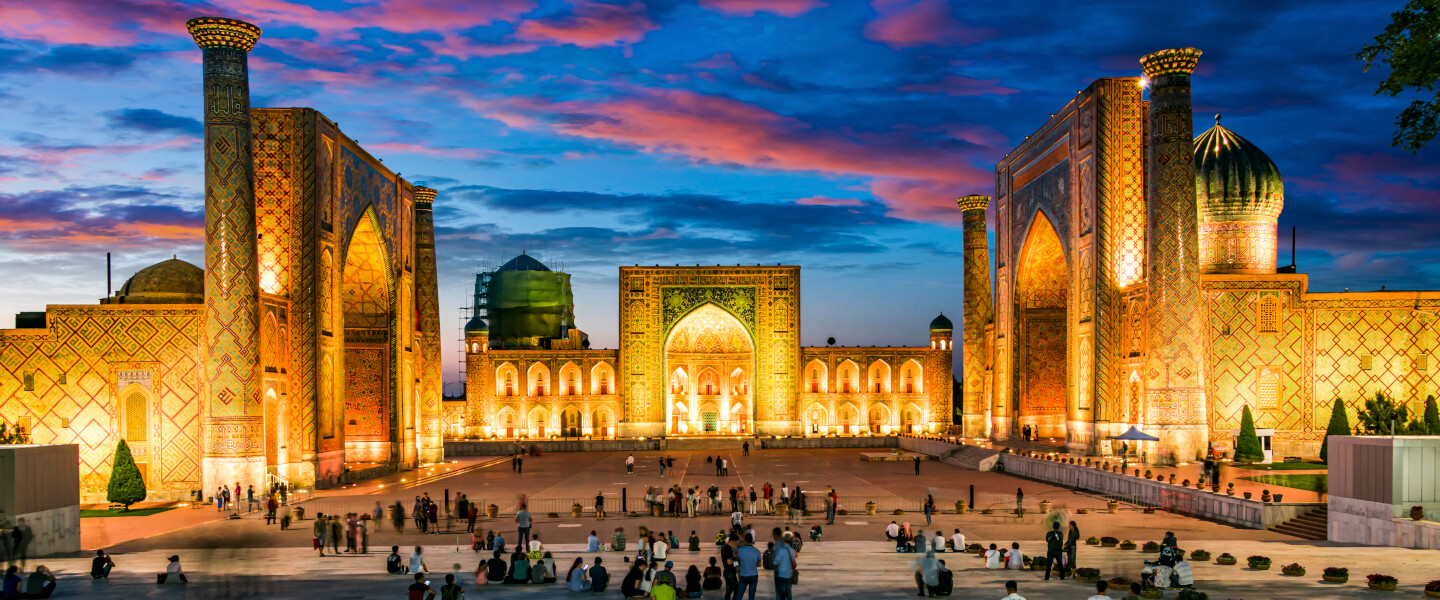
Uzbekistan Had 10.3 Million Foreign Tourists in 2026, Report Says
Uzbekistan recorded 10.3 million foreign tourist arrivals in the first nine months of 2026, marking a 20.4 percent increase over the same period in 2025 and placing the country on track to meet its annual target of 12 million visitors, The Diplomatic Insight reported. The steady climb in international travel follows sweeping infrastructural and procedural reforms enacted under President Shavkat Mirziyoyev, shifting the nation’s economic engine from a heavy reliance on historical monuments toward a broader market for trade, commerce, and international business investment.
Tourism in Uzbekistan functions as a multiplier across multiple domestic sectors, drawing consistent capital into hospitality, transport, craft manufacturing, and urban construction. The state’s push to modernize stems from a deliberate strategy to break away from the economic limitations of being a doubly landlocked nation. What began as a nostalgic draw for travelers tracing the ancient Silk Road has steadily evolved into a modernized economic framework designed for easy entry, trade, and corporate partnership.
Eight UNESCO Heritage Listings Anchor a Expanding Cultural Portfolio
The country’s tourism foundation relies on eight UNESCO World Heritage sites that merge ancient history with everyday civic life. These recognized locations include Itchan Kala in Khiva inscribed in 1990, the historic center of Bukhara in 1993, Shakhrisabz in 2000, Samarkand in 2001, and the transnational Silk Roads: Zarafshan-Karakum Corridor added in 2023. Unlike preserved museum fragments, cities like Khiva, Bukhara, and Samarkand remain active urban centers where centuries-old architecture shapes daily routines.

This heritage portfolio expanded beyond medieval structures in July 2026, when the World Heritage Committee inscribed ten modernist landmarks in Tashkent built between the 1960s and the early 1990s. This recent addition includes the Chorsu Market and the Kosmonavtlar metro station, pairing Soviet-era modernist architecture with centuries-old Islamic monuments. While conservation efforts continue across these regions, Shakhrisabz remains on the heritage danger list, highlighting the ongoing tension between managing high tourist influxes and protecting fragile historical structures from rapid commercial development.
Spike in Business Travel Outpaces Leisure Growth Across Tashkent and Samarkand
While regional mobility remains high—with 81.5 percent of 2025 arrivals originating from neighboring nations like Kyrgyzstan, Tajikistan, and Kazakhstan—distant markets are expanding rapidly. Data from the first nine months of 2026 show arrivals from China more than doubled, while visitors from Malaysia rose 1.9 times and Indonesia increased 1.7 times compared to the prior year. Religious tourism continues to drive significant traffic from Muslim-majority countries, supported by the reopening of the Imam al-Bukhari complex in Samarkand, which drew over one million visitors in its first month.
Purpose-of-visit data reveals a complex demographic footprint. Out of 11.7 million foreign arrivals in 2025, 67.3 percent visited relatives, 16.5 percent came for leisure, 11.3 percent traveled for business, and 3.8 percent arrived for commercial trade. Business travel experienced the most striking momentum, surging by nearly 983,000 trips compared to 2024. International executives and traders are evaluating local markets and exploring the country’s streamlined business environment, creating sustained demand for corporate infrastructure.
Liberalized Visa Rules and 1.4 Billion Euros in Hospitality Investment
The current influx of capital is the result of deliberate policy changes initiated after President Shavkat Mirziyoyev took office in December 2016. Early administrative reforms eliminated mandatory police station registrations within three days for foreign visitors, transferring registration duties to hotels and private hosts. The government also instituted thirty-day visa-free entry for select nations starting in 2018, later expanding the policy to the European Union, Gulf states, China in June 2025, and United States citizens in January 2026.

These regulatory updates unlocked substantial commercial investment in the domestic hospitality sector. Tourism-related investment reached approximately 1.4 billion euros across 421 active projects by the end of 2025. The country’s accommodation capacity expanded to 6,861 facilities providing roughly 184,000 beds, supported by nearly 30 international hotel brands operating nationwide. Consequently, tourism service exports climbed from $531 million to $4.8 billion in recent years, reaching $5.3 billion in the first nine months of 2026 alone.
Achieving sustainable growth now depends on balancing high visitor volumes with infrastructure preservation and service quality.