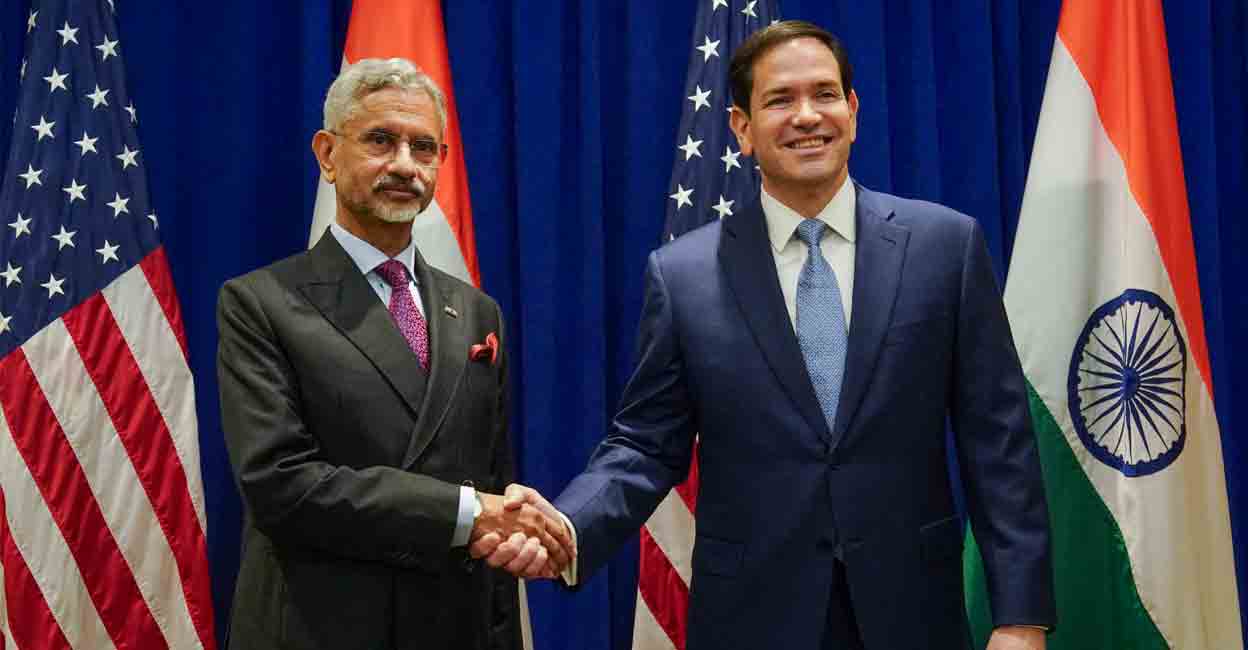
US Secretary Marco Rubio Warns India Over Sanctions and Maritime Security Following Attack on Indian Sailors
United States Secretary of State Marco Rubio has issued a formal warning to Indian External Affairs Minister S. Jaishankar, demanding strict adherence to international maritime sanctions following a series of attacks on commercial vessels near the Strait of Hormuz. The diplomatic ultimatum follows confirmed reports that Indian-crewed ships have been targeted by munitions in a volatile corridor that remains critical to global energy supplies.
The Diplomatic Ultimatum: Sanctions and Sovereignty
The exchange between Washington and New Delhi marks a significant escalation in regional tensions. Secretary of State Marco Rubio’s directive to Minister Jaishankar emphasizes that the U.S. will not tolerate the violation of existing sanctions, regardless of the operational pressures faced by merchant crews. This stance aligns with the U.S. policy of maintaining “maximum pressure” on entities operating within restricted waters, a strategy detailed in official U.S. Department of the Treasury sanctions programs.

For Indian shipping firms, the message is clear: neutrality in the Strait of Hormuz is no longer a viable buffer against international enforcement actions. The risk of secondary sanctions now looms over logistics providers who fail to conduct rigorous due diligence on their cargo and transit routes.
“The stability of the global supply chain depends on the absolute enforcement of maritime protocols. Any deviation—intentional or otherwise—invites immediate scrutiny from international regulatory bodies,” says a senior analyst at a Washington-based maritime security think tank.
The Hormuz Flashpoint: A Technical Breakdown
The friction point involves a specific incident where a missile struck a commercial vessel, though it failed to detonate. The Indian Navy successfully neutralized the threat, preventing a catastrophic loss of life and cargo. However, U.S. intelligence reports confirm that the vessel had been operating in a manner that violated established transit guidelines, which are meant to prevent the accidental escalation of regional conflicts.

The technical failure of the warhead provided a narrow window for damage control, but it has not shielded the operators from political fallout. Shipping companies now face a dual crisis: the immediate physical threat of kinetic warfare and the looming legal threat of non-compliance penalties. In this high-stakes environment, businesses are increasingly turning to International Maritime Law Firms to ensure their transit manifests and insurance policies meet the stringent requirements of both U.S. and international maritime law.
Infrastructure and Economic Ripple Effects
The Strait of Hormuz is the world’s most important oil transit chokepoint, with roughly 21 million barrels of petroleum passing through it daily. Any disruption caused by sanction-related investigations or vessel seizures impacts regional insurance premiums and fuel costs globally. According to the U.S. Energy Information Administration, the volatility in this region dictates the economic health of markets far beyond the Middle East.
Local economies that rely on maritime logistics are already feeling the pinch. Port authorities and freight forwarders are struggling to balance the need for speed with the new, heightened burden of proof required for every shipment. For organizations caught in this regulatory crossfire, securing Risk Management and Compliance Consultants has become the primary defense against catastrophic financial loss.
Navigating the New Compliance Reality
The U.S.-India dialogue underscores a shift in how maritime security is being enforced. It is no longer just about naval presence; it is about the “paperwork of war.” Every vessel must now account for its cargo, its origin, and its destination against a constantly shifting list of prohibited entities.

Failure to maintain this level of transparency is no longer categorized as a simple administrative oversight; it is treated as a breach of international security. Companies that operate in these waters must now invest in real-time tracking and legal oversight to survive. The reliance on legacy logistics models is rapidly becoming a liability.
As the geopolitical situation in the Strait of Hormuz continues to evolve, the distinction between a commercial shipping operation and a political target is blurring. The warning from Secretary Rubio to Minister Jaishankar is a signal that the grace period for “accidental” non-compliance has ended. Owners and operators must now choose: align with international sanctions or risk losing access to the global financial system entirely. For those operating on the front lines of global trade, the only way forward is through absolute, verified compliance, supported by experts who can navigate the complexities of international law.
Worth a look
- Europe Far-Right Weaponises Cost-Of-Living Riots to Push Anti-Immigration Agenda
- Paul St-Pierre Plamondon to unveil reduced Quebec cabinet Wednesday
- Congress Got a 30-Day Hold on Ending Russia Sanctions, None on Waivers (daybreakwire.com)
- Modern Server Technology and Security in Digital Gaming (newsy-today.com)