US Sanctions Three Lebanese Men, Relief Association, Two Gold Firms Tied to Hezbollah
Washington imposed new sanctions on Wednesday targeting three Lebanese men, a relief association in southern Lebanon and two gold-trading companies it says finance Hezbollah — an escalation that moves US pressure beyond banks and into the cash-and-bullion channels the group still relies on.
The US Treasury Department’s Office of Foreign Assets Control listed Afif Abdel Reda Shuman, Hassan Khushan and Ibrahim Khushan, along with the “Wa Taawanu” association and the firms Gold Global and Sankari Gold, Asharq Al-Awsat reported. Treasury accused the Khushan brothers of moving money from Iran’s Quds Force to Hezbollah through gold and cash, and accused the association of using humanitarian work as cover for the group.
The sources added the personal details: Shuman, born in 1983 in Zafta in the Nabatieh district, Hassan Khushan, born in 1986, and Ibrahim Khushan, born in 1992. The Wa Taawanu association is registered in Lebanon since 2021 and based in Zafta.
Gold Global, based in Sidon and founded in March 2021, trades metals wholesale; Sankari Gold, based in Istanbul and founded in February 2020, trades jewelry and precious metals, according to Annahar. Both are tied to Hassan Khushan under the US designation.
All six entries went onto the SDN list under the SDGT terrorism category, the sources reported, meaning assets under US jurisdiction are frozen and secondary-sanctions exposure applies to anyone dealing with them. Treasury Secretary Scott Bessent said in a statement that Washington would not tolerate “the Iranian regime’s attempts to violate Lebanon’s sovereignty through terrorist proxies such as Hezbollah,” and would keep blocking Tehran’s efforts to fund its proxies.
A gold route from Africa to Beirut
The network, Treasury said, moves gold and cash from Africa. It tied the designations to a man arrested at Beirut’s airport in February 2025 carrying $2.5 million, according to Aawsat. According to the Treasury statement, Hassan Khushan owns Gold Global and uses it to move funds through transit countries into Lebanon, while Sankari Gold — under his control — carries gold bars and cash from Africa.

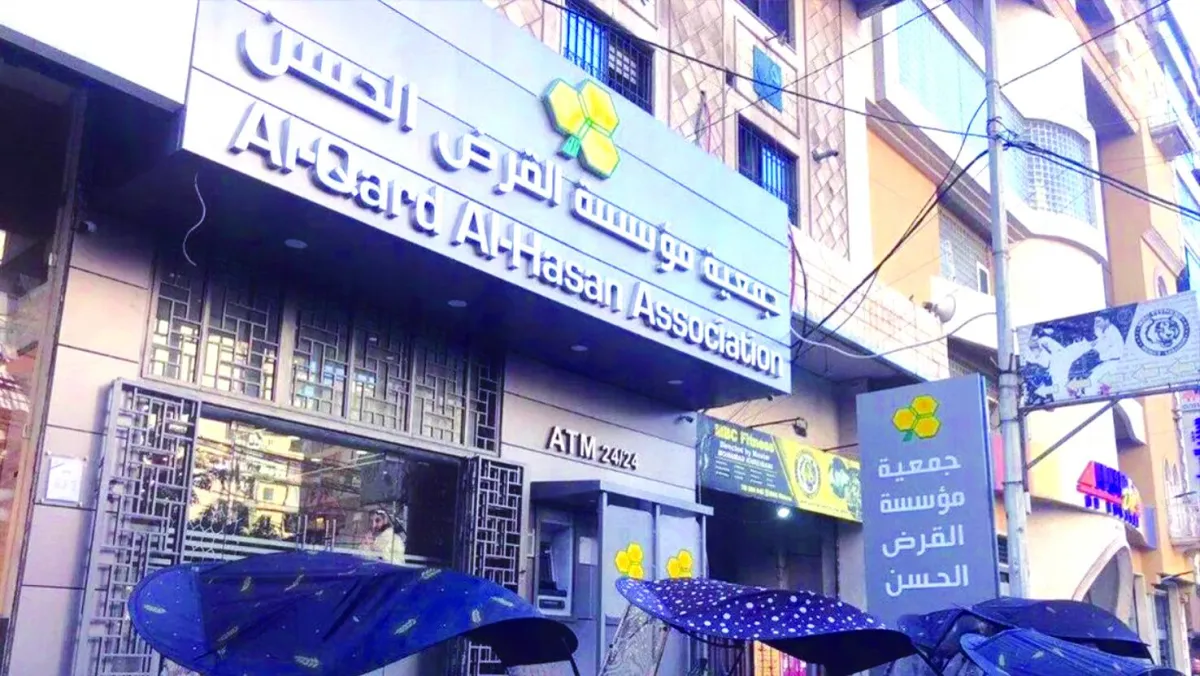
The gold focus is not new. On February 10, 2026, Treasury sanctioned the gold-trading firm Good, accusing it of operating under the supervision of Al-Qard Al-Hassan, itself already on US lists, and of converting gold reserves into usable funds for Hezbollah. Wednesday’s action extends that same pressure to a Turkish node and a relief charity.
The State Department went further than Treasury. It accused the Wa Taawanu association of using its emergency relief work in southern Lebanon to transport Hezbollah members and store the group’s weapons under the cover of aid delivery.
Channels banks cannot see
Economist Walid Abu Sleiman told Asharq Al-Awsat the United States is trying to cut every possible funding route for groups aligned with Iran, Hezbollah among them, at a time when Iran itself already operates under sanctions. The difficulty, he said, is structural: the money no longer moves through traditional financial channels but through direct cash transport and cryptocurrency.
“The financing has in practice become decentralized, and tracking it is not easy — that is America’s great challenge today,” Abu Sleiman told Asharq Al-Awsat.
His assessment of the economic effect is blunt. “The economic and financial impact is limited, because these institutions do not participate in the legitimate economic cycle,” he said. He ruled out the targeted entities halting their work, adding that they “have grown accustomed to dealing with US sanctions and will look for other ways to keep funding and operating.”

The threat lands elsewhere — on anyone doing legitimate business in the region. Firms with dollar correspondent banking relationships face real exposure from secondary sanctions.
The social base in Washington’s sights
Political researcher Hayat Hariri told Asharq Al-Awsat the designations fit a broader strategy: “encircling all the outlets and institutions that could serve as an economic lever for Hezbollah.” She drew a line between social institutions generally and those accused specifically of moving money.
“Washington sees the social institutions as capable of reviving the party’s economic capacity and reshaping its supportive environment, especially after the economic blockade and sanctions that hit many of its institutions,” Hariri told Asharq Al-Awsat.
She said the US view holds that Hezbollah’s military defeat alone is insufficient. “There is an American vision that Hezbollah cannot be eliminated militarily only, because the social base forms an essential part of this party’s continuity.” The approach, she concluded, aims at “dismantling the economic and social structure” of the group and limiting its ability to rebuild its popular base.
Relief work entangled with disarmament
What makes Wednesday’s action unusual is the target.
Southern Lebanon is still recovering from the war between Hezbollah and Israel that ended with the November 2024 ceasefire. The Lebanese government approved a plan to disarm Hezbollah; the group refuses to give up its arsenal, held since the civil war’s end in 1990 under the banner of resisting Israel, and rejects the direct Lebanon-Israel talks underway under US sponsorship, according to sources.
Bessent’s statement frames the sanctions as part of that same campaign: “The United States will continue to thwart Iran’s attempts to exert influence in the region and fund its proxies.”
On Wednesday, pressure tightened
The designations freeze what US jurisdiction can reach and deter others from dealing with the six entities. They do not, by Abu Sleiman’s account, stop the underlying trade, because decentralized cash-and-gold financing was built to survive exactly this kind of listing.
The State Department’s line is that Hezbollah “continues to undermine Lebanon’s future.” Whether Wednesday’s listings change that — or simply push the same gold deeper underground — remains the open question.