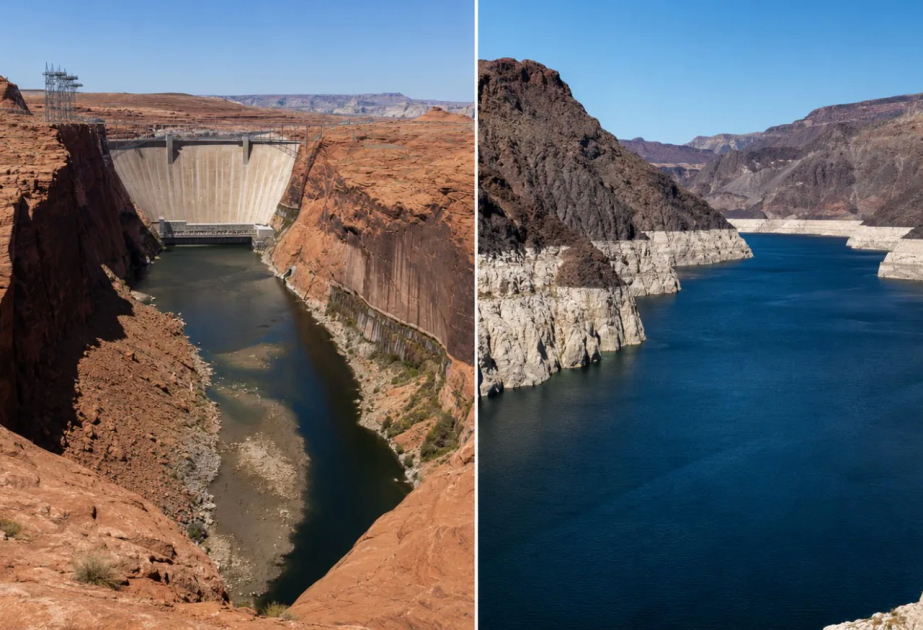
US Reservoirs Lake Mead and Lake Powell Reach Record Low Water Levels Amid Drought
As of August 18, 2026, the combined water levels in Lake Mead and Lake Powell—the two largest reservoirs in the United States—have dropped to record lows after 25 years of persistent drought, threatening drinking water, agricultural output, and hydropower generation for more than 40 million people across seven states, according to federal and municipal authorities.
The unfolding crisis along the Colorado River system hits a critical tipping point this summer. Both reservoirs, fed by the Colorado River originating in the Rocky Mountains, supply essential water and electricity to major metropolitan areas including Los Angeles and Phoenix, as well as vast agricultural regions across Arizona, California, Colorado, Nevada, New Mexico, Utah, and Wyoming.
Record-Breaking Declines Across the Colorado River Basin
Data from the Interior Department’s Bureau of Reclamation shows that the combined contents of Lake Powell and Lake Mead have not dipped this low since before the Glen Canyon Dam began filling in 1963. Since 2000, water use has consistently exceeded total system inflow in most years.
Lake Mead, situated on the Arizona-Nevada border, has served as the nation’s largest reservoir since the completion of the Hoover Dam over 90 years ago. According to current readings, Lake Mead stands at approximately 27 percent of its total capacity, registering roughly 1,039 feet above sea level—the lowest figures ever documented for the reservoir. Meanwhile, Lake Powell, positioned on the Utah-Arizona border, saw its water level drop to 3,519 feet above sea level, eclipsing previous lows recorded in 2023.
Federal officials point to extreme weather patterns as a primary catalyst. Last winter ranked among the warmest ever recorded in the western United States, leaving behind an exceptionally light snowpack that failed to adequately replenish the Colorado River during the spring melt.
Threats to Hydropower Generation and Regional Utilities
The plunging water levels pose an immediate danger to regional electrical grids. When water levels in Lake Mead fall below an operational threshold of 1,035 feet, the Hoover Dam’s hydropower generation capacity drops by 70 percent. A further drop of just five feet risks shutting down the facility’s vital turbines.
Historically, the Hoover Dam has provided electricity to roughly 1.3 million people across the Southwest. According to the Bureau of Reclamation, generation has already decreased by about 30 percent due to ongoing drought conditions. Officials warn that without intervention, further declines threaten the long-term financial viability of the facility and threaten to drive up consumer utility rates.
Municipalities and utility providers are scrambling to adapt to the shifting baseline.
Political Stalemates and Lower Basin Negotiations
The dwindling water supply has intensified political friction among the seven states dependent on the Colorado River Basin. In response to the crisis, the federal government recently proposed sweeping usage cuts targeted at the three states in the lower basin: Arizona, California, and Nevada.

State leaders quickly rejected the federal proposal, arguing that the mandatory reductions are unfeasible. Arizona Governor Katie Hobbs stated that the federal plan contained unacceptable options forcing Arizona to absorb the majority of draconian water cutbacks. Similarly, Nevada Governor Joe Lombardo noted that the plan sought to impose unrealistic reductions on Nevada and its water users, warning of devastating economic and environmental impacts.
JB Hamby, chairman of the Colorado River Board of California and Colorado River commissioner for California, emphasized that negotiations remain ongoing. “This is an important milestone, but it is not the finish line,” Hamby stated regarding the ongoing interstate talks.
As state officials and federal regulators attempt to forge new operating guidelines, stakeholders throughout the affected sectors are bracing for protracted legal and logistical battles.
With no immediate relief in sight from weather patterns, the long-term sustainability of the American Southwest depends on swift cooperation among state and federal agencies.