US Army to Detonate 9,700 Pounds of Lead Azide in Iowa Wednesday After Court Ruling
“Every expert agency agrees, and both Iowa’s current and incoming Governors say the call belongs to the experts,” acting Army Secretary Adam Telle posted on social media Monday.
The U.S. Army plans to detonate about 9,700 pounds of lead azide — described as the nation’s entire stockpile — at the Iowa Army Ammunition Plant in Middletown on Wednesday morning after a federal appeals court lifted a legal pause.
Court clears detonation after emergency arguments
The 8th U.S. Circuit Court of Appeals ruled late Monday that the Army could proceed, rejecting environmental groups’ lawsuit that had temporarily halted an emergency Environmental Protection Agency permit, AP News reported. The Justice Department argued the permit was not required because the degrading explosives posed an immediate threat of accidental detonation.
“We will be examining every single storage facility across the U.S.,” Telle told reporters Tuesday, saying the service will conduct a “thorough examination” of weapons storage nationwide to prevent a repeat, Task & Purpose reported.
Lead plume modeled toward Missouri
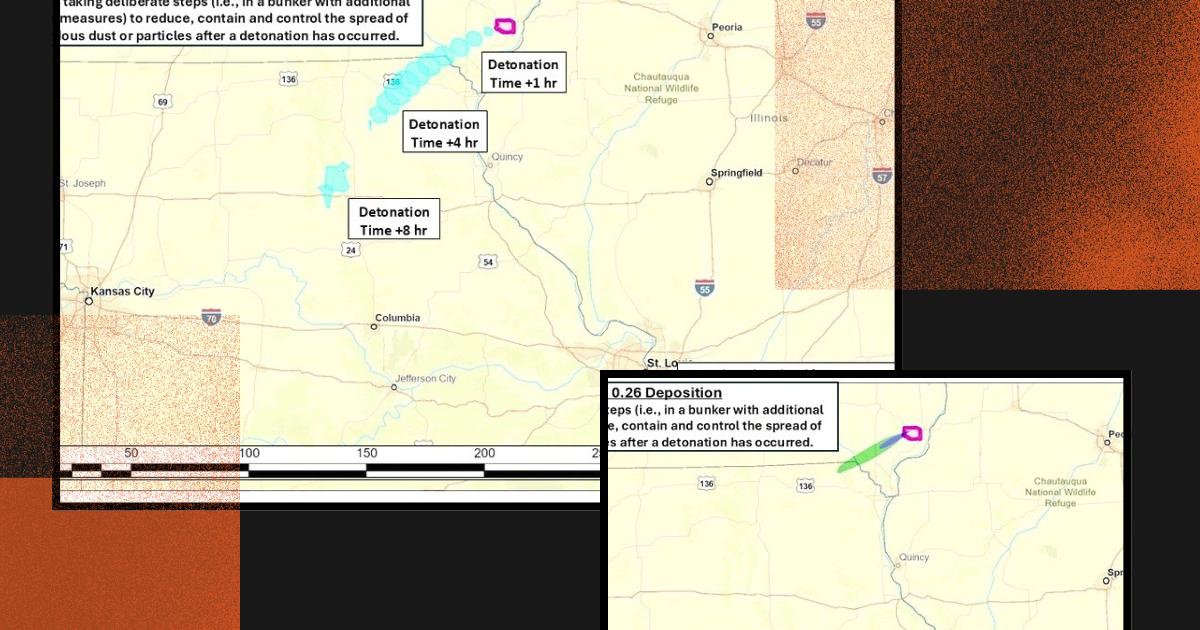
Army dispersion maps show lead particles could travel southwest into northern Missouri over an eight-hour window, Iowa Public Radio reported. Surface deposition models outline two scenarios: a lighter coating of 5 micrograms per square foot and a heavier concentration of 100 micrograms per square foot near the plant — levels that match EPA hazard standards for lead dust in homes and daycares.
“If the Army goes through with its rescheduled plan, the preliminary forecast is for much slower wind blowing toward the south-southwest,” Patrick O’Shaughnessy, a professor of occupational and environmental health at the University of Iowa, told The Conversation. Slower winds mean less dilution and a wider ground-level footprint, he said.
Residents prepare; farmers warned
In Middletown, a town of about 360 people, residents taped windows and covered air conditioners with tarps, The Conversation reported. FEMA is supporting relocation for Middletown residents and immediate surrounding areas “out of an abundance of caution,” the Army said, according to The Guardian.
The Iowa Department of Agriculture estimates 350 farms could be affected, Iowa Public Radio reported. Secretary Mike Naig said the state is working with the USDA to test forage and livestock afterward to ensure “Iowans are fully compensated” for any losses.
Chemical neutralization rejected
Army officials said they evaluated every viable alternative but found chemical treatment carried too great a risk of triggering a spontaneous explosion, Col. Aaron Teller, commander of the 71st Explosive Ordnance Disposal Group, said at a Tuesday press conference covered by Task & Purpose.
“Once we do it, then it becomes considered a viable option for other situations in other places,” Peter Thorne, a University of Iowa public health researcher, told Iowa Public Radio.
“So, we expose Iowans this time, but how many more times will we think of doing this and think it’s okay now?”
The Army’s last major open-air lead azide detonation, in 1977, left 25% of lead particles in the atmosphere, Teller said. Officials believe current mitigation strategies can “significantly reduce that last 25%.”
USDA is on the ground in Iowa, working with state agriculture officials to support farmers and ranchers who may be affected by the U. S. Army’s planned detonation in Middletown, slated for 9:00 AM CT. Under Secretary Richard Fordyce is coordinating with Iowa and Missouri… pic.twitter.com/BccLlFmcDE
Army warned of deteriorating stockpile in 2004
A 2014 Army press release cited by social media posts noted the Pentagon already worried about a “40-year-old stockpile of lead azide deteriorating at the Iowa Army Ammunition Plant in Middletown, Iowa.”
Around 2009, the military consolidated the nation’s lead azide supplies at the Iowa plant during a base reorganization, ATF Director Robert Cekada said at a Nov. 24 press conference covered by Task & Purpose.
This evening, the Eighth Circuit Court of Appeals issued an order that allows the Army to proceed with the detonation of long-ago-placed explosives (2009) at the Iowa Army Ammunition Plant. Likewise, the current Governor of Iowa, Kim Reynolds, has given her support to go forward,…
Chemical neutralization rejected over safety concerns
Army officials said they evaluated every viable alternative but found chemical treatment carried too great a risk of triggering a spontaneous explosion, Col. Aaron Teller, commander of the 71st Explosive Ordnance Disposal Group, said at a Tuesday press conference covered by Task & Purpose. “That’s why they can’t be treated, and that’s why you can’t open the lids to treat it with a chemical neutralization agent,” Teller said.
The request asked MuniRem Environmental to develop a plan to “neutralize and dispose” of 68 drums of lead azide at the plant, according to documents cited by The Washington Post.
FEMA supports relocation amid worst-case modeling
The Federal Emergency Management Agency is supporting “relocation for all residents of Middletown, Iowa, and immediate surrounding impacted areas,” according to the Army, “out of an abundance of caution,” The Guardian reported. FEMA Administrator Cameron Hamilton said at a news conference that the White House has made it “very very clear that we are to spare no expense to ensure that Americans are kept safe.”
Hamilton said that the dispersion maps shared by the Army represent “some of the worst case scenarios” of lead dispersion.
Researchers and officials warn of precedent and health risks
University of Iowa public health Peter Thorne warned the detonation could set a precedent for future disposals. “So, we expose Iowans this time, but how many more times will we think of doing this and think it’s okay now?”
Senator-elect Josh Turek said Thursday he has heard from many Iowans worried about health and safety risks from potential lead exposure and called for a delay. The Knox County Health Department in Northeast Missouri released safety guidance for residents ahead of the detonation, WGEM reported, as Army models show the plume could travel southwest into northern Missouri.
Public safety is the Army’s top priority, and I have directed Army Materiel Command to postpone tomorrow’s controlled detonation at the Iowa Army Ammunition Plant in Middletown, Iowa until Monday, November 23. This will delay the detonation until the latest possible moment prior…
Warnings date back decades
Internal documents show the Defense Department flagged concerns about the deteriorating 40-year-old stockpile as early as 2004, KCCI reported. The material was consolidated at the Iowa plant in 2009, and contractors sought to neutralize it chemically as recently as September 2025 — months before the Army says it recognized the danger, The Washington Post reported.
The detonation is scheduled for approximately 9 a.m. local time Wednesday, with final timing dependent on weather conditions.
More on University of Iowa
My office is continuing to monitor the planned detonation at the Iowa Army Ammunition Plant on Wednesday and I remain in contact with officials at the White House and the Army. Protecting the health and safety of people in surrounding communities must come first, and every…
To farmers and livestock producers in southeast Iowa and northeast Missouri: USDA is on the ground to help ahead of the U. S. Army’s planned detonation in Middletown, Iowa. Under @SecRollins’ leadership, USDA is coordinating with @IAGovernor, @MikeNaigIA and Missouri agriculture…
Keeping Missourians safe also means keeping Missourians informed with facts. Tomorrow's federal operation at the Iowa Army Ammunition Plant is taking place to reduce the risk of an uncontrolled, spontaneous explosion. The federal multi-agency team planning the detonation is…
Army tells court it intends to detonate bomb-making material in Iowa by Tuesday despite recent pause and risk of potential toxic lead dust. https://t.co/rS48GgrPnM