
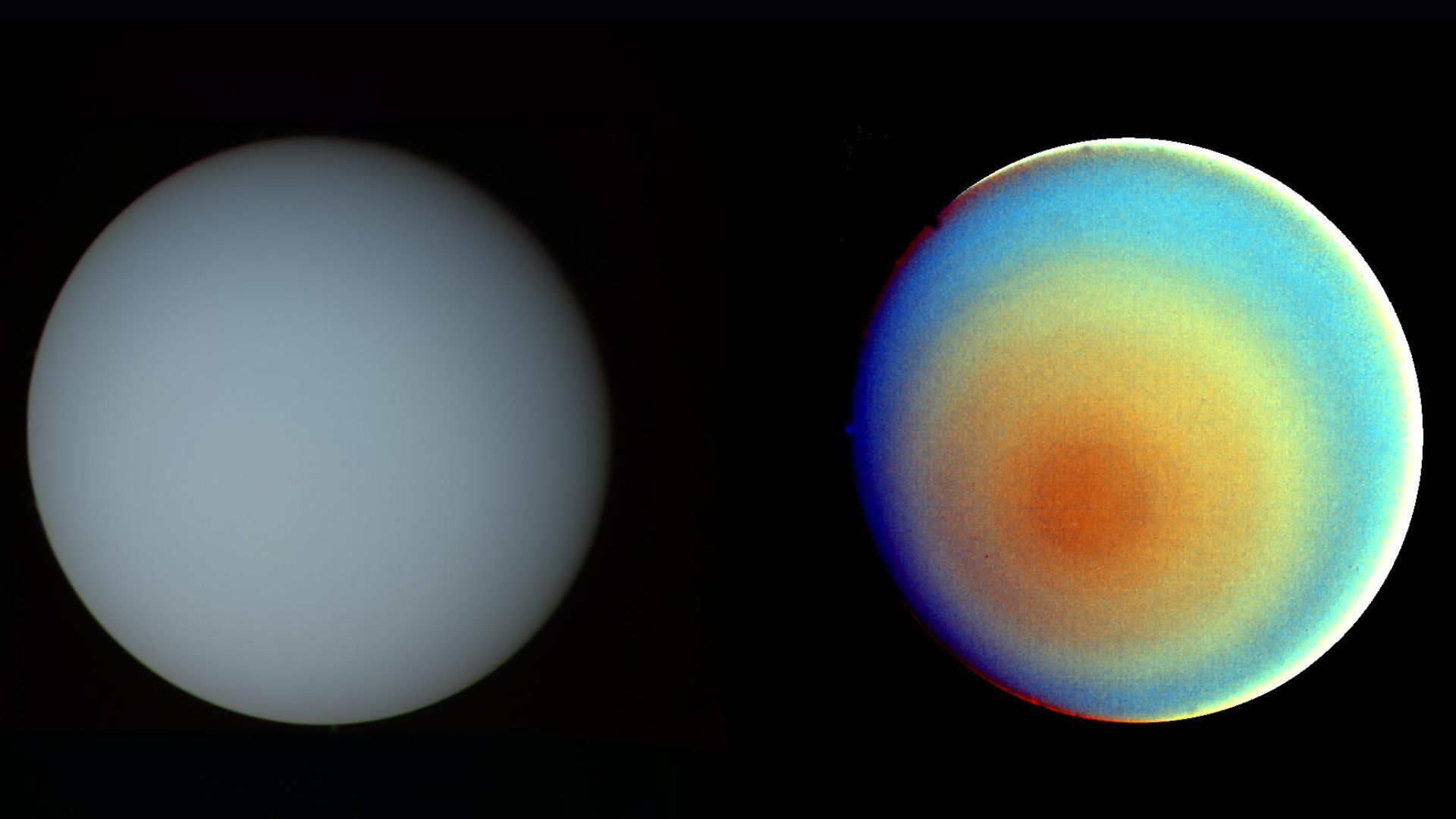
Forty years after NASA’s Voyager 2 spacecraft made a surprising discovery at Uranus, scientists believe they have solved a decades-old mystery surrounding the planet’s unexpectedly powerful electron radiation belt. New research, published in November 2025 in the journal Geophysical Research Letters, suggests a temporary surge in space weather, specifically a co-rotating interaction region in the solar wind, likely amplified the radiation belt’s intensity during the Voyager 2 flyby in 1986.
When Voyager 2 passed Uranus, instruments detected an electron radiation belt far stronger than anticipated, nearly at the maximum intensity the planet could sustain. While the planet’s ion radiation belt was slightly weaker than predicted, the electron belt’s strength baffled researchers. Conventional understanding, based on observations of other planets, could not explain the intensity of the radiation field.
“Science has come a long way since the Voyager 2 flyby,” said Robert Allen, a space physicist at the Southwest Research Institute (SwRI) and coauthor of the new study. “We decided to take a comparative approach looking at the Voyager 2 data and compare it to Earth observations we’ve made in the decades since.”
The research team compared the Voyager 2 data to observations collected from Earth orbit during a significant space weather event in 2019. They identified similarities between the two events, leading them to hypothesize that a co-rotating interaction region – a phenomenon where high-speed solar winds overtake slower streams – was passing through the Uranian system during the Voyager 2 flyby. This interaction could have accelerated electrons, injecting energy into the radiation belt.
“In 2019, Earth experienced one of these events, which caused an immense amount of radiation belt electron acceleration,” explained Sarah Vines, a space physicist at SwRI and study co-author. “If a similar mechanism interacted with the Uranian system, it would explain why Voyager 2 saw all this unexpected additional energy.”
The findings reshape the understanding of Uranus and its magnetosphere, and highlight the planet’s dynamic interaction with the solar wind. Uranus’ unique axial tilt – it rotates on its side – creates extreme seasonal variations, and the stability of the radiation belt through these seasons remains an open question. The research suggests that the Uranian radiation environment is more variable than previously thought.
The study authors argue that a dedicated mission to Uranus, including an orbiter, is crucial to further investigate these phenomena. Such a mission could collect data from different parts of the magnetosphere, providing a more comprehensive understanding of the planet’s radiation belts and their response to solar activity. Allen noted that the findings too have implications for understanding similar systems, such as Neptune’s magnetosphere.
