UNSW Report Warns Smart Car Features Misused for Domestic Abuse, Urges Safety by Design
University of New South Wales researchers warned on Tuesday that smart car functions marketed to help owners monitor and protect their vehicles are being misused by domestic violence perpetrators to track, control and restrict survivors, with real-time geolocation advertised by all 15 leading car brands examined in Australia.
The report, released by UNSW, mapped connected-car features across major brands and found digital key access marketed by 67% of them, zone-exit alerts by 60%, and speed or acceleration restrictions by 20%.
Researchers said these functions — controllable remotely via apps — can be weaponised in three main scenarios: when the abuser owns the car and created the account, when granted access as a secondary user, or when the perpetrator impersonates the victim-survivor to create an account on their behalf.
“There is an urgent need for carmakers to adopt safety by design principles from the early stages of designing both the apps and the cars,” said Katharine Kemp, a data privacy and consumer protection expert at UNSW and co-author of the report.
The report detailed three cases. Earlier this year, an Australian court found a man guilty of using a connected-car app to harass his former partner, including restricting the vehicle’s speed to 40 km/h. In 2022 in the United States, a woman discovered her former husband had used a car app linked to her vehicle to track her movements; the carmaker allegedly refused to terminate the former partner’s digital access.

Geolocation, marketed variously as “Vehicle Tracking,” “Vehicle Locator” or “Find My Car,” was advertised by 100% of the 15 brands and could be misused to track people, the researchers said. Zone-exit alerts could be used to “Set a zone of 3km from the family home to receive alert if the victim-survivor attempts to leave or fails to follow abuser’s rules limiting travel by the victim-survivor.”
Speed restrictions, described by carmakers as tools for young drivers or valet parkers, could be set to 40 km/h so that a victim-survivor “cannot safely use highways or escape at speed.”
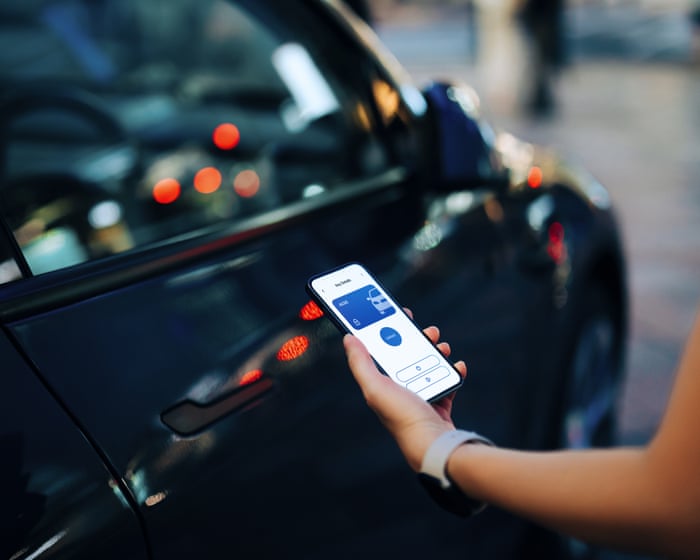
Digital key access, which allows drivers to unlock a car or start its engine from a mobile phone, “may also allow an abuser to remotely terminate or severely restrict the victim survivor’s ability to use the vehicle,” the report warned, for example by remotely deactivating the victim-survivor’s digital key or setting speed restrictions — effectively stranding them in an unsafe location or limiting their ability to escape.
eSafety Commissioner urges immediate industry action
Australia’s eSafety Commissioner, Julie Inman Grant, said “We need urgent action to make them safer” in response to the UNSW findings. Her statement follows the report’s call for carmakers to embed safety-by-design principles from the earliest stages of app and vehicle development.
Government to weigh further measures in next action plan
The federal government will consider what more it can do as it finalises its Second Action Plan to End Violence Against Women and Children. The plan, currently in development, is expected to address technology-facilitated abuse, and the UNSW research has been cited in policy discussions as evidence that automotive software requires specific regulatory attention.
The report said carmakers mainly market the problematic functions as enabling an owner to “keep an eye on” and protect their car.
It highlighted an advertisement on Kia’s Australian website for “Kia Connect,” which stated: “Kia Connect is also bundled with geofence and time fencing alerts which let the owner know when another user strays outside preset limits of geographical areas or time limitations. It’s a perfect feature for anyone dealing with a family member who is borrowing the car.” Kia was contacted for comment.