University of Queensland Sends “Gravity” Through Brick Wall at 1 Bit Per Minute
Physicists at the University of Queensland have sent the word “gravity” through a brick wall using nothing but a moving mass — a proof-of-concept published in Science Advances that demonstrates a communication channel no ordinary material can block.
The catch: it runs at 1 bit per minute.
- The Tech TL;DR:
- Researchers transmitted a message through a brick wall by modulating a local gravitational field with an elevator counterweight — no electromagnetic waves involved.
- The signal traveled about 0.7 meters at 1 bit per minute. Modeling suggests quantum sensors could push this to roughly 500 meters at 15 bits per minute.
- The physics defeats Faraday cages and concrete shielding, but noise from other moving masses and vibrations remains a practical blocker.
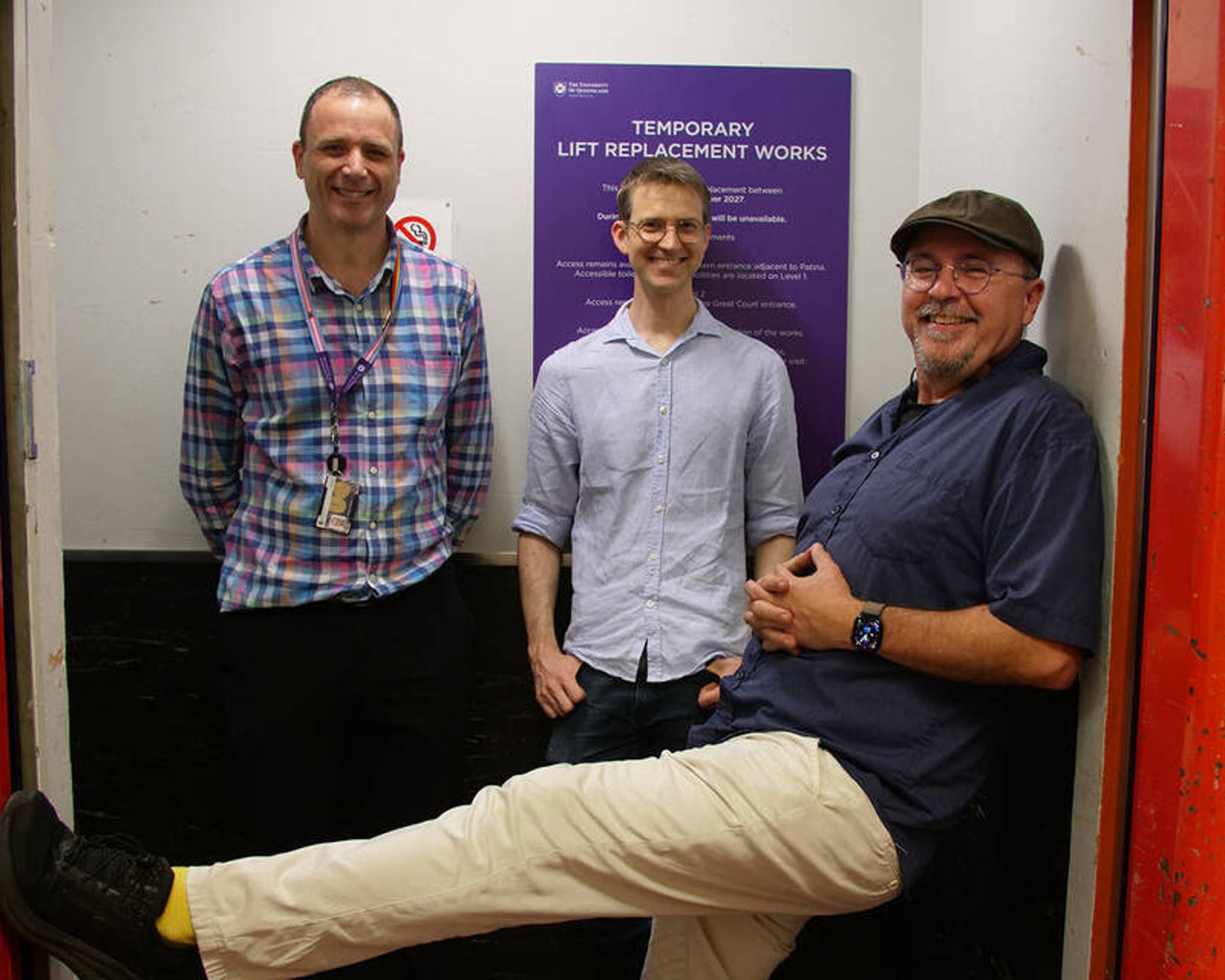
The experiment, published in the journal Science Advances, took place in UQ’s Parnell Building. The team operated a 1950s-era elevator between two floors while a gravimeter, stationed in a men’s bathroom on the other side of a brick wall, tracked the position of the lift’s 1.8-tonne counterweight. Counterweight up or down — binary 1 or 0. They spelled “gravity” in binary code, encoding 1000111 1110010 1100001 1110110 1101001 1110100 1111001, one bit at a time.
Why does this matter? Because every wireless protocol in production today — Wi-Fi, LTE, satellite, Bluetooth — rides on electromagnetism, and electromagnetic signals can be attenuated or fully screened by ordinary matter. A Faraday cage kills a radio signal. Gravity doesn’t care. Only positive mass has ever been observed, so there’s no way to arrange cancellation the way positive and negative charges cancel in an electric field.
“Unlike the electromagnetic signals used in modern wireless communication, a gravitational signal cannot simply be screened out by placing ordinary material in its path,” said Dr. Charles Woffinden, from UQ’s School of Mathematics and Physics. “Anyone who has lost phone reception in a tunnel or struggled with Wi-Fi through a solid wall will understand the appeal.”

The signal-to-noise problem is brutal
The gravimeter measured relative changes in vertical gravitational acceleration with a sensitivity of roughly 2 nm/s² using about 30 seconds of averaging. At its closest approach, the counterweight’s center of mass sat about 0.68 meters from the sensor — horizontally, roughly 0.56 meters separated the shaft and the instrument. That’s a laboratory-scale link, not a network segment.
The researchers themselves are blunt about the bandwidth. “Our lift was snail-paced — it’s from the 1950s — so our experiment transmitted just 1 bit per minute, meaning it took an hour to send a single word,” said Professor Andrew White.
As a point of comparison, Professor Matthew Davis said that NASA’s Voyager 1 spacecraft — now one light-day from Earth after 49 years in flight — beams data home more quickly than their communication concept can manage.
The rate is a function of transmitter mass, how fast that mass can be moved, and detector sensitivity, White explained. The team’s modeling indicates that quantum sensors could, with rather ambitious assumptions, support ranges up to about 500 meters and data rates of around 15 bits per minute.

From weighbridge to wireless
The elevator study traces back to an effort to build a weighbridge requiring no contact — one that would rely on quantum sensors to pick up shifts in gravitational strength caused by a truck driving past, from which scientists could work out how much the large vehicle weighed.
“Once we had shown that the idea worked, we realised the same physics could be used to encode and transmit information,” Charles Woffinden said.
That lineage matters for evaluating the claim. This isn’t LIGO-style gravitational wave detection; it’s a measurement of a local field, which is why modest laboratory equipment could perform the demonstration. The trade-off is that the channel is vulnerable to other moving masses, building vibrations, anything that perturbs the gravimeter. No shielding, but no isolation either.

What an enterprise architect should take from this
Realistically: nothing deployable. A 15-bit-per-minute link is far below practical wireless standards. But the underlying principle — a channel that survives complete electromagnetic denial — maps onto contingency planning for environments where RF genuinely fails: deep mines, underwater, or other challenging environments where conventional signals cannot penetrate.
# Conceptual: encode bit stream as counterweight position
def encode_bit(bit: int) -> str:
    return "UP" if bit else "DOWN"  # 1.8t counterweight position

def transmit(word: str) -> list[str]:
    return [encode_bit(int(b))
            for char in word.encode("ascii")
            for b in format(char, '07b')]
The study, “Unblockable communication with gravity” by Andrew J. Groszek, Charles W. Woffinden, Michael D. Harvey and colleagues, appeared in Science Advances. The Parnell Building, fittingly, also hosts the pitch drop experiment — which began in 1927.
The University of Queensland, founded by an act of the state parliament on 10 December 1909 to mark the 50th anniversary of Queensland’s separation from New South Wales, is one of the six “sandstone” universities — the oldest university in each Australian state.
Its riverside St Lucia campus in Brisbane now hosts more than one hundred research institutes and centres. The university’s research record includes pioneering the HPV vaccine that prevents cervical cancer, and it counts two Nobel laureates among its alumni and former staff.
“It took more than 100 years to go from the first telegraph system to the mobile phone, so while gravity communication is not practical today, it could be in the future,” White said.