University of Miami Researchers Identify New Viruses Bridging Evolutionary Gap
University of Miami researchers have identified a previously unknown group of viruses that bridge an evolutionary gap between viruses and cellular protein compartments, a finding published in Nature Communications.
Viruses and encapsulins may have swapped roles repeatedly
The study challenges the long-held view that encapsulins — protein compartments found in bacteria and archaea — simply evolved from viruses. Instead, the evidence suggests viruses and encapsulins evolved from one another repeatedly over millions of years, according to the study.
At the center of the discovery are proteins that fold into a structure known as the HK97-fold.
These proteins assemble into protective shells in both viruses and encapsulins. The newly identified viruses have smaller, simpler genomes than other viruses that produce HK97-fold shells and possess characteristics of both viruses and encapsulins, making them possible evolutionary intermediates.

“What makes the HK97-fold proteins so interesting is that they can form shells that enclose biochemical reactions in cellular lineages, archaea, and bacteria. But they also serve genetic purposes in viruses, storing and protecting their viral genome,” Abelardo Aguilar, the study's first author and a Ph.D. student in the Department of Biology at the University of Miami College of Arts and Sciences, said.
AI tools mined billions of environmental sequences
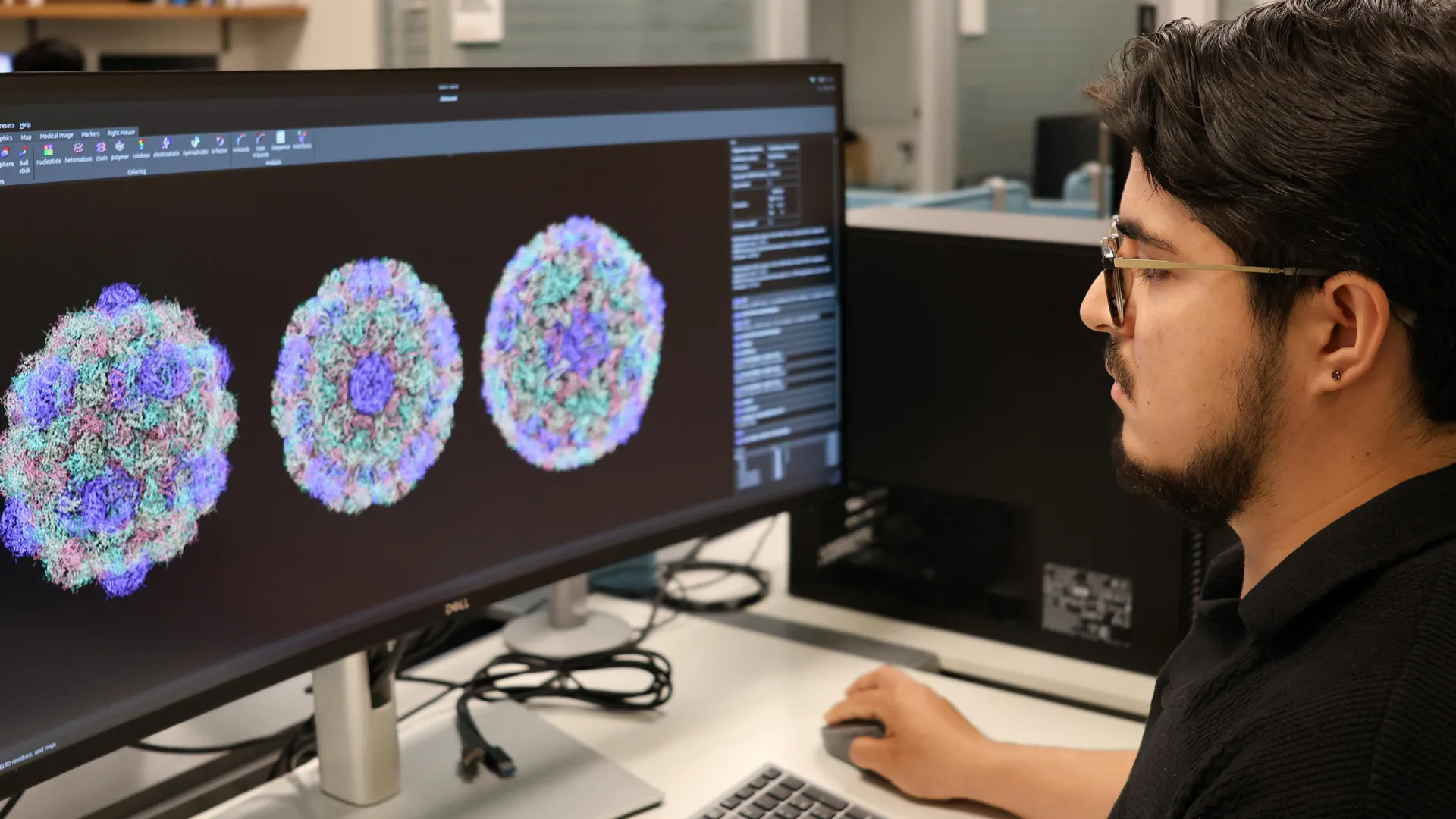
Ph.D. student Abelardo Aguilar, the study’s first author, worked with senior author Antoni Luque Santolaria, an associate professor of biology. Rather than growing viruses in a lab, the team combined bioinformatics, biophysical models and artificial intelligence tools — including protein language models and AlphaFold — to search databases containing billions of DNA sequences.
Those databases included IMG/M, a resource affiliated with the U.S. Department of Energy’s Joint Genome Institute and the University of California, Berkeley.
The sequences come from environmental samples collected worldwide: soil, seawater, wastewater and the human gut.
“The majority of viruses cannot be grown in the lab. But now through sequencing, we have access to information on viruses for which we don’t know the host, that we can’t culture in the lab, but that are everywhere,” Luque said.
University of Miami College of Arts and Sciences supports advanced biology and virology research through its Department of Biology, where Ph.D. student Abelardo Aguilar and associate professor Antoni Luque Santolaria led a 2025 Nature Communications study.
The team used bioinformatics, biophysical models, and AI tools — including AlphaFold and protein language models — to analyze billions of environmental DNA sequences from global databases, identifying viruses that bridge evolutionary gaps between viral capsids and bacterial encapsulins. The college’s biology unit provided the academic home for this computational discovery, which proposes that procapsids may link genetic and metabolic functions across viral and cellular lineages.
Procapsids may link genetic and metabolic functions
The researchers propose that procapsids — immature viral protein shells — could provide a pathway between viruses and encapsulins. These shells might support both genetic functions, such as containing viral DNA, and metabolic functions involving biochemical reactions.
“One implication of this research is the possibility that viral capsids could also facilitate biochemical reactions, which would open up the potential roles that capsids have in environments as a whole,” Aguilar said.
The findings suggest scientists may need to look beyond infectious viral particles.
“When we’re looking at viruses, we tend to look only at the particles that are infective, and this study points out that we might need to start putting more emphasis on the non-infective versions of the virus and what other functions those viral-like particles may have that we have overlooked in the past,” Aguilar said.
The project was supported by the Gordon and Betty Moore Foundation and the U.S. National Science Foundation.