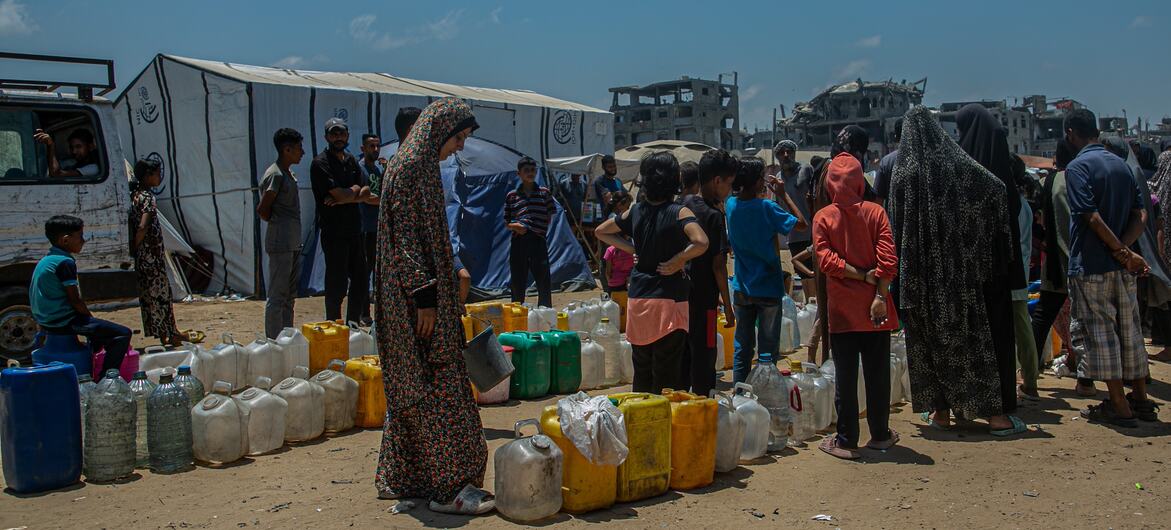
UNICEF Condemns Killing of Water Truck Drivers in Gaza
UNICEF condemned the killing of two contracted water truck drivers delivering clean aid to Gaza families on April 17, 2026, demanding an immediate investigation into what it called a blatant violation of humanitarian law that further endangers civilians already facing catastrophic water shortages.
The attack occurred near Rafah in southern Gaza as the drivers transported water from a UN-supported desalination plant to displacement camps housing over 300,000 people. This latest violence exacerbates a crisis where 95% of Gaza’s water supply is now unsafe for human consumption, according to UN assessments from March 2026, forcing families to rely on sporadic aid deliveries that have become increasingly perilous.
The Human Cost Behind the Headlines
Water truck drivers in Gaza are not just logistics workers—they are lifelines. For months, these contracted crews have navigated checkpoints, rubble-strewn roads and active conflict zones to deliver what little clean water remains available. Their killing signals a dangerous escalation in the targeting of humanitarian infrastructure, a trend documented by the World Health Organization which recorded 47 attacks on water facilities in Gaza between January and March 2026 alone.
“These weren’t combatants. They were fathers, brothers, neighbors—men who showed up every day knowing the risks because their communities had no other option,” said Dr. Amira Hassan, a Palestinian public health expert with the Gaza Mental Health Programme, in an interview with Al Jazeera on April 17. “When you attack water workers, you don’t just harm individuals—you sentence entire neighborhoods to dehydration and disease.”
A System Under Siege
The implications extend far beyond immediate tragedy. Gaza’s water infrastructure has been systematically degraded since 2023, with repeated damage to desalination plants, pipelines, and pumping stations reducing operational capacity to less than 25% of pre-conflict levels. The Coastal Municipalities Water Utility (CMWU) reports that repairing even minor damage now takes weeks due to restricted access to spare parts and fuel, turning every attack into a prolonged crisis.
This degradation creates a vicious cycle: damaged systems require more frequent water trucking, which increases exposure to risk, which leads to more attacks, which further damages the system. Economically, the World Bank estimates that water-related illness and lost productivity cost Gaza’s economy approximately $180 million annually—a figure that has likely doubled since escalations began in late 2023.
Who Steps In When the Pipes Run Dry?
When official systems fail, communities turn to ad hoc solutions with varying degrees of safety and reliability. Informal water vendors have proliferated, often sourcing from untreated agricultural wells or brackish groundwater, raising risks of waterborne diseases like cholera and typhoid—both of which have seen case increases of 300% in northern Gaza since January 2026, per UNICEF surveillance data.
In this environment, the role of verified humanitarian actors becomes not just helpful but essential. Organizations specializing in water, sanitation, and hygiene (WASH) interventions are critical for maintaining minimum safety standards during crises. For those seeking to support or engage with credible responders on the ground, accessing vetted emergency water restoration contractors through trusted directories ensures aid reaches those most in need without compromising safety or accountability.
Legal Accountability in a Fog of War
Under international humanitarian law, deliberately attacking civilian objects indispensable to survival—including water supplies—constitutes a war crime. The Rome Statute of the International Criminal Court explicitly protects such infrastructure, and legal experts argue that repeated, patterned attacks may demonstrate intent sufficient for prosecution.
“Isolated incidents can be tragic mistakes. But when water trucks are hit repeatedly along known routes, when desalination plants are struck despite their clear civilian marking, when the pattern shows a disregard for protected objects—we move beyond negligence into potential criminal liability,” stated Professor Kenneth Roth, former executive director of Human Rights Watch and now adjunct professor of international law at Columbia University, during a briefing at the UN Security Council on April 16.
For organizations navigating the complex legal landscape of documenting violations or pursuing accountability, consulting experienced international humanitarian law attorneys can be crucial in building evidentiary cases that meet international standards.
The Long Shadow of Thirst
Even if hostilities ceased tomorrow, Gaza’s water crisis would persist for years. Aquifer recharge rates are far below extraction levels, meaning the coastal aquifer—the territory’s primary natural water source—is undergoing irreversible salinization. Without massive investment in desalination, wastewater recycling, and infrastructure repair, the UN projects that Gaza could have no locally accessible safe water by 2030.
This reality shifts the focus from emergency response to sustainable reconstruction. Long-term resilience requires not just repairing pipes but rethinking entire systems: solar-powered desalination, rainwater harvesting at the household level, and decentralized treatment units that can function despite grid failures. Implementing such solutions demands expertise that extends beyond immediate relief.
For municipalities, NGOs, or donors planning recovery initiatives, identifying qualified water infrastructure engineers with experience in conflict-affected or fragile contexts is not optional—it’s foundational to building systems that last.
As the sun set over Rafah on April 17, two water trucks sat idle, their drivers gone. The tanks they carried—meant for children’s formula, for washing wounds, for keeping infants cool in 40-degree heat—remained full. But in Gaza, where every drop is a calculation of survival, the true measure of this loss won’t be in liters spilled, but in the quiet, thirsty hours that follow when no one comes to fill the jug.
In the silence between crises, the work of rebuilding begins—not with sirens or slogans, but with the quiet determination of those who still believe clean water should never be a privilege of war.