
UNHCR Chief: Addressing Protracted Displacement & Seeking Durable Solutions
Geneva – Barham Salih, the newly appointed UN High Commissioner for Refugees, wasted little time signaling a shift in approach to a global displacement crisis reaching unprecedented scale. Within days of assuming office on January 1, Salih visited refugee camps in Kenya and Chad, a departure from the traditional confines of his Geneva headquarters, and a demonstration of his intent to confront the challenges directly.
“The responsibility in every sense of the word is awesome,” Salih said in a recent interview, his voice reflecting the weight of the task before him. For Salih, the role is deeply personal. Born in Iraqi Kurdistan in 1960, he experienced displacement firsthand as a teenager, spending years in exile during the repressive rule of Saddam Hussein. He later served as Iraq’s eighth president, beginning in 2018, a journey that now informs his understanding of the plight of millions.
“Behind every statistic is a life,” Salih emphasized, “a person with aspiration, with a right to dignity, with the right to a better future.” This insistence on individual dignity underscores his early efforts, but is coupled with a stark assessment: the international system designed to respond to displacement is increasingly strained. Rising numbers of displaced people are colliding with tightening humanitarian funding, forcing agencies like UNHCR to stretch limited resources.
For decades, refugee protection operated on the assumption that displacement was temporary. People would flee, receive protection, and eventually return home when safe. “Being a refugee is not meant to be a fate,” Salih stated. “It is meant to be a temporary condition.” However, protracted conflicts and stalled political settlements have eroded this premise. Today, nearly two-thirds of refugees experience “protracted displacement,” living in limbo for five years, ten years, or even decades, with entire childhoods unfolding in camps.
Salih is blunt in his assessment: “That is not an acceptable situation. What we have is a violation of the basic human rights to dignity.” He has set an ambitious goal – to reduce by half, within ten years, the number of people in long-term displacement dependent on humanitarian assistance. Acknowledging the scale of the challenge, he admitted, “I know, and I understand full well, that this is far beyond the means and the capabilities of [UNHCR] today.”
His strategy centers on shifting from emergency aid to economic inclusion, arguing that refugees must be empowered to perform and contribute to host societies. This requires a broad coalition, including development banks, private investors, donor governments, and host countries – many of which are already facing economic pressures. A shift in political will is also crucial, particularly as wealthier nations increasingly restrict borders.
Salih highlighted the disproportionate burden borne by countries with limited resources. “We demand to help host nations who are mostly, by the way, low-income, middle-income countries,” he said. Countries like Colombia, Uganda, Chad, and Bangladesh absorb the vast majority of displaced people, straining their schools, hospitals, and labor markets. He expressed humility for the generosity of these nations, but cautioned that generosity alone is insufficient. Without sustained investment and inclusion, the system risks becoming a permanent crisis, warehousing the displaced rather than welcoming them.
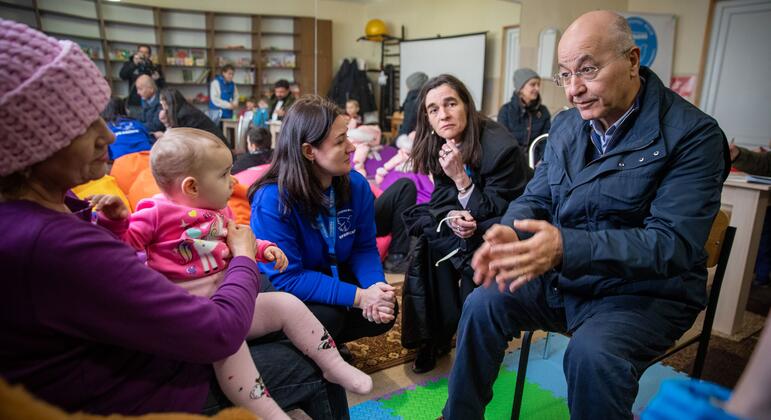
During visits to Kakuma refugee camp in Kenya, home to around 300,000 people, and Syrian refugee communities in Turkey, Salih observed a resilience that defied despair. “The story of resilience with every refugee I have met is genuine and is real,” he said. He emphasized the importance of agency, particularly for young refugees. “To the young people, I say we are going to be working to help you with your agency,” he stated, signaling a move away from viewing refugees solely as victims and towards recognizing them as active participants in their own futures.
However, the conditions to enable that agency remain uneven. Ongoing conflicts, including recent escalations in the Middle East, coupled with shrinking humanitarian budgets and a fraying political consensus, continue to drive displacement upwards. As Salih concluded, returning to the central tenet of his mission, “Once again, a refugee is meant to be a temporary situation, not a permanent pain.” For millions in camps like Kakuma, that distinction remains increasingly blurred.