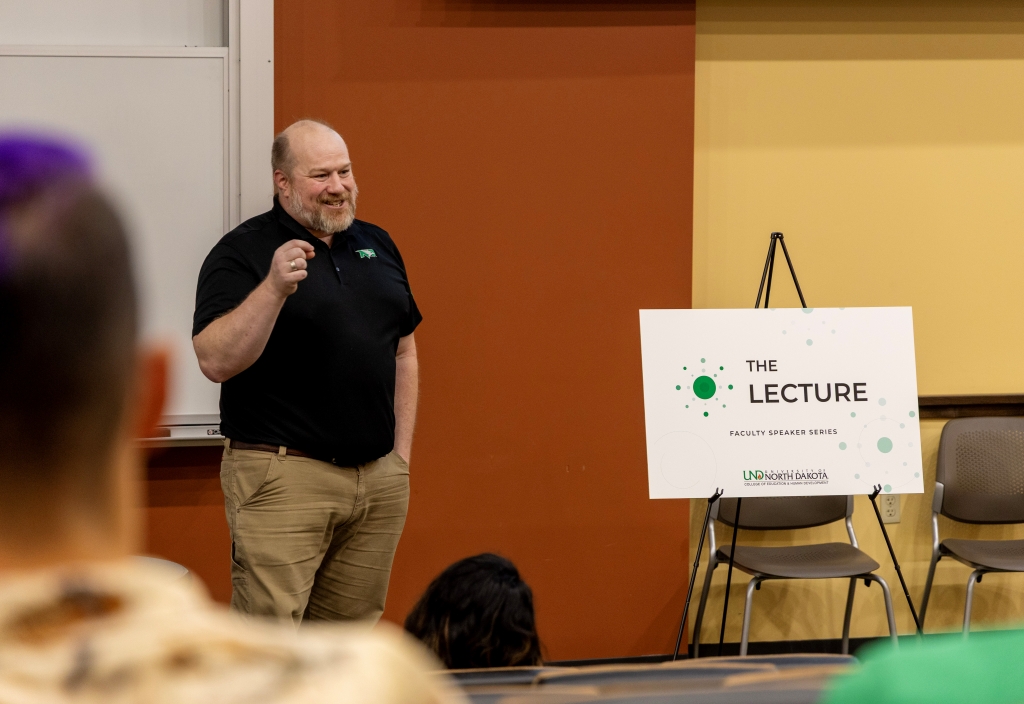
UND Professor Jesse Rhoades Discusses His Academic Path to NASA
From Farm Explorations to Repeating Second Grade
Before teaching biomechanics and working with NASA, Rhoades grew up on a farm where his days involved hands-on exploration without structured lesson plans. When he entered a traditional classroom setting, however, that style of learning did not align with standard instructional methods. He struggled with the curriculum and repeated second grade. Elementary and high school brought persistent academic hurdles alongside labels that classified him as non-college bound.
“I had two second grades, and I became a full professor,” Rhoades remarked during his presentation at The Lecture, a new series hosted by the College of Education and Human Development.
Athletics and Academic Rebuilding at Parkland College
Faced with low grades and standardized test scores that discouraged higher education pursuits, Rhoades found an alternative route through athletics. He enrolled at Parkland College on a full athletic scholarship, competing in track and field while spending two years catching up academically.

“I didn’t get the freshman year everyone else had,” Rhoades stated. “But I got the one I needed.” That performance earned him a subsequent full scholarship to Indiana State University, where he continued competing as a Division I track and field athlete and ultimately earned his degree in physical education teaching.
Rhoades Studies Biomechanics and Collaborates with NASA
After spending two years teaching middle school physical education, Rhoades returned to graduate school. He studied exercise science at Indiana State University and completed his Ph.D. in kinesiology at the University of Illinois. Those academic pursuits bridged quantitative movement analysis with educational theory.

That background eventually connected him with UND’s Space Studies program. His ongoing biomechanics research includes projects related to an astronaut’s spacesuit boot, leading to direct collaborations with NASA researchers. Describing the transition into high-stakes aerospace projects, Rhoades noted the initial anxiety of working in rooms where no higher authority existed to check his work before NASA evaluation, advising others to simply “say yes and just kind of buckle in.”
Launching the College of Education and Human Development Series
The College of Education and Human Development designed The Lecture to highlight the personal histories behind faculty achievements. Shelbie Witte, dean of the college, explained the purpose of the initiative. “It is a great opportunity for us to celebrate and make our faculty’s work more visible,” Witte said. “More importantly, it’s a way to get to know them as individuals and learn about their journeys to academia.” Witte noted that even at advanced academic ranks, faculty members continue asking questions and exploring future directions.
Komal Mangle, a doctoral student in the College of Education and Human Development’s Education, Health and Behavior Studies program and president of the CEHD Student Council during the 2025-26 year, spoke about Rhoades’ impact on students prior to his presentation. Describing his approach as grounded in patience and mutual respect, Mangle credited him with helping her overcome self-doubt during her doctoral research.