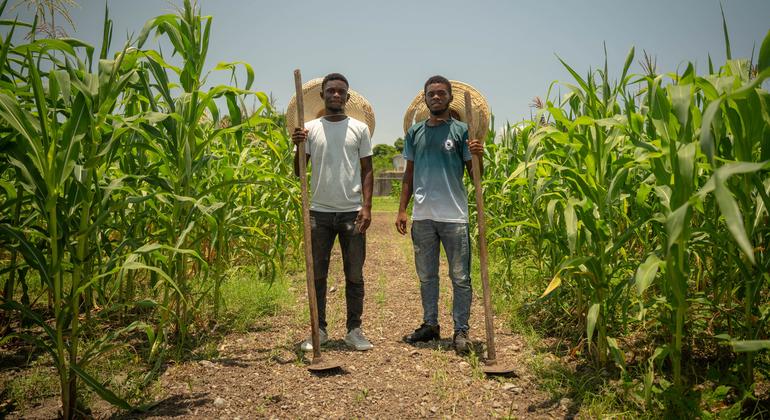
UN: Violence and El Niño Threaten Half of Haiti with Hunger by 2027
Half of Haiti’s population will face acute hunger by June 2027 as gang violence, displacement and El Niño-driven drought converge to collapse rural food production, the United Nations reported Saturday.
The Integrated Food Security Phase Classification analysis, led by the Haitian government with support from the Food and Agriculture Organization and the World Food Programme, projects 6.35 million people will not get enough to eat between March and June next year. Almost two million of them will reach emergency levels where families sell productive assets to survive, according to the UN.
“Rain isn’t falling,” said Dieula Célestin. “You work the soil, but there is no rain. You plant your crops, and you end up with nothing to harvest.”
More than 1.5 million people have fled their homes because of armed gang violence, severing the link between farmland and markets, UN News reported. Insecurity prevents farmers from tending fields and blocks transport of what little harvest survives. The El Niño phenomenon adds a third shock, with drought conditions projected to affect four million people by December 2026, the UN said.
“Because of the country’s crisis, we struggle just to eat,” said Délivrance Dovily, who lost her livestock to disease and instability. “We used to raise livestock to help pay for school, the animals used to support us. But because of the crisis and diseases that came through, we lost them.”

Emergency pipeline keeps millions alive
The World Food Programme reached 2.6 million people this year with emergency food and cash, working alongside Haitian authorities, UN News reported. School meals feed more than 620,000 students, 74 percent sourced from local farmers. Pre-positioned stocks can supply rice, beans and oil to 300,000 people for one month in disasters like Hurricane Melissa, which struck the southern peninsula one year ago.
The UN Humanitarian Air Service flies aid workers into Port-au-Prince and remote areas, maintaining access where roads are cut by violence or floods. The Food and Agriculture Organization distributes poultry and goats to generate immediate food and income.
“The animals are interesting because we can distribute them at any time. So, we do not have to wait for the planting season and farmers can immediately use them,” FAO country chief Pierre Vauthier told UN News.
Dovily confirmed the impact: “Receiving these goats helps boost our activities and strengthen our capacity, giving us more resources to support our children with school and meet their needs.”
Resilience investments target root causes
WFP, FAO and the International Fund for Agricultural Development are rehabilitating water-management infrastructure and rural roads while providing crop insurance against drought and excessive rain, the UN reported. The strategy links immediate assistance to long-term self-sufficiency.
“As Haiti faces a complex and multifaceted crisis, it’s more important than ever for UN agencies to work together with the government, not only to provide life-saving emergency food assistance, but also to scale up long-term investments that help communities build hope and resilience, withstand shocks and protect livelihoods from events like El Niño,” said Erwan Rumen, WFP Acting Country Director, to UN News.
Climate outlook remains hostile
El Niño conditions are expected to persist through early 2027, extending the drought-flood cycle that has already reduced the spring harvest. The IPC projection for March–June 2027 assumes security and rainfall will not improve. Any further deterioration in either factor would push the emergency-level population above the current two-million estimate.
The Food and Agriculture Organization was founded on 16 October 1945 in Quebec City, Canada, after a 1943 conference in Hot Springs, Virginia, committed to a permanent body. It replaced the International Institute of Agriculture, created in 1905 as the first intergovernmental group to tackle agriculture globally, and later joined the UN General Assembly in establishing the World Food Programme.
“Food aid keeps people alive today. Seeds, animals, roads and insurance make families less dependent on it tomorrow,” the UN summary stated.