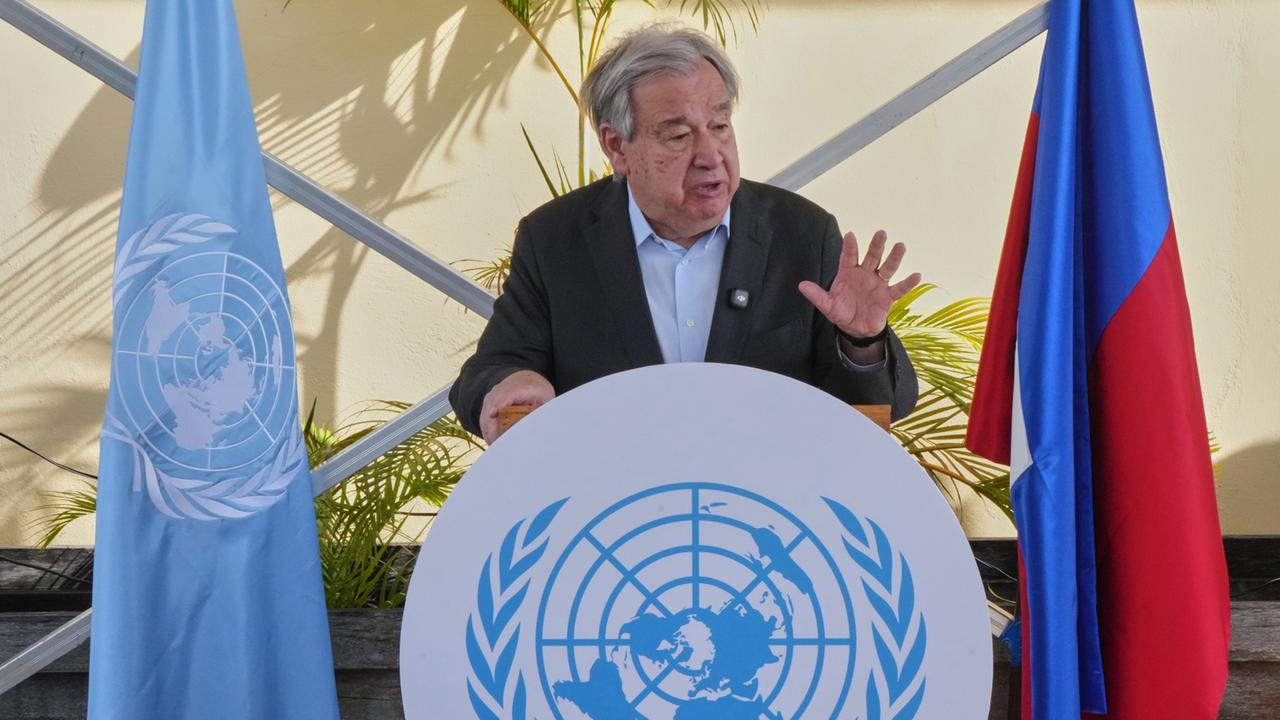
UN Chief Guterres Apologizes for Global Inaction as Haiti’s Violence Escalates
UN Chief Apologizes for Inaction as Violence Escalates in Haiti
UN Secretary-General António Guterres apologized for the international community’s failure to address escalating violence in Haiti, as the nation’s capital, Port-au-Prince, grapples with record-high homicide rates and collapsing infrastructure. The statement, made on June 17, 2026, comes amid growing pressure from local leaders and global human rights organizations.
Why This Matters: A Nation on the Brink
Haiti’s security crisis has worsened since 2021, with gang violence displacing over 700,000 people and leaving 30% of the population without access to clean water, according to the World Health Organization. Guterres’ apology follows a leaked UN internal review confirming systemic under-resourcing of peacekeeping missions in the country. “The world failed Haiti,” said Guterres, “and we must now prioritize its survival.”
Local officials describe a “state of emergency” in Port-au-Prince, where 120 homicides were recorded in May 2026 alone, per the Haitian National Police. “Our hospitals are overflowing, and the government lacks the tools to protect citizens,” said Mayor Jean-Robert Léonard, in a
statement released June 15. “International aid is arriving, but it’s not addressing the root causes of this chaos.
The Human Toll: A City in Crisis
Residents of Cité Soleil, one of Haiti’s most impoverished neighborhoods, report daily kidnappings and looting. “We live in fear,” said Marie Thérèse, a 42-year-old mother of three. “The police don’t come here. The UN doesn’t help. What are we supposed to do?”
Experts link the violence to Haiti’s political instability. Since the 2021 assassination of President Jovenel Moïse, the country has lacked a functioning government, per the U.S. Department of State. “The absence of leadership has created a vacuum that gangs and foreign interests are exploiting,” said Dr. Édouard Leclerc, a political scientist at the Université d’État d’Haïti. “This isn’t just a security issue—it’s a governance failure.”
Global Response: Apologies and Action?
Guterres’ apology followed a June 14 report by the UN Office for the Coordination of Humanitarian Affairs (OCHA) detailing a $280 million funding gap for Haiti’s humanitarian response. The UN has pledged an additional $150 million, but aid groups warn that resources are still insufficient. “We’re fighting a war with a teaspoon,” said Sarah Mitchell, head of Médecins Sans Frontières’ Haiti operation.

Regional allies have also faced criticism. The Caribbean Community (CARICOM) suspended Haiti’s membership in 2023 over governance issues, according to its official website. “We’ve tried to engage, but Haiti’s leaders have not shown the political will to reform,” said CARICOM Secretary-General Irwin LaRocque.
Historical Context: A Legacy of Neglect
Haiti’s current crisis echoes patterns of international neglect. After the 2010 earthquake, which killed 220,000 people, donor funds were mismanaged, and reconstruction stalled. “The same mistakes are being repeated,” said historian Dr. Claudine Michel. “Haiti is treated as a problem to be solved, not a partner to be engaged.”
The country’s economic struggles are compounded by climate disasters. Hurricane Matthew in 2016 and Tropical Storm Grace in 2021 destroyed 80% of agricultural land in the south, per the Food and Agriculture Organization. “Without sustainable development, violence will persist,” Michel added.
What’s Next: A Path to Stability?
Local leaders are calling for a multi-pronged approach. “We need security, governance, and economic revival,” said Senator Yves Alexis. “But first, the international community must stop treating Haiti as a dumping ground for aid.”
Legal experts suggest that enforcing international laws against arms trafficking could curb gang violence. “Haiti’s gangs are armed with weapons from the U.S. and Europe,” said attorney René Jean-Louis. “If the world wants peace, it must stop fueling the conflict.”
For residents, the priority is survival. “We don’t need speeches,” said Marie Thérèse. “We need jobs, schools, and protection.”
The Directory Bridge: Solutions in Action
Communities in Haiti and beyond are turning to verified humanitarian organizations and international law firms to address systemic challenges. Local initiatives like the Haitian