
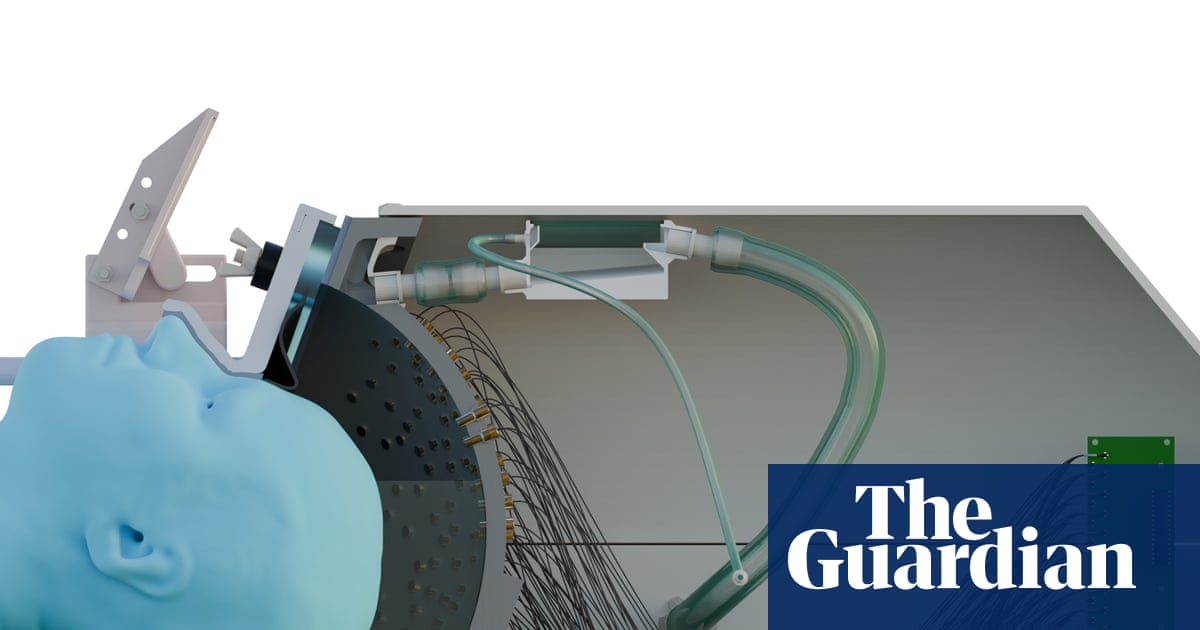
Breakthrough Ultrasound Helmet Shows Promise for Non-Invasive Parkinson’s Treatment
OXFORD, UK – Researchers have developed a novel ultrasound “helmet” capable of precisely targeting deep brain structures, offering a potential non-invasive alternative to current treatments for Parkinson’s disease and other neurological conditions. A study, led by Professor Charlotte Stagg at Oxford University and involving teams from UCL, demonstrated the helmet’s ability to accurately focus ultrasound waves on a specific region of the brain using MRI guidance.
Currently, deep brain stimulation (DBS) for Parkinson’s patients relies on surgically implanted electrodes and rigid metal frames screwed into the skull. The new system bypasses the need for invasive surgery.In initial testing with seven volunteers, the helmet successfully directed ultrasound to the lateral geniculate nucleus (LGN), a key area for visual processing, with “remarkable accuracy,” according to prof. Stagg. Follow-up experiments revealed that modulating the LGN resulted in lasting reductions in activity within the visual cortex. “The equivalent in patients with Parkinson’s would be targeting a motor control region and seeing tremors disappear,” she added.
The research, a decade-long collaboration between UCL and Oxford University, represents a “fundamental neuroscience milestone” and paves the way for clinical applications, according to independent expert Professor Elsa Fouragnan of Plymouth University. “This represents a fundamental neuroscience milestone that opens the way for clinical translation,” Fouragnan stated, offering “heartfelt congratulations to the authors.”
the helmet is currently guided by MRI scans, but developers envision incorporating artificial intelligence to enable standalone operation, perhaps allowing patients to use the technology at home. Elly Martin and Brad Treeby, the UCL academics instrumental in building the helmet, have emphasized the importance of patient-centered design for broader applicability. Treeby has already established a company dedicated to helmet growth.
The team is now preparing to test the system on brain areas associated with Parkinson’s, schizophrenia, stroke recovery, pain, and depression. Prof. Stagg anticipates clinical applications could emerge within the next decade, noting that the project began when she was pregnant with her now 12-year-old daughter. The long-term goal, according to Martin, is to refine the system into a practical clinical tool that could eventually replace invasive brain implants.
