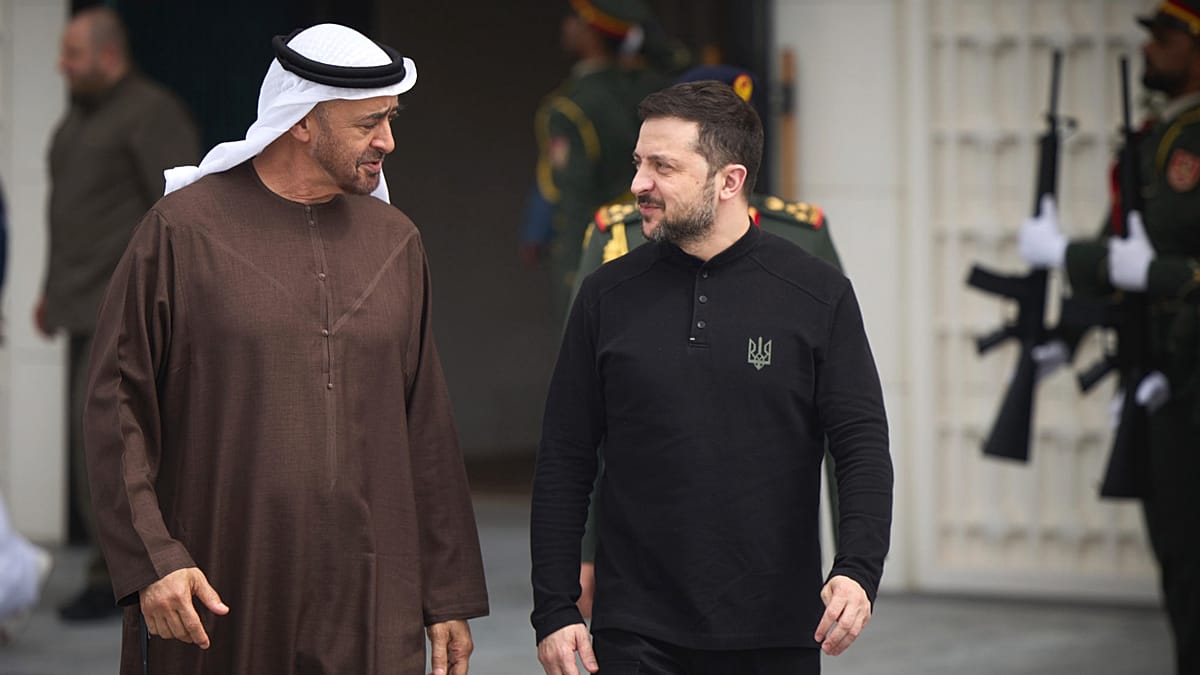
Ukraine Secures 10-Year Defense Deals with Gulf States: Production & Tech Cooperation
Ukrainian President Volodymyr Zelensky secured decade-long defense pacts with Saudi Arabia, Qatar, and the UAE on March 28, 2026. This strategic pivot exchanges Kyiv’s drone warfare expertise for Gulf capital, countering Iranian regional aggression while bypassing Western aid fatigue to establish joint military production lines across the Middle East.
The global security architecture is fracturing. Western aid pipelines are constricting under domestic political pressure in Europe and North America. Kyiv knows this. The Gulf States know this. What emerged this weekend in Riyadh, Doha, and Abu Dhabi is not charity. It is a transaction. Ukraine offers battle-hardened asymmetric warfare technology. The Gulf offers sovereign wealth and industrial infrastructure. What we have is the new morphology of alliance.
The Ten-Year Horizon: Industrializing Defense
Zelensky’s tour concluded with signed frameworks extending beyond immediate ammunition transfers. The agreements mandate joint production facilities and technology sharing for a decade. This duration signals a shift from emergency relief to long-term industrial integration. Saudi Arabia and Qatar are not merely buying off-the-shelf systems; they are importing the manufacturing logic behind them.
In the UAE, discussions with President Mohammed bin Zayed Al Nahyan focused on airspace security. The specifics involve drone interception capabilities. Kyiv possesses the world’s most tested data on neutralizing low-cost aerial threats. The Emirates possess the capital to scale these solutions. Technical teams are now tasked with finalizing the deployment architecture. This is a direct response to the tightening noose around the Strait of Hormuz.
Qatar’s Ministry of Defense confirmed the scope involves investment in defensive projects. They are not just purchasing security; they are building it. The agreement includes exchange programs for missile defense and unmanned aerial systems. For Ukraine, this diversifies their donor base. For the Gulf, it reduces reliance on Western security guarantees that may waver during election cycles.
“We are witnessing the commodification of survival. Nations are no longer asking for aid; they are negotiating industrial partnerships based on mutual threat perception.”
Regional analysts note the timing is critical. Geopolitical tensions in the Persian Gulf have reached a inflection point. As one senior fellow at a Washington-based think tank noted off the record, “The Gulf states realize that passive defense is obsolete. They need active interception networks that Ukraine has already stress-tested in high-intensity conflict.” This validation of Ukrainian tech in the Middle East market opens new revenue streams for Kyiv’s defense sector, potentially offsetting losses from traditional export markets.
The Iranian Variable and Information Warfare
Tehran is watching. Iranian state media claimed a strike on a UAE storage facility housing Ukrainian anti-drone systems. Kyiv dismissed this as disinformation. The Ukrainian Foreign Ministry labeled the assertions “lies and media deception.” Yet, the mere allegation underscores the volatility. If Iranian proxies can threaten UAE soil, the logic for this partnership solidifies.
The Strait of Hormuz remains a choke point for global energy flows. Any disruption here spikes insurance premiums worldwide. Global shipping lanes are vulnerable to asymmetric attacks. By fortifying Gulf airspace with Ukrainian technology, these nations are insuring their economic lifelines. This is not just about borders; it is about the free flow of hydrocarbons.
However, integrating these systems creates complex compliance challenges. Defense technology transfer involves strict regulatory frameworks. Multinational corporations facilitating this hardware movement must navigate dual-employ export controls. Companies managing these logistics are urgently consulting with vetted trade compliance specialists to ensure sanctions regimes are not violated during transit. One error in documentation could freeze assets across multiple jurisdictions.
Macro-Economic Ripple Effects
This alliance reshapes Foreign Direct Investment (FDI) flows in the defense sector. Traditionally, Gulf states purchased from the US or France. Now, they are co-developing with Eastern European partners. This diversifies the global arms market. It also creates new supply chain dependencies. Raw materials for drone production may now flow from the Gulf to the Black Sea, while finished interceptors move south.
Consider the cost of insecurity. When regional conflict escalates, energy prices volatility increases. Institutional investors hedge against this risk. The stability provided by these defense pacts aims to lower the risk premium on Gulf sovereign debt. Global stability metrics often correlate with investment confidence. A secure Gulf means stable oil prices, which means lower inflation globally.
The following table outlines the shifting defense dynamics observed in the region as of Q1 2026:
| Region | Primary Threat Vector | Strategic Response | Investment Focus |
|---|---|---|---|
| Eastern Europe | Conventional Ground Invasion | Artillery & Armor Mass | Domestic Production Scaling |
| Persian Gulf | Asymmetric Drone/Missile | Air Defense Interception | Joint Tech Development |
| Global Supply Chain | Chokepoint Disruption | Security Hardening | Risk Mitigation Insurance |
Security is now a line item in corporate balance sheets. Multinational firms operating in the region are rapidly onboarding elite global cybersecurity consultants to harden digital infrastructure against state-sponsored retaliation. The kinetic conflict is mirrored in the digital domain. Protecting the industrial data shared between Ukraine and the Gulf is as vital as protecting the physical factories.
The Legal and Logistical Framework
Executing a ten-year defense treaty requires robust legal scaffolding. Intellectual property rights regarding drone technology must be protected. Liability clauses for joint production failures need clarity. This is fertile ground for international law firms. As the EU tightens import tariffs and export controls, transnational distributors are scrambling. Importers are urgently consulting with vetted international trade lawyers to structure these agreements within NATO and non-NATO regulatory frameworks.

The International Institute for Strategic Studies highlights that defense partnerships of this magnitude often precede broader economic unions. If Ukraine and the Gulf synchronize their defense industries, trade barriers in other sectors may lower to facilitate component movement. This could open Ukrainian agricultural markets deeper into the Middle East, leveraging the security relationship for economic gain.
the logistics of moving sensitive military hardware require secure corridors. Geopolitical risk assessments indicate that shipping routes through the Red Sea remain contested. Alternative overland or air corridors must be established. Logistics firms specializing in high-value secure transport are seeing increased demand. They must guarantee chain-of-custody integrity from Kyiv to Abu Dhabi.
The New Chessboard
This is not a temporary alignment. It is a structural adjustment to a multipolar world. The West is no longer the sole security guarantor. Nations are building bilateral security architectures based on immediate utility. Ukraine needs survival. The Gulf needs stability. The transaction is clear.
But complexity lies in the execution. Ten years is a long time in geopolitics. Regimes change. Priorities shift. The firms facilitating this exchange must build flexibility into their contracts. They must anticipate sanctions, regime changes, and technological obsolescence. This requires sophisticated risk modeling.
For the global business community, the message is unambiguous. Security is no longer outsourced. It is insourced. Nations are becoming their own arsenals. As the dust settles on this summit, the real function begins in the boardrooms and legal offices. Navigating this new landscape requires partners who understand both the bullet and the balance sheet. To secure your organization’s position in this shifting order, explore the World Today News Directory for verified risk management and geopolitical consulting partners capable of steering you through the turbulence.