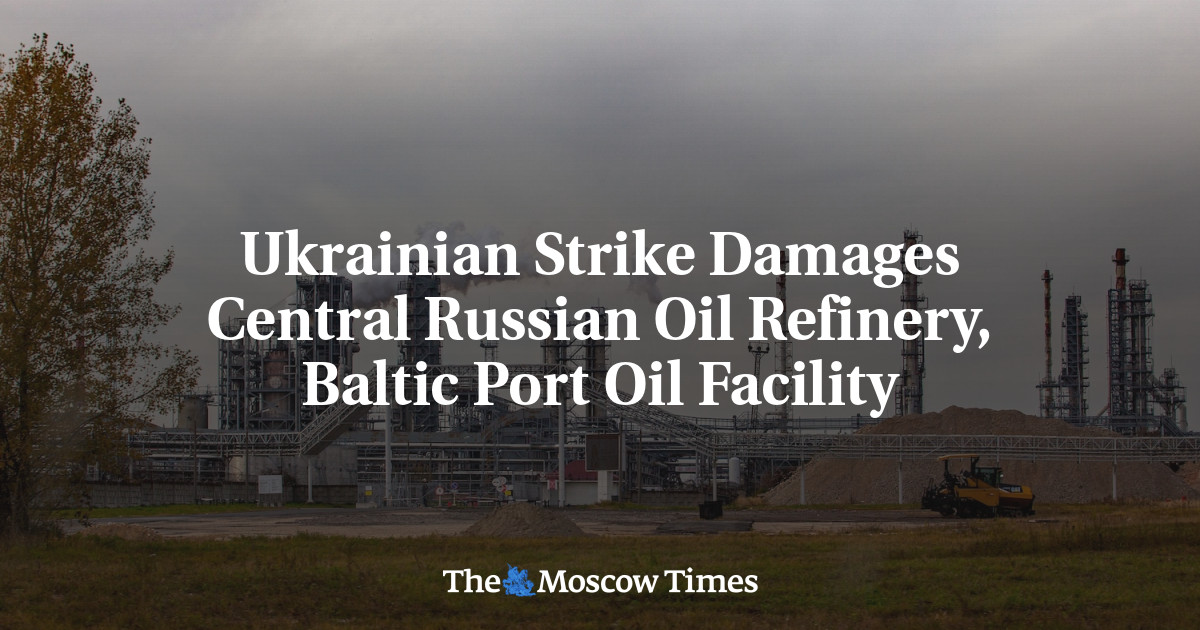
Ukraine Attacks Primorsk Near St. Petersburg
Ukrainian forces have targeted a central Russian oil refinery and a critical fuel facility at the Baltic port of Primorsk, disrupting regional energy exports and domestic fuel supplies. These strikes aim to degrade Russia’s economic capacity to fund its military operations by crippling its hydrocarbon infrastructure and logistics.
This isn’t just a tactical skirmish. It is a calculated war of attrition targeting the very veins of the Russian economy. By hitting Primorsk—a strategic gateway located between the Finnish border and St. Petersburg—Ukraine is signaling that no facility, regardless of its distance from the front lines, is beyond reach.
The immediate fallout is a logistical nightmare. When a refinery goes dark, the ripple effect extends far beyond the smoke plumes. It triggers a cascade of fuel shortages, price volatility in regional markets, and a desperate scramble for emergency repairs. For the local municipalities and businesses operating in the Leningrad Oblast, the reality is a sudden collapse of predictable energy costs.
The Logistics of Energy Degradation
The Primorsk port is vital because it handles a massive percentage of Russia’s crude oil exports to global markets. By repeatedly attacking this node, Ukraine is attempting to create a “bottleneck effect.” If the tankers cannot load because the refinery infrastructure is shattered, the oil backs up in the pipelines, forcing other refineries to slow production or shut down entirely.
This represents a macro-economic strangulation strategy. Russia’s reliance on oil revenue is well-documented, but the vulnerability of its “midstream” infrastructure—the refineries and ports—is the Achilles’ heel. The damage to the central refinery further complicates the distribution of refined petroleum products to the Russian interior, potentially impacting military mobilization and civilian transport.
“The systemic nature of these attacks suggests a sophisticated intelligence map of Russia’s energy grid. We are seeing a transition from opportunistic strikes to a coordinated campaign of economic sabotage,” says Dr. Elena Volkov, a senior analyst of Eurasian energy security.
The complexity of repairing these facilities cannot be overstated. Modern refineries rely on highly specialized components, many of which are subject to stringent international sanctions. Replacing a damaged distillation column or a high-pressure pump isn’t as simple as ordering a part; it involves navigating a labyrinth of “grey market” intermediaries and clandestine shipping routes.
For companies caught in the crossfire, the legal and financial risks are staggering. Insurance providers are increasingly designating these zones as “high-risk,” leading to skyrocketing premiums or total coverage denials. Businesses attempting to maintain operations in these volatile regions are now forced to seek specialized international trade attorneys to navigate the intersection of war-risk insurance and sanction compliance.
Local Fallout and Infrastructure Collapse
In the regions surrounding St. Petersburg and the Finnish border, the impact is visceral. Local municipal governments are struggling to manage the environmental hazards associated with refinery fires and the potential for toxic runoff into the Baltic Sea. The risk of an ecological disaster in the Gulf of Finland is a growing concern for environmental regulators.
the disruption of fuel supplies creates a vacuum. When state-run refineries fail, a shadow economy of fuel smuggling and price gouging typically emerges. This creates an unstable environment for local commerce, where small businesses discover themselves unable to secure the diesel necessary for transport and heating.
The instability is not limited to fuel. The physical damage to the grid often affects nearby civilian infrastructure. With regional power and heating systems frequently tied to industrial hubs, a refinery strike can inadvertently plunge nearby residential districts into darkness. In these moments of crisis, the need for vetted industrial restoration experts becomes a matter of survival for the local economy.
Operational Impact Overview
| Impact Area | Immediate Effect | Long-term Strategic Risk |
|---|---|---|
| Export Capacity | Reduced throughput at Primorsk port | Permanent loss of market share in Baltic corridors |
| Domestic Supply | Fuel shortages in Leningrad Oblast | Increased inflation and civilian unrest |
| Infrastructure | Physical destruction of refinery units | Reliance on sanctioned/obsolete technology for repairs |
| Environmental | Air pollution and potential oil spills | Long-term Baltic Sea ecosystem degradation |
The Invisible War: Sanctions and Spare Parts
To understand the true gravity of these strikes, one must look at the Associated Press reporting on global sanction regimes. Russia is not just fighting drones; it is fighting a global blockade of technology. The “Information Gap” here is the assumption that Russia can simply rebuild. In reality, the precision-engineered parts required for refinery maintenance are largely produced by Western firms under strict export controls.
This creates a “technological decay” cycle. Each single strike does more than cause immediate damage; it accelerates the aging of the entire facility because the repairs are often makeshift or “cannibalized” from other plants. This is a strategic victory for Ukraine that doesn’t show up on a map but appears on a balance sheet.
“We are witnessing the gradual degradation of Russian industrial capacity. When you cannot replace a specialized valve because of a sanction, the entire system becomes fragile. One drone can cause a failure that takes years to truly fix,” notes Marcus Thorne, a consultant on global energy logistics.
As the conflict evolves, the focus will likely shift toward more “interconnected” targets. The Baltic port is a gateway, but the pipelines feeding it are the arteries. If the arteries are severed, the heart of the Russian energy sector stops beating.
For those operating in the periphery of this conflict—investors, shipping companies, and regional administrators—the priority is now risk mitigation. The volatility of the energy sector requires a level of due diligence that exceeds standard corporate auditing. Many are now turning to risk management specialists to hedge against the systemic instability of the Eurasian energy corridor.
The strikes on Primorsk and the central refineries are more than military maneuvers; they are a blueprint for modern economic warfare. By targeting the intersection of energy production and global export, Ukraine is effectively shrinking the geography of Russia’s economic power. The long-term consequence is a Russian energy sector that is not only physically damaged but technologically isolated.
As these vulnerabilities deepen, the divide between those who can navigate this chaos and those who are consumed by it will widen. Whether you are a business owner facing supply chain collapse or a legal entity managing cross-border liabilities, the only way forward is through verified, expert guidance. The World Today News Directory remains the definitive resource for connecting with the verified professionals and civic organizations capable of managing the fallout of a world in flux.